

Your home loan application just came back rejected. The bank says the 7/12 extract shows a name that isn’t the seller’s.
Or you’ve inherited ancestral land in Ratnagiri,and three visits to the Talathi office later,
you still don’t know whether the old ferfar entry was ever updated.
Maharashtra’s land records system is powerful and increasingly digital, but it punishes anyone who reads it casually.
This article walks through what the Satbara 7/12 actually proves, how ferfar mutations work,
where Index 2 fits in, and how to pull all three without wasting a trip to the sub-registrar’s office.
What Is Satbara 7/12 and Why Does It Matter?
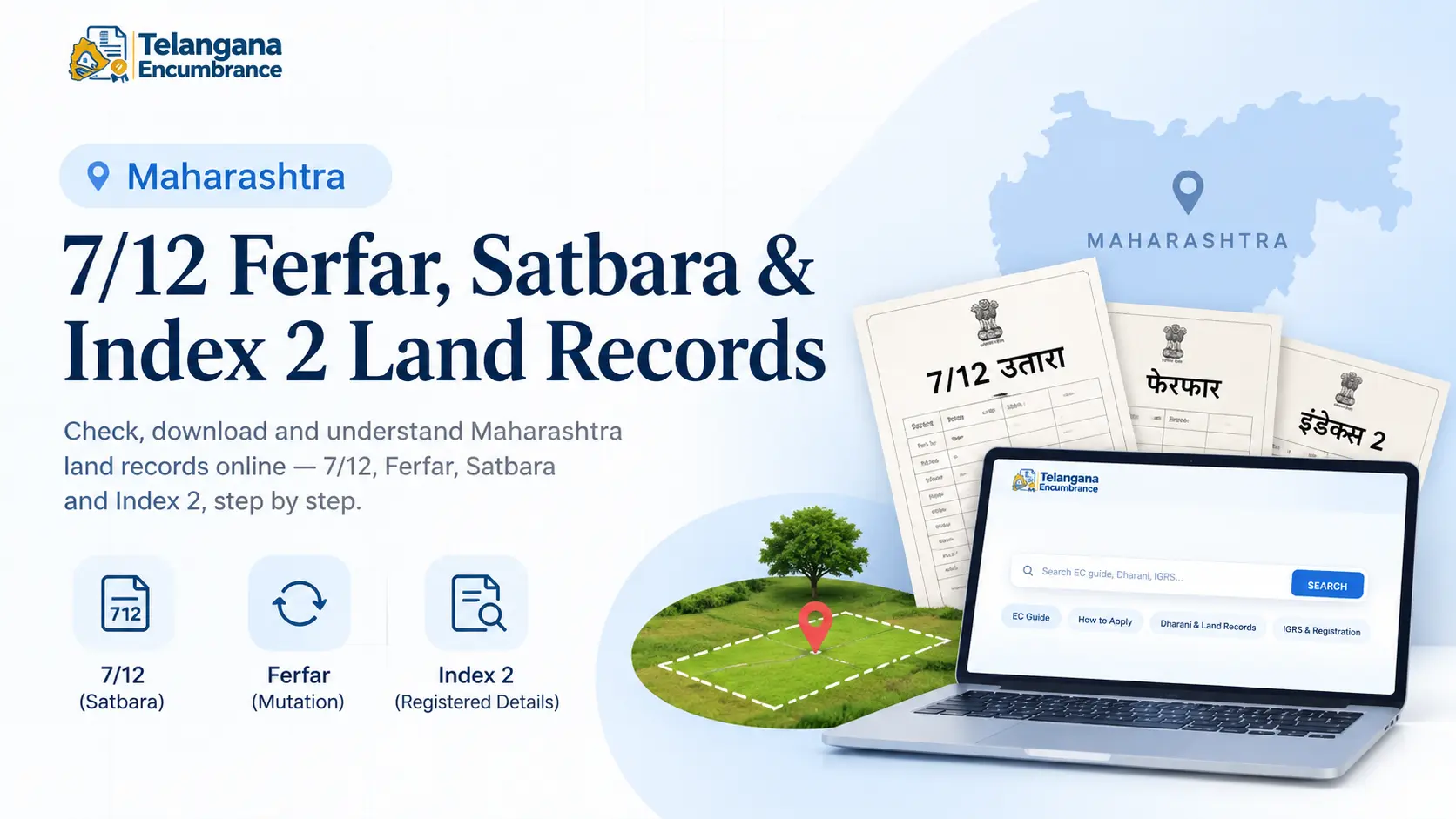
The Satbara, formally the 7/12 Utara, is Maharashtra’s primary record for agricultural land. It merges two village forms: Form 7, covering the land itself survey number,
area, assessment, and cultivation details and Form 12, listing who holds rights in that land and what those rights are.
Banks, courts, and registration offices ask for a current 7/12 for crop loans, scheme benefits, and sale transactions. But here’s the distinction that trips people up: the 7/12 is a revenue record, not a title deed.
It shows whom the revenue administration currently holds responsible for the land. If ownership is disputed, a civil court decides based on evidence and law not on the 7/12 alone.
Treat it as strong evidence of possession, not as the final word on title.
The digital version on the Mahabhumi portal carries full legal validity when it includes a digital signature, QR code, and unique verification number.
For most official purposes, you generally don’t need a Talathi’s physical signature or a revenue office stamp.
You may also like to read these posts : 👇
Karnataka RTC Online & Bhoomi Portal – Full Guide
Gujarat Village Map & 7/12 Utara Online: Survey Number & TP Records
Haryana Jamabandi Map & Digital Land Records
Understanding Ferfar: The Mutation Entry That Changes Everything
Ferfar (फेरफार) means “change.” When land rights shift through sale, inheritance, partition, a court order, or government acquisition, that shift must be recorded in the village records. That recorded change is a ferfar entry.
Where to Find Ferfar in the Satbara
Ferfar entries appear in a dedicated table, usually on the second page of the 7/12. Each row carries a mutation number, the date of the order, and a short description of what changed. If you’re buying land, read this table before anything else.
It tells you whether the seller’s name was actually entered after the last transfer and whether older claims or disputes are still visible in the record.
How Ferfar Processing Has Changed
Not long ago, a court-ordered mutation meant physically collecting the order, carrying it to the revenue office, and waiting for manual entry. Delays were routine, and informal payments were an open secret.
Much of that has shifted online. Orders from e-QJ (electronic quasi-judicial) courts now transmit directly to the Talathi’s system, and mutations can initiate automatically once a sale document is registered. Parties receive notices online.
Implementation still varies by district some transactions flow through cleanly, others stall so check the portal for current status rather than assuming an entry has gone through.
You may also like to read these posts : 👇
West Bengal Mouza Map, RS Khatian & Porcha Guide
Odisha Land Records – Bhulekh Naksha & Plot Map Online
Tamil Nadu A-Register, Guideline Value & Survey Number Search
How to Check 7/12 and Ferfar Online: Step-by-Step
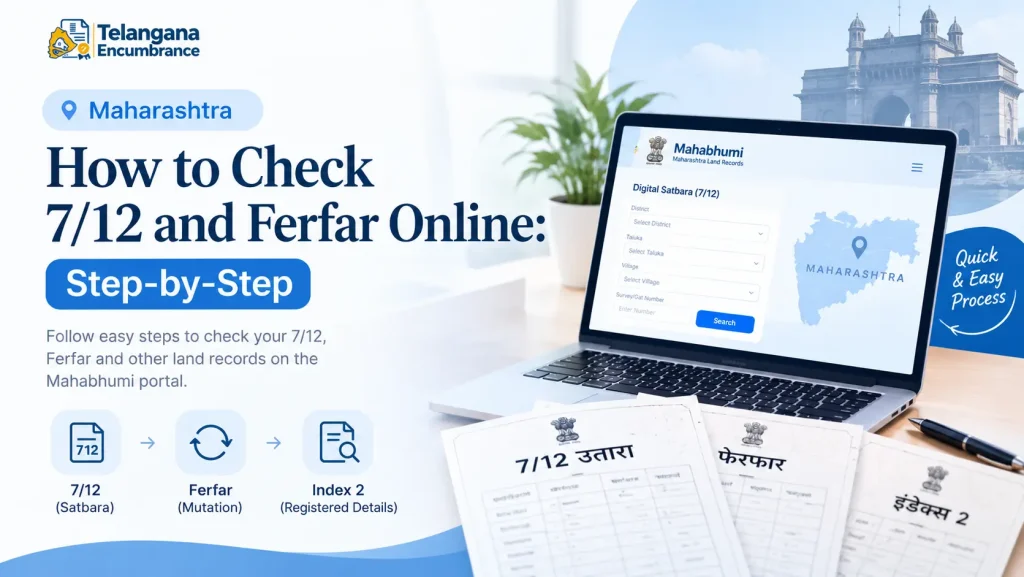
Land records are available through the Mahabhumi portal (mahabhumi.gov.in) and its linked Digital Satbara service. Here’s how the process generally works.
Step 1: Open the portal. The Mahabhumi site covers all 36 districts, organized by district, taluka, and village. The Digital Satbara service is linked directly from it.
Step 2: Select your location. Choose district, taluka, and village from the dropdowns. Have your survey number, gat number, or the account holder’s name ready before you start.
Step 3: Enter the plot identifier. Input the survey or gat number. Searching by account holder name is possible but less precise common surnames return long lists, and spelling variations in revenue records are frequent.
Step 4: Verify before you download. The extract displays land details, holder names, and ferfar entries.
Compare the holder name against your sale deed or inheritance documents character by character.
A single missing initial or a “Shri” versus “Smt.” mismatch is enough to stall a bank application later.
Step 5: Download the signed copy. Save the PDF with its digital signature, QR code, and verification number that combination is what makes it legally valid.
The portal charges a nominal fee for downloads; check the official portal for the current rate rather than relying on older figures.
For village maps, the Maha Bhunaksha service shows plot boundaries and cadastral layouts. Enter the plot number to see its location, dimensions,
and surrounding parcels useful when a boundary dispute is brewing or when you want to confirm that the survey number on paper matches the land on the ground.
Two pitfalls worth knowing. First, downloaded 7/12 extracts reflect the record at the moment of download. If a mutation is pending, the extract won’t show it.
Second, the portal occasionally lags behind Talathi-level updates by days or weeks, so a fresh mutation may not appear immediately don’t panic, but do re-check.
Searching Index 2: What It Is and When You Need It
Index 2 is the register at the sub-registrar’s office listing every document registered in that jurisdiction sale deeds, gift deeds, mortgages, and similar instruments.
The 7/12 and ferfar show the revenue side of ownership. Index 2 shows the registration side: what transactions were actually executed and stamped.
Why Index 2 Matters
The two records don’t always agree. A sale deed might have been registered years ago while the ferfar entry was never completed, leaving the 7/12 in the old owner’s name.
Or a mutation might exist with no corresponding registered document behind it.
Either discrepancy deserves investigation before money changes hands Index 2 is where you catch it.
How to Search Index 2
Searches are usually conducted at the sub-registrar’s office covering the property’s location. Some records are available online through the IGRS (Inspector General of Registration and Stamps) Maharashtra portal, but coverage varies widely by district and year.
For older transactions, an in-person visit is often unavoidable. You can search by seller’s name, buyer’s name, or property details, depending on what you already have.
Common Issues to Watch For in Land Records
Digitization hasn’t eliminated anomalies. These four come up often enough to check for deliberately.
Forest area notations. Some 7/12 extracts carry entries like “Forest Area” or “Reserved Forest” even on land cultivated for generations. These notations can affect ownership rights and loan eligibility.
If you spot one, verify with both the revenue and forest departments records are being cross-referenced, and some entries are under review.
Stale ferfar entries. After a sale or inheritance, the mutation should be completed so the 7/12 reflects the current holder.
When it isn’t, the record can still show a deceased or previous owner complicating matters for legal heirs and buyers alike.
Satbara–Index 2 mismatches. A registered deed without a mutation, or a mutation without a registered deed, both warrant a closer look before you proceed.
Name and survey number errors. A misspelled name or transposed digit is enough to get an application rejected. Check the details carefully and initiate corrections through the proper channel.
Documents Typically Required for Ferfar-Related Work
Requirements vary by district and case type, so confirm with your local Talathi or revenue office. Commonly required documents include:
- Registered sale deed or transfer document (for sale-based mutation)
- Death certificate, heirship certificate, or family tree (for inheritance)
- Court order or decree (where mutation rests on a judicial decision)
- Identity proof of the applicant Aadhaar, PAN, or voter ID
- Previous 7/12 extract showing the existing entry
- Application form as prescribed by the revenue department
Inheritance mutations often involve notices to other legal heirs and a waiting period for objections.
The e-QJ system handles many court-ordered mutations now, but private applications still route through the Talathi.
You may also like to read these posts : 👇
Telangana Prohibited Property List – How to Check Onlinet
AP Field Measurement Book (FMB) & Land Parcel Sketch
Frequently Asked Questions
What is the difference between 7/12 and 8A?
The 7/12 combines land details (Form 7) with holder details (Form 12). The 8A extract, sometimes called the khata, focuses on the account holder’s rights and revenue liabilities. Both are revenue records, and both carry legal validity in digital form.
Can I use a downloaded 7/12 as proof of ownership?
A digitally signed 7/12 with QR code and verification number is accepted by government departments, banks, courts, and registration offices.
It reflects possession and liability, not absolute title. In disputed cases, additional documents and legal advice are usually necessary.
How long does a ferfar entry take to appear on the 7/12?
Timelines vary. Registered sale documents are meant to trigger mutation automatically, and e-QJ court orders flow directly to the Talathi.
Actual completion depends on verification, notices, and local workload check the portal periodically rather than assuming a fixed window.
Can I check ferfar history for a property I plan to buy?
Yes. The 7/12 typically shows ferfar entries with mutation numbers and dates. For older history, request records from the Talathi or revenue office.
Gaps or inconsistencies in that history are exactly what you want to find before paying a token amount.
What should I do if there is an error in my 7/12 or ferfar entry?
Apply for a correction through the Talathi or relevant revenue office with documents establishing the correct details.
The process may involve verification and notices to affected parties. Keep copies of every application and acknowledgment.
Is Index 2 available online?
Some registration records are accessible through the IGRS Maharashtra portal, but comprehensive searches especially for older documents usually require a visit to the sub-registrar’s office. Online coverage varies by district.
A Final Note
If you’re buying agricultural land, pull the 7/12 and search Index 2 before you pay anything not after.
The ferfar table will tell you whether the seller’s name was ever properly entered,
and Index 2 will tell you whether anyone else holds a registered claim.
When the two records disagree, resolve the discrepancy before the transaction, not during registration.
And if a mutation seems stuck for weeks, a written follow-up at the Talathi office tends to move things faster than repeated portal checks.

6 Comments
Pingback: Karnataka RTC Online & Bhoomi Portal | Easy Guide
Pingback: West Bengal Mouza Map, RS Khatian & Porcha Guide | Easy
Pingback: Tamil Nadu A-Register & Guideline Value | Survey Search
Pingback: Haryana Jamabandi Map & Digital Land Records | Easy Guide
Pingback: Bhu Bharathi Portal Telangana 2026 | Login & Land Records
Pingback: Pahani Telangana Online | Download via Bhu Bharathi