

You’ve found the plot, negotiated the price, and the seller’s papers look clean until your lawyer runs the survey number and it flashes red on the prohibited list. The reason, more often than not, is a decades-old land ceiling or ULC entry that nobody ever cleared. The land ceiling act telangana framework and the Urban Land Ceiling (ULC) Act of 1976 were meant to redistribute excess land,
but their unfinished business still blocks registrations, mortgages, and inheritances across Hyderabad and its surrounding districts. This article walks you through what these laws actually do, how they affect your specific property, and the practical route to clearing a ULC flag including the mistakes that cost buyers months.
What Is the Telangana Land Ceiling Act?
The Telangana Land Reforms (Ceiling on Agricultural Holdings) Act, 1973, caps how much agricultural land one person or family can hold. It was designed to break up large landholdings and redistribute the surplus to landless and small farmers a core piece of the broader land reforms in Telangana story.
The Act counts land held as owner, tenant, or mortgagee when calculating a “holding,” and the ceiling depends on the land’s type and productivity. For a family of up to five members, the limit is generally one “standard holding,” with extra allowance for larger families under an overall cap.
Hold anything beyond that, and you’re required to declare it; the excess is supposed to vest with the government. Until that declaration process is complete, transfers of the excess land are restricted.
Most buyers today don’t deal with the 1973 Act directly. They run into it sideways while verifying an ancestral title, or when a survey number shows a ceiling proceeding that was never closed. That’s usually the first hint that a property has more history than the seller is volunteering.
The Urban Land Ceiling Act and Its Legacy
The Urban Land (Ceiling and Regulation) Act, 1976, was a separate central law aimed at vacant urban land in agglomerations like Hyderabad. It capped individual and entity holdings; anything beyond the cap was tagged “surplus” and slated for government takeover.
The central government repealed the ULC Act in 1999, but repeal didn’t clean up the mess. In Telangana, the process of identifying surplus land and regularising eligible holdings was never finished. Applications for ULC clearance certificates piled up, and thousands sat pending for decades.
A ULC clearance certificate confirms that a specific plot isn’t surplus under the Act and can be transferred freely. Without it, registration can be blocked outright, or the land stays on the prohibited list.
Keep the two laws separate in your head: the 1973 Act governs agricultural holdings; the 1976 ULC Act governed vacant urban land. Different statutes, different authorities but both feed into the title complications you see on the portal today.
Why ULC Clearance Matters for Property Buyers
A plot in Hyderabad or Rangareddy district can look perfect on paper clean title, genuine seller, fair price and still be unregistrable because of an unresolved ULC entry. Properties classified as surplus under the ULC Act, or caught by Section 22A of the Registration Act (which restricts registration of certain lands),
stay locked until the flag is cleared. Owners who bought in good faith years ago often discover the problem only when they try to sell or mortgage.
The courts have taken notice. In one interim order, the Telangana High Court directed authorities not to interfere with a petitioner’s possession where the original vendor had obtained ULC exemption decades earlier, stressing that due process must be followed before any action.
In another, the Court directed a district collector to compensate family members illegally deprived of land under the ULC Act. The pattern is consistent: ULC issues don’t fade with time. They sit and wait, and they surface at the worst possible moment.
The Current Push to Resolve ULC Cases
Telangana has recently moved to fast-track pending ULC applications. Revenue Minister Ponguleti Srinivasa Reddy acknowledged that a 2016 Government Order meant to address these cases was never effectively implemented, leaving thousands unresolved.
A fresh memo directs officials to examine pending applications filed under Government Orders 455, 456, 747, and 92, and regularise eligible cases per the rules. Separately, the government has permitted registration of houses, plots, and flats with valid GHMC, HMDA, DTCP, or municipal approvals, even where they were previously listed under Section 22A.
For owners stuck for years, this is real movement but it’s still case-by-case. Outcomes hinge on your documents and the specific facts, so check the latest position on the official portal or with your local sub-registrar office before assuming you qualify.
You may also like to read these posts :👇
Adangal / 1B – What It Is & How to Get It
Dharani Portal Telangana – Complete Guide
Meebhoomi – How to Check Adangal & Land Records Online
Telangana Prohibited Property List – How to Check Online
How the Land Records System Works in Telangana
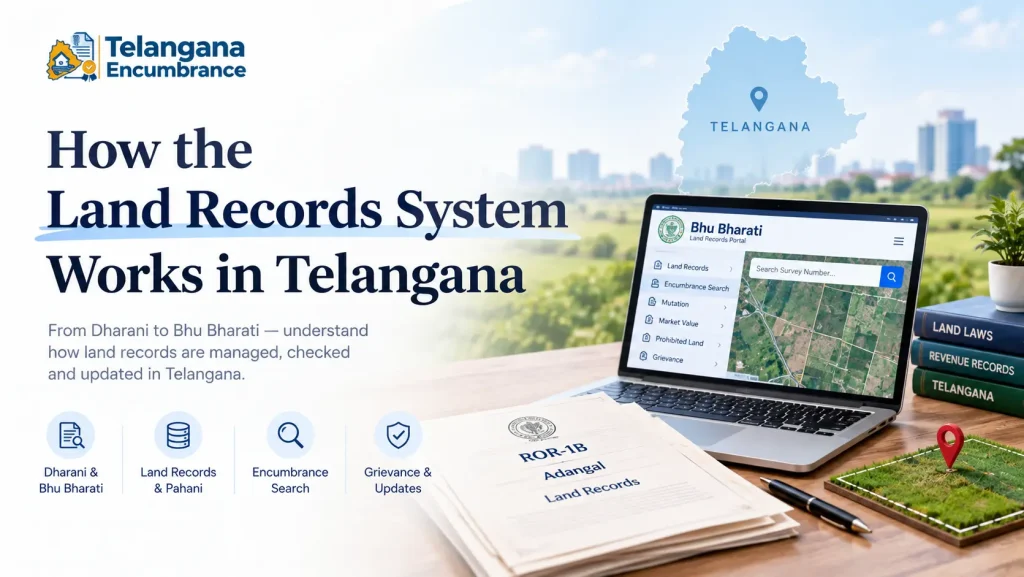
Telangana’s land administration has shifted twice in recent years, and that churn matters when you’re chasing a clearance.
The Dharani portal launched in 2020 as a single-window system for agricultural land records and registration encumbrance search, market value data, prohibited land lists, and slot booking all in one place. It became the default tool for checking property status.
It also drew heavy criticism: data errors, survey numbers wrongly dumped into the prohibited list, and no clear appellate route for grievances.
The Bhu Bharati portal has since come in as Dharani’s successor, promising better transparency and a structured grievance redressal mechanism, with appeals starting at the district level. The practical takeaway for ULC purposes: records change.
A status that was accurate six months ago may have been corrected, or newly flagged, since. Verify through the official portal on the day it matters not from a screenshot your broker saved last year.
Step-by-Step: How to Check ULC Status and Seek Clearance
This is a general outline, not a fixed procedure exact steps shift with your case. Treat it as the route someone who’s actually done this would describe.
Step 1: Check the Prohibited Properties List. Go to the official land records portal (currently Bhu Bharati, which replaced Dharani) and search the survey number. If it’s listed, note the exact reason ULC, assigned land, or something else entirely. This distinction decides your next move.
Step 2: Pull the Encumbrance Certificate (EC). An EC lists registered transactions on the property over a chosen period. It won’t show ULC status directly, but it can reveal registered ULC orders or court directions tied to the land. Apply through the registration portal or at a MeeSeva centre.
Step 3: Gather the paper trail. Collect every document you can: sale deeds, gift deeds, partition deeds, and critically any prior ULC exemption order. If the original vendor obtained exemption decades ago, that single document can be the difference between a quick fix and a years-long fight.
Step 4: File the ULC application. If the land is flagged as surplus or has pending ULC proceedings, file with the ULC authorities under the Revenue Department.
You’ll submit a declaration or application form with supporting documents. Confirm the current form and fee with the local revenue office or portal don’t rely on an old checklist.
Step 5: Follow up and answer notices. Authorities will likely issue notices or seek clarifications. Respond fast, keep copies of everything. This is where most cases stall: applicants miss a notice or send incomplete replies, and the file goes cold for months.
Step 6: Collect the clearance certificate. If authorities are satisfied the land isn’t surplus, or qualifies for regularisation, they issue the ULC clearance certificate. That certificate then needs to reflect in the land records, and the property may come off the prohibited list.
Step 7: Verify and update records. Don’t stop at the certificate. Confirm the portal reflects the change. You may need to apply for a mutation or correction. Keep certified copies you’ll need them at every future sale, mortgage, or partition.
Pitfalls worth knowing. First, a survey number on the prohibited list isn’t always correct data entry errors are common, and a wrongly flagged plot can sometimes be corrected without full ULC proceedings.
Second, the reverse is also true: a plot missing from the prohibited list can still carry an unresolved ULC issue that surfaces later. Never treat the portal as the final word on its own.
Documents Typically Required
Requirements vary by case, but these are commonly required for ULC-related matters:
- Title documents sale deed, gift deed, or partition deed establishing your ownership or your predecessor’s.
- Prior ULC orders or exemptions any document showing earlier clearance or exemption for the land.
- Encumbrance Certificate for the relevant period.
- Survey records village map, survey settlement records, or adangal/pahani extracts.
- Identity proof Aadhaar, PAN, or another government-issued ID.
- Application form as prescribed by the revenue department.
- Payment proof challan or receipt for fees paid.
Confirm the exact list with the concerned office, since requirements differ based on the nature of the case.
You may also like to read these posts :👇
AP Land Records Portal – Bhulekh AP & Meebhoomi Guide
Dharani Pattadar Passbook: Download & Verify Online
Odisha Land Records – Bhulekh Naksha & Plot Map Online
Tamil Nadu A-Register, Guideline Value & Survey Number Search
FAQs on Land Ceiling and ULC in Telangana
What is the difference between the Land Ceiling Act and the ULC Act?
The Telangana Land Reforms (Ceiling on Agricultural Holdings) Act, 1973, limits how much agricultural land a person or family can hold. The Urban Land (Ceiling and Regulation) Act, 1976, dealt with vacant urban land. The ULC Act was repealed in 1999, but pending cases and unresolved issues still affect property in Telangana.
How do I know if my property has a ULC issue?
Check the prohibited properties list on the official land records portal (Bhu Bharati/Dharani). If your survey number appears, the reason for prohibition is typically indicated. An EC and historical documents may reveal ULC-related orders. For a definitive answer, consult the local revenue office.
Can I register a property that is listed under Section 22A?
The Telangana government has recently permitted registration of houses, plots, and flats with valid GHMC, HMDA, DTCP, or municipal approvals, even if previously listed under 22A. The property must meet specified conditions, and procedural requirements still apply. Verify the current position with the sub-registrar.
What happens if my ULC application is rejected?
You may be able to appeal to a higher authority or seek legal recourse. The Bhu Bharati system introduces a structured appeal process Tahsildar, then RDO, District Collector, and CCLA. The right remedy depends on the grounds for rejection.
Is a ULC clearance certificate required for agricultural land?
The ULC Act applied to urban land, not agricultural land. However, if agricultural land falls within an urban agglomeration and was converted or treated as urban land, ULC issues can arise. The 1973 Act applies to agricultural holdings separately. Check your land’s classification and any relevant orders.
How long does it take to get ULC clearance?
Timelines vary widely with the complexity of the case, document completeness, and the authorities’ workload. The fast-track initiative aims to speed up pending cases, but no fixed timeline can be guaranteed. Follow up regularly and keep your file complete.
A Note on Verification
Land laws and administrative processes in Telangana change government orders get issued, portals get updated, court rulings shift how existing rules are read. Treat this article as general awareness, not legal advice.
For your specific case, verify through the official land records portal, check with the local sub-registrar office, or consult a qualified professional.
One last thing worth doing: if you’re mid-transaction, don’t wait for the clearance to finish before flagging it to your buyer or seller. A pending ULC file can be disclosed upfront and managed it becomes a dealbreaker only when it surfaces after money has changed hands.
And if you’re the owner, start now rather than at the point of sale. The current government push has created a window where files are actually moving; that window won’t stay open forever.

2 Comments
Pingback: తెలంగాణ భూమి రికార్డులు | Survey Number Guide
Pingback: Land Documents Checklist Before Buying Land in Telangana