

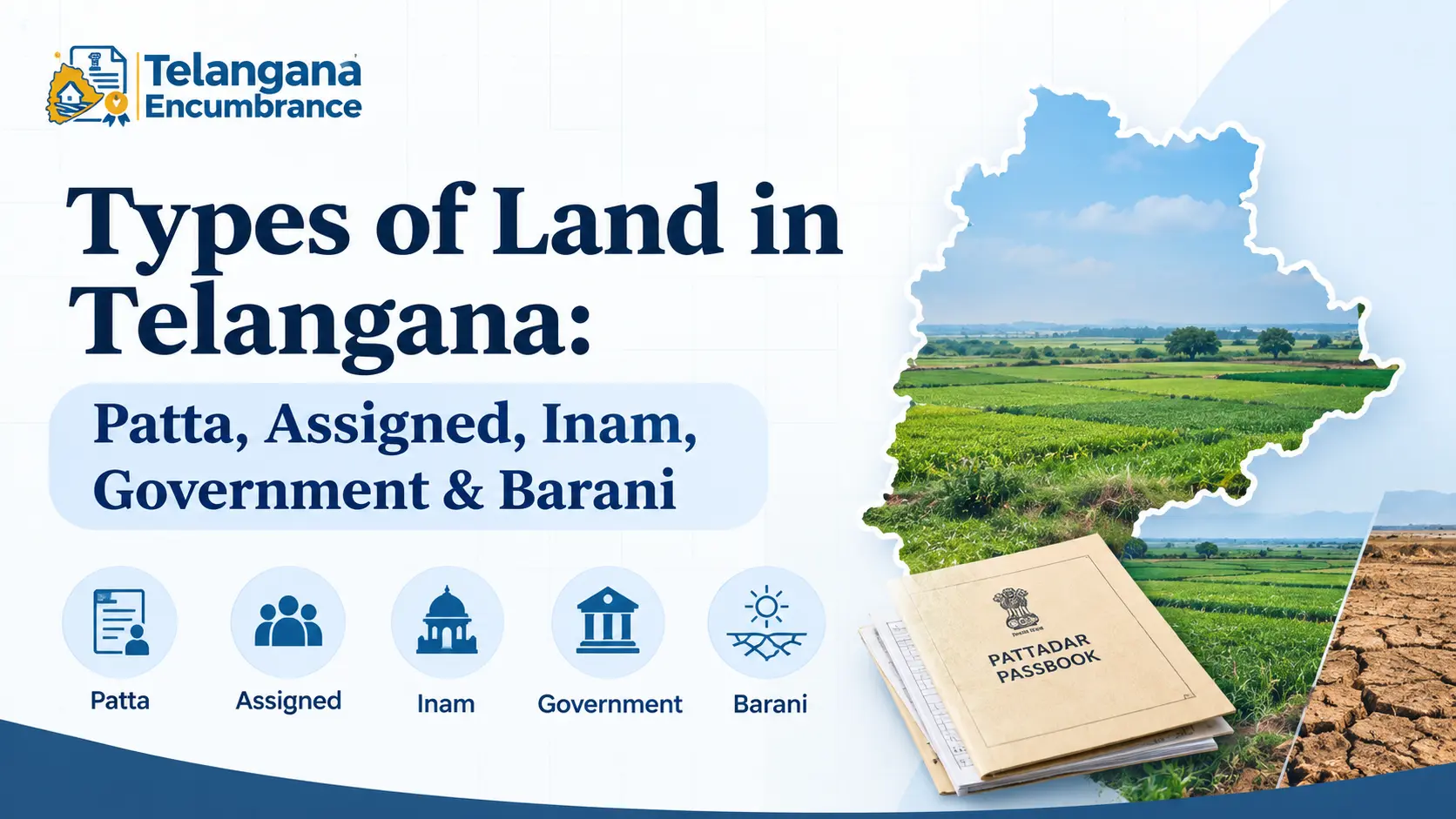
Your land purchase just got rejected at the sub-registrar’s office. Or the bank won’t accept your Pattadar Passbook as collateral. Or a cousin is claiming a share of ancestral land you thought was yours. In Telangana, most of these disputes trace back to one overlooked question: what type of land is this? Patta, assigned, inam, government, and barani lands each operate under different rules,
and those rules decide whether you can sell, mortgage, or inherit a parcel at all. This guide walks through each category, shows you where to verify the classification in official records, and flags the mistakes that cost buyers their money.
What is Patta Land in Telangana?
Patta land is privately owned agricultural land where the government has formally entered the owner’s name in revenue records. That owner the pattadar holds a Pattadar Passbook, which works as proof of title and is commonly required for crop loans, subsidy schemes, and registering sale or gift deeds.
This is the only category among the five that can be freely transferred, mortgaged, and inherited under ordinary property law. On the Dharani portal, you can search patta records by Khata number,
survey number, or pattadar name, view the land status, download the electronic passbook, and apply for mutation when ownership changes hands.
If your land is patta and the records are clean, you are in the simplest position of any landholder in the state. The complications begin with the next category.
Assigned Land: Government Land Given to Landless Poor
Assigned land is government land allotted to landless poor persons for farming or as house sites. The defining feature is a hard restriction on transfer. Under the Telangana Assigned Lands (Prohibition of Transfers) Act, 1977, assigned land cannot be sold, gifted, mortgaged, exchanged, or leased to anyone other than the government.
Violate that prohibition, and the government can resume the land restoring it to the original assignee if they remain landless, or reassigning it to another eligible person. For a buyer, the practical consequence is brutal: once a parcel is classified as assigned, the transaction is generally treated as void, and you can lose both the land and everything you paid for it. Verify classification before paying any advance, not after.
You may also like to read these posts :👇
Bhu Bharathi Login: Citizen Registration, Password Reset & Common Errors
Dharani / Bhu Bharathi App: Is There an Official App? Download & Alternatives
What Is a Survey Number? Meaning, Format & How to Find It
ROR-1B & Adangal Telangana: Download 1B Online (Bhu Bharati Update)
Inam Lands in Telangana: Legacy Grants and Occupancy Rights

Inam lands trace back to grants made by the Nizam or other competent authorities, often for religious, charitable, or service purposes “inam” means gift. The Telangana Abolition of Inams Act,
1955 abolished all inams and vested the lands in the government, while giving occupants a path to regularise their holdings through an Occupancy Rights Certificate (ORC).
The critical date is 1 November 1973. Inamdars, permanent tenants, protected tenants, and certain occupants who were in possession on that date could apply for an ORC, pay the prescribed premium,
and have their names entered in revenue records. Buyers who purchased inam land after the vesting date do not automatically inherit occupancy rights entitlement hinges on possession as on the cut-off date,
and courts have generally held that only those in possession on the relevant date can be registered as occupants. If a seller cannot produce a clear ORC followed by a patta, walk away.
Government Land and State Land in Telangana
Government land also called state land or collector land is everything not under private ownership and administered by the revenue department. It includes barren and uncultivable land,
poramboke (land reserved for public purposes such as roads, tanks, and grazing), forest land, land assigned to institutions, and land resumed for public projects.
Much of this land appears under Section 22-A of the Registration Act, which bars registration of transactions on it. The Dharani portal maintains a prohibited lands list you can search by district, mandal, and village before attempting any deal.
Telangana’s total land area is roughly 276.95 lakh acres, though how much counts as “government land” shifts depending on whether forest, assigned, and other classifications are folded in so treat any single figure with caution.
Barani Land: Rain-Fed Dry Land
Barani land is dry land dependent on rainfall, with no assured irrigation from a canal or borewell. Revenue records typically classify it as dry land, as distinct from wet land with guaranteed irrigation. It usually commands a lower market value than irrigated land,
and the crops grown on it tend to be millets, pulses, and other dryland varieties rather than paddy. The classification matters beyond optics it feeds into land valuation, stamp duty calculation, and eligibility for certain agricultural schemes.
How to Check Land Type and Records on Dharani and Other Portals
Dharani and the newer Bhu Bharati platform, which has taken over many services is the primary digital gateway for agricultural land records in Telangana. Here is how verification works in practice:
- Open the official Telangana land records portal. Access Dharani or Bhu Bharati through the government’s official website. Avoid lookalike sites; several private portals mimic government design.
- Run a land status or Pahani search. Enter district, mandal, and village, then the survey number, Khata number, or pattadar name. The record will show whether the land is patta, assigned, inam, or government-classified.
- Check the prohibited lands list separately. This is the step most buyers skip. A survey number can be partially flagged one portion government, the rest private so a clean Pahani alone does not clear the deal. Search the prohibited list for the same survey number before proceeding.
- Download the documents you need. Typically the Pahani (record of rights), the Pattadar Passbook, and an Encumbrance Certificate. For non-agricultural land, the IGRS Telangana portal handles registration and encumbrance details.
- For inam land, expect to go offline. If the record doesn’t clearly show patta status, check whether an ORC was ever issued. Historical inam records are not fully digitised, so this usually means a visit to the local Tahsildar or Revenue Divisional Officer’s office.
Two pitfalls worth knowing: First, the prohibited list is not perfectly maintained there have been cases where entire survey numbers were flagged when only a fragment belonged to the government, and equally, records that should be flagged weren’t.
Second, a mutation application on Dharani can stall for months if the previous owner’s details don’t match legacy records, so start the process well before any deadline.
Common Mistakes to Avoid When Dealing with Telangana Land
- Assuming all agricultural land is freely transferable. Assigned land and inam land without an ORC cannot be sold or mortgaged. Confirm classification before paying an advance, not after.
- Treating the prohibited list as optional. It is the single most useful filter before a purchase. Check it even when the Pahani looks clean.
- Relying only on the Pattadar Passbook. A passbook does not guarantee the land is free of restrictions. Cross-check Dharani’s land status and prohibited list; for non-agricultural land, check IGRS.
- Ignoring inam origins in old family land. Land held for generations may have started as an inam grant. Without a clear ORC and subsequent patta, ownership can be challenged years later.
- Believing fallow land loses its agricultural status. Leaving land uncultivated for a season or more does not convert it. Unless formally converted for non-agricultural use, it remains agricultural land under revenue law.
You may also like to read these posts :👇
How to Check FTL, Buffer Zone & Land Zone in Telangana
Telangana Cadastral Map, Tippon & FMB Sketch: How to Get Copies
Types of Land in Telangana: Patta, Assigned, Inam, Government & Barani
Land Ceiling Act & ULC Clearance in Telangana Explained
FAQs
How can I tell if my land is patta or assigned land in Telangana?
Pull the Pahani or land status on Dharani/Bhu Bharati using your survey or Khata number. Assigned land is typically marked as such, and the prohibited list may flag it too. If the record is ambiguous, the local Tahsildar’s office can confirm the classification in person.
Can I buy inam land in Telangana?
Only if an Occupancy Rights Certificate has been issued and the seller holds valid title built on it. Inams were abolished in 1955, and occupancy rights depend on possession as on 1 November 1973. Without a clear ORC and patta, the purchase is risky verify status with the local revenue office first.
What is barani land, and can it be converted to irrigated land?
Barani land is rain-fed dry land with no assured irrigation. It can potentially be converted if a water source becomes available, but the revenue classification usually needs updating through an application to the revenue department and the land’s market value and assessment may change as a result.
Where can I check if a survey number is government land in Telangana?
Start with the prohibited lands section on Dharani, searching by district, mandal, and village. For deeper verification, the local Tahsildar’s office or Chief Commissioner of Land Administration (CCLA) records can be consulted.
What documents do I need to verify land type before purchase?
Commonly required: the Pattadar Passbook (if available), the latest Pahani, an Encumbrance Certificate, and a Dharani land status printout. For non-agricultural land, check the IGRS portal for registration details. A lawyer’s opinion based on these documents is advisable before any transaction.
Does Dharani show inam land records?
Dharani’s records largely date from its 2020 implementation and draw on underlying revenue data. Historical inam grants and ORC details are often not fully reflected, so older inam records usually require physical verification at the Tahsildar or RDO office.
If there is one habit worth building, it is this: verify the land classification and the prohibited list on the same day you first consider a parcel not the week you plan to register. Records change, survey numbers get reclassified, and a clean status today can look different after a government notification.
And if a transaction you have already completed turns out to involve assigned or government land, consult a local advocate quickly; the earlier the issue is raised with the revenue authorities, the more options generally remain open.

1 Comment
Pingback: Land Documents Checklist Before Buying Land in Telangana