

You’ve found a plot, negotiated the price, and the pattadar passbook looks clean. Then the bank’s legal team rejects the loan, or the municipality refuses building permission, because the land sits inside a lake’s Full Tank Level. This happens more often than most buyers expect in Telangana, and it almost always surfaces late after the token advance has changed hands.
This guide explains how to check FTL land in Telangana, how to check zone of land online, and what the different zone classifications actually mean for a purchase. The information is scattered across revenue records, irrigation maps, and municipal portals, and no single website gives you the full picture. Knowing which source to trust for which question is most of the battle.
What Is FTL Land and Why It Matters
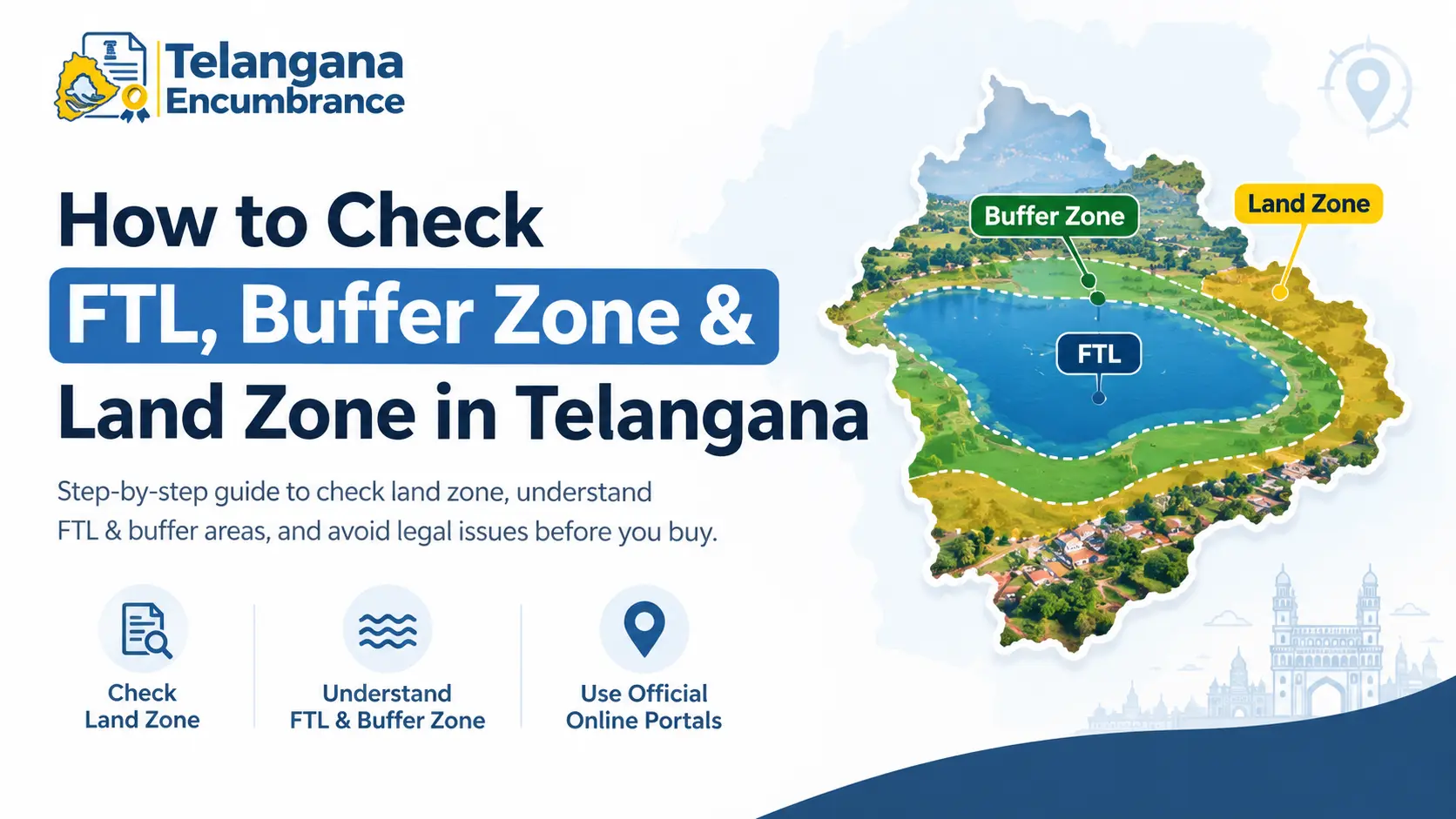
FTL stands for Full Tank Level the maximum water level a lake, tank, or reservoir reaches when full, as certified by the Irrigation and Revenue Departments.
Everything inside that boundary is effectively the water body’s bed. Construction there is prohibited, and structures built inside it are treated as encroachments liable for removal.
Just outside the FTL sits the buffer zone, a regulated belt where development is restricted or heavily scrutinised. Buffer widths differ by water body: rivers commonly carry a 50-metre buffer,
larger lakes around 30 metres, and smaller lakes roughly 9 metres. These norms shift with new notifications, so treat them as a starting point rather than a fixed rule.
A third restriction applies to G.O. 111 areas 84 villages around Osman Sagar and Himayat Sagar in Hyderabad, where land use was frozen decades ago to protect the catchment. The order’s legal status has been contested; the government moved to repeal it,
but the Telangana High Court directed that it be enforced until a committee submits its report. If your property falls in this belt, confirm the current position with HMDA or the local authority before committing.
The consequences are practical, not theoretical. FTL land generally cannot get building permission, banks typically refuse loans against it, and enforcement action remains a live risk. Buffer zone parcels often face the same rejections, just with more room for argument.
You may also like to read these posts :👇
Land Documents Checklist Before Buying Land in Telangana
House Number Search in Telangana: Find Assessment / Property Tax Number
How to Check Plot Details Online: Plot Number, Survey No. & Status
How to Check FTL, Buffer Zone & Land Zone in Telangana
How to Check Zone of Land Online in Telangana
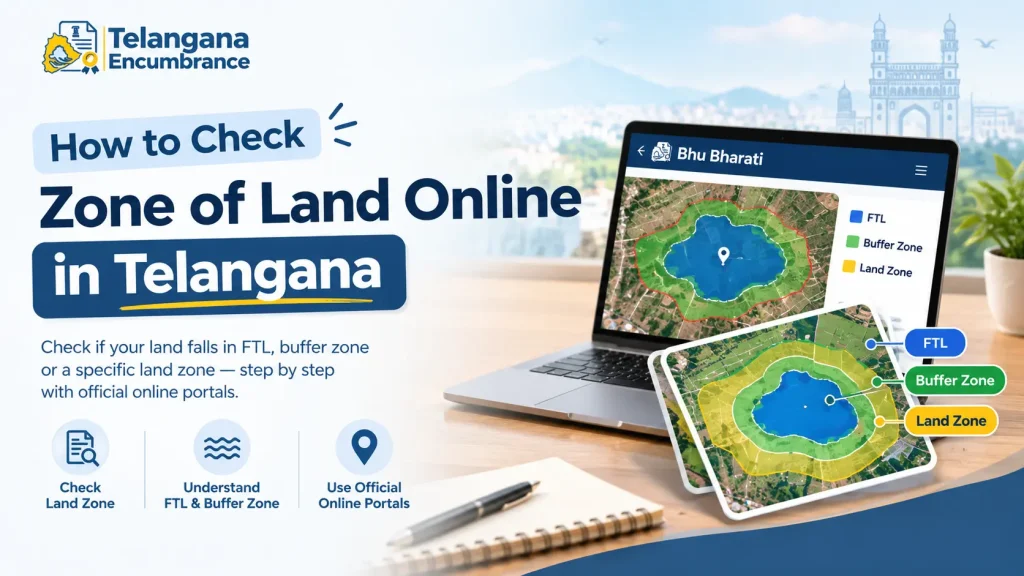
Telangana’s land records run across a few official channels. The primary system has moved from the older Dharani portal to Bhu Bharati, though Dharani-era records still surface in some searches. For urban properties, the IGRS Telangana portal handles registration and encumbrance checks.
Here is how to check zone of land in Telangana using the available online tools, in the order that makes sense.
Step 1: Pull the Bhu Bharati (or Dharani) Land Record
Start with the basic revenue record. On Bhu Bharati, use the “Details of Land” service under Information Services. You will need the district, mandal, and village,plus either the survey number or the Pattadar Passbook number. If you’re working from the older system, Dharani’s land details search follows a similar path survey number and khata number in, record out.
What you’re scanning for is the land classification. Entries like “tank,” “cheruvu poramboke,” or “water spread area” are strong signals that the parcel forms part of a water body and likely falls within FTL. Ordinary agricultural land typically shows as wet, dry, or garden.
Pitfall to watch: a blank or “no record found” result does not mean the land is clean. It often means the survey number has been renumbered or subdivided under Telangana’s resurvey, and you’re searching an outdated reference. Try the LPM number or check with the village revenue officer before assuming anything.
Step 2: Check the Prohibited Lands Register
Bhu Bharati links to a “Prohibited Lands Details” service that draws on Registration Department records. This register flags parcels that are government land, endowment land, assigned land, or otherwise barred from sale. If your survey number appears here, stop and investigate before going further this is one of the few genuinely disqualifying findings.
Step 3: Cross-Check Lake Maps for Hyderabad-Area Properties
Inside HMDA or GHMC limits, the revenue record alone won’t settle the question. The HMDA Lakes Portal maps lake boundaries, FTL limits, and buffer zones. You can check whether a survey number or plot falls inside a notified FTL or buffer.
This step exists because revenue records lag behind FTL notifications. A parcel can read as ordinary dry agricultural land in the revenue register while sitting squarely inside a lake’s FTL on the irrigation department’s maps. The maps are the more current source for this specific question.
Step 4: Confirm with the Local Tahsildar or Revenue Office
When the online records are ambiguous or contradict each other, the local revenue office is where you get a definitive answer. Ask for the village map and the FMB (Field Measurement Book) sketch for the survey number. These show water body boundaries and reveal whether the parcel overlaps with a tank bed.
For precise demarcation, apply for a land survey through the Tahsildar or a Mee Seva centre. A government surveyor inspects the land physically and confirms the boundaries on the ground.
Second pitfall: don’t rely on the seller’s or agent’s assurance that “it’s not in FTL.” Sellers sometimes genuinely don’t know, and sometimes they do. The surveyor’s report is the version that holds up.
Understanding Land Zone Classifications
“Land zone” means two different things in Telangana, and mixing them up causes real confusion.
Agricultural land classification is how the land is categorised for revenue purposes: wet, dry, garden, or waste. It affects what you can legally do with the land and whether conversion is needed for non-agricultural use.
Regulatory zones cover FTL, buffer zones, G.O. 111 areas, and similar development restrictions. These operate independently of revenue classification. A parcel can be perfectly ordinary dry agricultural land on paper and still sit inside a lake buffer zone. You have to check both, because clearing one tells you nothing about the other.
Common Mistakes Buyers Make
Treating the pattadar passbook as proof of buildability. The passbook establishes ownership. It says nothing about development rights, FTL status, or buffer restrictions.
Assuming the sale deed’s survey number matches current records. Resurvey and renumbering have changed survey references across many parts of Telangana. A failed search usually means a stale number, not clean land.
Relying on Bhu Bharati alone for urban plots. Properties inside HMDA or GHMC limits often don’t appear meaningfully in the agricultural land record system. For these, IGRS and municipal records carry more weight.
Skipping the site visit. Records can be incomplete or years out of date. Walking the land with the FMB sketch in hand frequently reveals what the portals miss a dried tank bed, a boundary marker, a neighbouring plot’s construction history.
Documents Required for FTL Verification
If you’re approaching the revenue office or a surveyor to confirm FTL status, these are commonly required:
- Registered sale deed or title document for the property
- Pattadar passbook and a current Pahani (ROR 1-B) extract
- Survey number and subdivision details as they appear on the deed
- Village map or FMB sketch, if you already have a copy
- Identity proof Aadhaar or voter ID is typically accepted
- Application form for the survey request, available at the Tahsildar office or Mee Seva centre
A formal survey request usually involves an application and a fee. Rates change, so confirm the current amount at your local Mee Seva centre or Tahsildar office rather than going by an old figure.
You may also like to read these posts :👇
Bhu Bharathi Login: Citizen Registration, Password Reset & Common Errors
Dharani / Bhu Bharathi App: Is There an Official App? Download & Alternatives
What Is a Survey Number? Meaning, Format & How to Find It
Old Pahani, Sethwar & Khasra Pahani (1954-55) Telangana: How to Get a Copy
Frequently Asked Questions
Can I get a building loan on FTL land in Telangana?
Generally, no. Most banks and financial institutions reject loans for properties within FTL or notified buffer zones, because construction rights are restricted and the collateral value is impaired.
What is the difference between FTL and buffer zone?
FTL is the area submerged when the water body is full construction is prohibited there. The buffer zone is the belt outside the FTL where development is restricted but not always completely banned.
How do I check if my land is in a G.O. 111 area?
G.O. 111 covers specific villages around Osman Sagar and Himayat Sagar. No single online tool reliably shows G.O. 111 status for a given survey number. The most dependable route is the local Tahsildar or HMDA, especially since the order’s legal status has been through court proceedings.
What should I do if my land shows as prohibited or FTL in the records?
Don’t proceed with purchase or construction. Get clarification from the Irrigation or Revenue Department on the exact boundary first. If the record contains an error, you may be able to file a correction application through the portal or approach the Tahsildar with supporting documents. If the classification is correct, the land is generally not developable, and the transaction likely doesn’t make sense.
Is the Dharani portal still active, or has Bhu Bharati replaced it?
Bhu Bharati is the current land records system, brought in to replace Dharani. Older Dharani links may still resolve, but for current records and services, use Bhu Bharati. Some historical Dharani-era data remains accessible through specific services.
A Final Word on Timing
If you’re serious about a property, start the FTL and zone verification before paying any advance, not after. A survey request or Tahsildar clarification can take weeks depending on the office, and that delay is far cheaper than discovering the problem after money has changed hands. If a seller resists a survey or pressures you to skip verification, treat that resistance as information in itself.

7 Comments
Pingback: భూ భారతి పోర్టల్ తెలంగాణ | లాగిన్ & సేవలు
Pingback: How to Find Survey Number of Land in Telangana | 5 Easy Ways
Pingback: Bhu Bharathi Login | Registration & Password Reset
Pingback: What Is a Survey Number? | Easy Guide
Pingback: Telangana Revenue Department | Services & Contacts
Pingback: Land Documents Checklist Before Buying Land in Telangana
Pingback: Types of Land in Telangana | 5 Key Categories