
You have the survey number, you have the seller’s name, and you have a registration deadline looming but when you open the Andhra Pradesh land records website, nothing matches what you were told. This happens constantly, because AP’s land record information system is not one website.
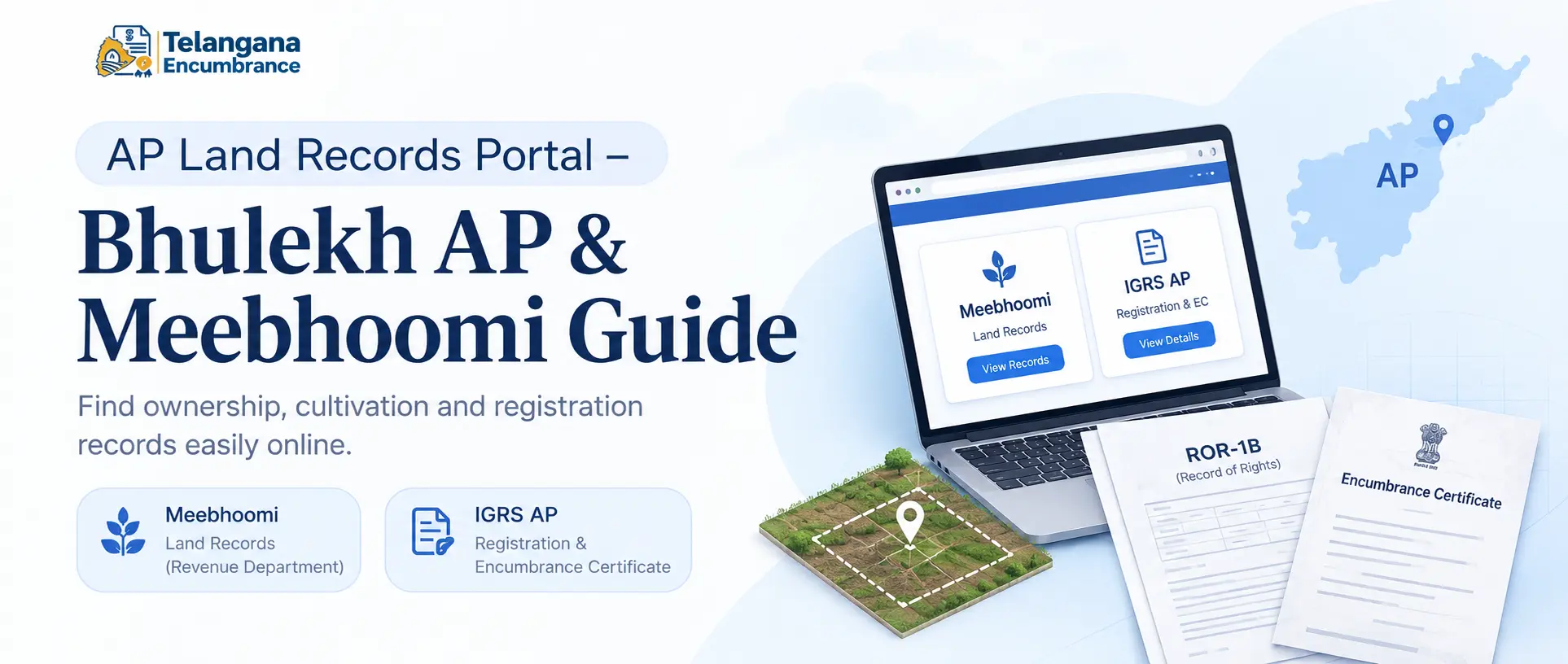
It is two: Meebhoomi, run by the Revenue Department for ownership and cultivation records, and IGRS AP, run by the Registration and Stamps Department for registered transactions and encumbrance certificates. Search the wrong one and you will conclude, wrongly, that the records do not exist.
This guide maps out which portal holds what, walks through the search and download process step by step, and flags the mistakes that send people back to the sub-registrar’s office a second time.
What Is Meebhoomi and What Records Does It Hold?
Meebhoomi (meebhoomi.ap.gov.in) is the Revenue Department’s public window into agricultural land records in Andhra Pradesh. It exists so that a pattadar a recorded landholder can pull up ownership and cultivation details without standing in a queue at the Tahsildar’s office.
Four document types matter most here:
- Adangal (Village Account No. 2): A season-by-season record of what is grown on the plot, the irrigation source, and who is cultivating it. Useful for tenancy disputes and crop loan applications, not for proving ownership.
- ROR-1B (Record of Rights): The ownership document. It carries the survey number, land classification, extent, and government dues. When a bank, court, or buyer asks who owns the land, this is the paper they want.
- e-Passbook (Pattadar Passbook): The digitised version of the physical passbook issued to recorded owners, showing owner details, survey numbers, and land extent in one place.
- Village maps and FMB (Field Measurement Book): Cadastral sketches that show plot boundaries and measurements the reference point when a boundary is disputed.
The Adangal-versus-1B confusion is the most common one. Adangal tells you who is farming the land. ROR-1B tells you who owns it. They are not interchangeable, and a seller who produces only an Adangal has not proven anything about title.
How to Search Land Records on Meebhoomi
Meebhoomi supports land record search by name as well as by survey number, though the survey number route returns cleaner results. The typical flow:
- Open the Meebhoomi portal and pick the document you need Adangal, ROR-1B, or e-Passbook.
- Select district, mandal, and village from the drop-down menus. These cascade, so choose in that order.
- Choose your search key: survey number, khata number, or account number. Aadhaar-linked verification is available for some services.
- Enter the captcha and submit.
- Review the record on screen and download the PDF.
For e-Passbook downloads, Aadhaar authentication with an OTP to your registered mobile number is normally required so if the Aadhaar-linked phone number has changed since the passbook was issued, sort that out at the Aadhaar centre first. It is a small thing that blocks a surprising number of downloads.
The pitfall to watch: English transliteration of Telugu names is inconsistent across records. “Venkateswarlu” may be stored as “Venkateshwarlu,” “Venkateswarulu,” or a dozen other variants, and a name search will silently return nothing.
Switch to survey number, which is numeric and does not suffer from spelling drift. If even the survey number draws a blank, the parcel may not be digitised yet a Tahsildar office visit with your original documents is generally the next step.
You may also like to read these posts : 👇
Adangal / 1B – What It Is & How to Get It
Dharani Portal Telangana – Complete Guide
Meebhoomi – How to Check Adangal & Land Records Online
What Is IGRS AP and How Does It Differ from Meebhoomi?
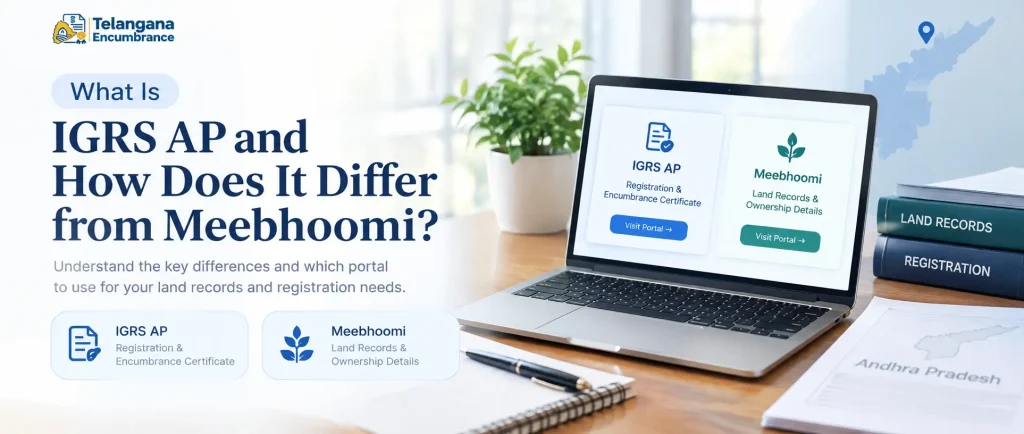
The Directorate of Settlement and Land Records sits at the state level overseeing survey and settlement work, but day-to-day registration transactions run through a separate system: IGRS AP (registration.ap.gov.in), operated by the Registration and Stamps Department.
Where Meebhoomi answers “who owns this land,” IGRS AP answers “what has been done with this land.” Sales, gifts, mortgages, leases, and court attachments all leave a trail here.
The headline service is the Encumbrance Certificate (EC) a dated list of every registered transaction attached to a property over a chosen period.
It is the document a buyer’s advocate asks for first, because it exposes mortgages and claims that a clean-looking 1B will not reveal.
The portal split exists because Andhra Pradesh never adopted Telangana’s unified Dharani platform after the 2014 bifurcation.
If a well-meaning relative tells you to “check Dharani” for an AP property, they are pointing you at the wrong state’s system entirely.
| What you need | Which portal |
|---|---|
| Who owns the land (1-B, Adangal, Passbook) | Meebhoomi |
| Registered transactions and EC | IGRS AP |
| Mutation status | Meebhoomi |
| Market value (guideline value) | IGRS AP |
Step-by-Step: Getting an Encumbrance Certificate on IGRS AP
An EC is not optional homework. Banks will not sanction a loan without one, and a buyer who skips it can inherit a mortgage they never agreed to. The online process:
- Go to the IGRS AP portal and open the Encumbrance Search option.
- Select the district. AP’s district boundaries were reorganised, so a property you know as being in “old” Krishna or “old” Chittoor may now sit under a differently named district. Pick the current one.
- Choose the Sub-Registrar Office (SRO). This single field decides whether you get results. The EC is indexed against the SRO that registered the original deed which is frequently not the SRO nearest the property today. Open your sale deed and read the SRO name printed on it rather than guessing.
- Enter your search key: document number (most precise), survey number, or party name.
- Widen the date range as far as the portal permits. Digitised AP records commonly stretch back to the 1980s, but coverage thins out for older deeds and rural SROs, so a narrow window can hide transactions.
- Submit. A successful search returns Form 15 (a list of transactions) or Form 16 (a nil encumbrance certificate).
Two pitfalls worth internalising. First, a nil EC is not a clean chit. It can mean the property is unencumbered, or it can mean you searched the wrong SRO or too short a period the portal cannot tell you which.
Second, if the property changed hands recently, the new registration may not yet be indexed. Cross-check with the SRO before you treat the result as final.
What Is Bhulekh Andhra Pradesh and How Does It Relate?
Bhulekh Andhra Pradesh is a colloquial label, not an official portal name. There is no single government site branded “Bhulekh AP” that holds everything, which is precisely why searches go wrong. The functions people associate with the term are split between meebhoomi.ap.gov.in and registration.ap.gov.in.
A number of third-party websites trade on the Bhulekh name and redirect to these official portals some add advertising, some ask for personal details they do not need.
Go direct. For Bhulekh land registration ID lookups checking a document registration number or the status of a lodged deed IGRS AP is the correct destination; Meebhoomi will not have it.
Documents Required and Common Mistakes
Documents typically needed
For an EC search on IGRS AP, keep the survey number, document number (if you have it), and the sale deed handy. Aadhaar or another valid photo ID is commonly required for certified copies.
For a Meebhoomi e-Passbook download, you will typically need the account number and an Aadhaar-linked mobile number to receive the OTP.
For registration itself, the usual set includes the sale deed, a current EC, identity proof for buyer, seller, and witnesses, passport-size photographs, and PAN or Form 60.
Stamp duty and registration fees change from time to time check the official portal for current rates rather than relying on figures quoted by anyone, including agents.
Mistakes to avoid
- Searching the wrong portal. Ownership records live on Meebhoomi; transaction records live on IGRS AP. Mixing them up is the single biggest time-waster.
- Guessing the SRO. Read it off the deed. The nearest SRO is not necessarily the registering one.
- Trusting a name search. Transliteration variants bury records. Survey number or document number is safer.
- Assuming everything is digitised. Recently subdivided plots and older rural parcels often are not. The Tahsildar office fills the gap.
- Accepting a nil EC at face value. Verify the SRO and stretch the date range before you believe it.
You may also like to read these posts : 👇
Odisha Land Records – Bhulekh Naksha & Plot Map Online
Tamil Nadu A-Register, Guideline Value & Survey Number Search
Telangana Prohibited Property List – How to Check Onlinet
AP Field Measurement Book (FMB) & Land Parcel Sketch
Frequently Asked Questions
What is the difference between Meebhoomi and Bhulekh AP?
Meebhoomi is the Revenue Department’s official portal for ownership and cultivation records 1-B, Adangal, and the e-Passbook.”Bhulekh AP” is an informal term for the state’s land records system as a whole, which also includes IGRS AP for registration records.
Can I search for land records by name in Andhra Pradesh?
Yes, Meebhoomi supports name-based search, but survey number searches are more dependable because English spellings of Telugu names vary between records. If a name search returns nothing, retry with the survey number.
How long does it take to get an Encumbrance Certificate in AP?
If the relevant records are digitised, the IGRS AP portal generates the EC during the search itself. Older deeds, rural SROs, or offline applications can take longer timelines vary by office.
What is the Directorate of Settlement and Land Records in AP?
The Directorate of Survey, Settlements and Land Records (DSSLR) oversees survey and settlement operations across the state. It has been running a statewide resurvey programme using drone technology, aimed at reducing boundary disputes and tightening record accuracy.
Can I download my Pattadar Passbook online?
Yes the e-Passbook is available on Meebhoomi. You will typically need the account number and an Aadhaar-linked mobile number for OTP verification before the PDF downloads.
What should I do if my land is not showing on Meebhoomi?
Retry with the survey number rather than the name, and check for spelling variants. If it still does not appear, the parcel may not be digitised. Take your original documents to the local Tahsildar or revenue office.
Final Thoughts
If you are working against a registration deadline, pull the EC and the 1-B early rather than on the eve of execution. SRO indexing lags behind fresh registrations, and an EC that comes back nil today can quietly acquire a transaction entry next week once a pending deed is indexed so request one dated as close to your registration date as possible, and cross-check it against the deed’s SRO one last time before you sign.

2 Comments
Pingback: Bhu Bharathi Land Details Search | Easy Guide
Pingback: Land Ceiling Act Telangana | ULC Clearance Guide