

Your registration application gets rejected. Or worse it goes through, but the sub-registrar informs you that the stamp duty has been calculated on a government rate, not the price you actually agreed to pay. This happens more often than people expect, and it usually comes down to one thing: nobody checked the Dharani market value before sitting down at the registration desk.
This article walks through what that figure means, how the shift from Dharani to Bhu Bharati affects where you find it, how to look it up for your specific survey number, and the pitfalls that trip up even experienced buyers.
What the Dharani Market Value Actually Represents
The Dharani market value is the government-notified basic value attached to a land parcel in Telangana. You will also hear it called the guideline value, ready reckoner rate, or circle rate all the same thing. It is the state’s reference figure for what a plot is worth, used primarily to calculate stamp duty and registration charges.
Every survey number carries its own value. Agricultural land is rated per acre; non-agricultural and urban plots are rated per square yard. The figure shifts across districts and mandals, and can even differ between two parcels in the same village a plot abutting a highway typically commands a higher notified rate than one tucked behind it.
The rule that catches people off guard: the sub-registrar computes duty on whichever is higher your declared sale price or the government value. Declare ₹15 lakh for a plot the government values at ₹22 lakh, and you still pay duty on ₹22 lakh. There is no negotiation on this point.
Why the Portal Changed: Dharani to Bhu Bharati
Dharani served as Telangana’s single-window land records system for years. It handled everything from viewing land details to processing registrations. But it accumulated problems ownership entries that could not be corrected administratively, disputes that had nowhere to go except civil courts, and errors that left genuine landowners stranded.
The Telangana government introduced the Bhu Bharati Act and portal in April 2025 as a replacement framework. The new system gives revenue officials the authority to rectify record errors and process mutations (ownership transfers) within defined timelines, reducing the need to litigate over clerical mistakes.
For anyone checking land value today, the practical consequence is simple: the market value service now sits within the Bhu Bharati portal. Old Dharani bookmarks and forwarded links frequently fail or load stale pages. Navigate to the current portal directly rather than trusting a saved link.
You may also like to read these posts :👇
Bhu Bharathi Login: Citizen Registration, Password Reset & Common Errors
Dharani / Bhu Bharathi App: Is There an Official App? Download & Alternatives
What Is a Survey Number? Meaning, Format & How to Find It
CCLA Telangana: Chief Commissioner of Land Administration – Services, Land Status & Contact
How to Check Dharani Land Value: Step by Step
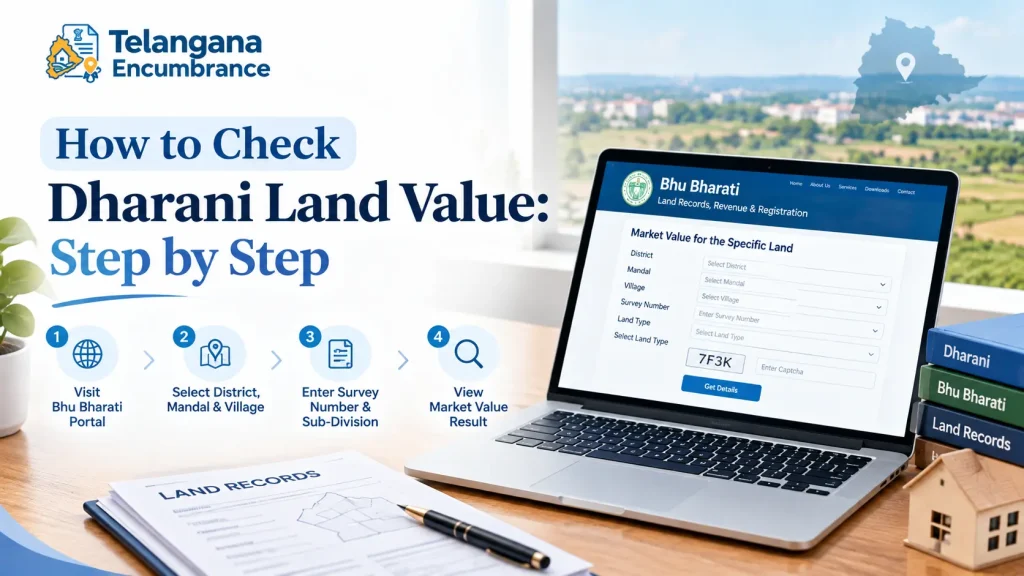
You need three things before you start: the district, the mandal and village, and the exact survey number with its sub-division. Get any of these wrong and you will pull up a rate for someone else’s land.
- Open the official Bhu Bharati portal. Type the address yourself or use a bookmark you created recently. Do not click through from a WhatsApp forward or an old search result those often point to the retired Dharani domain.
- Locate the market value service. Look for an option worded along the lines of “Market Value for the Specific Land” or “View Market Value of Lands for Stamp Duty.”
- Choose the land type. Agricultural or non-agricultural. This determines whether the result shows a per-acre or per-square-yard figure.
- Select district, mandal, and village from the dropdowns. The village list is usually the longest step scroll carefully rather than typing, since spelling variants can send you to the wrong entry.
- Enter the survey number and sub-division. This is where most errors happen. Pull the numbers directly from your Pahani or sale deed and read them aloud as you type. A transposed digit can pull up a neighbouring parcel with a completely different rate.
- Complete the CAPTCHA and fetch the result. The portal displays the notified value for that parcel.
For urban, non-agricultural properties, the IGRS Telangana portal also offers a market value search. Agricultural land, however, is best checked through the Bhu Bharati land records module.
Two pitfalls worth flagging. First, if your land sits near a highway or a recently developed corridor, the notified rate for your survey number may be noticeably higher than for parcels a few hundred metres away do not assume the village average applies to you.
Second, if you are checking shortly before registration, pull a fresh printout. Rates get revised, and a screenshot from three months ago may not match what the sub-registrar’s system shows on the day.
Reading the Number: What It Tells Buyers and Sellers
A wide gap between the government value and your negotiated price is worth pausing over. If the deal price runs well above the Dharani land value, that usually reflects real demand proximity to a growing town, new infrastructure, or scarcity in that village.
If the deal price sits far below the government figure, treat it as a signal to dig deeper. It can point to a title defect, an ongoing dispute, or an attempt to under-declare the transaction to reduce duty.
Sellers benefit from knowing the notified rate too. It anchors expectations and prevents the awkward moment when a buyer discovers the duty calculation differs from what they assumed.
Buyers should factor the value into their total budget, not just the headline price. Stamp duty and registration charges add a meaningful percentage on top, and lenders routinely cross-check both the government value and the deal price during loan appraisal. A large divergence invites extra scrutiny and delays.
Market values are revised periodically Telangana has carried out revisions in the past without a fixed annual schedule. Confirm the current figure close to your registration date rather than relying on memory or an old printout.
Common Mistakes That Cost Time and Money
Mixing up land classifications. Agricultural land is rated per acre, non-agricultural per square yard. Apply the wrong unit and the number you calculate will be meaningless. Confirm the classification from your Pahani first.
Borrowing the neighbour’s rate. Two adjacent survey numbers can carry very different values, particularly where one touches a road. Verify your own survey and sub-division numbers against the deed, not against what the plot next door fetched.
Treating the market value as a price tag. It is a floor for duty calculation, not a statement of what your land will fetch on the open market. It is a reference figure, nothing more.
Working from stale data. Revisions land without much notice. If registration is imminent, check the rate on the portal and confirm with the sub-registrar’s office on the day.
Clicking old Dharani links. Search engines and forwarded messages still surface the retired domain. Those pages may load but show outdated information. Go to Bhu Bharati directly.
Documents and Details to Keep Ready
Before checking the value or proceeding to registration, assemble the following:
- Previous sale deed or title document showing the survey number and extent of the land
- Pahani or ROR (Record of Rights) confirming ownership and land classification
- Pattadar Passbook, if issued
- Aadhaar and PAN of the parties involved PAN is commonly required for transactions above a threshold set by the registration department
- Survey number and sub-division number, matching exactly across all documents
- Khata number, where applicable
For inherited land, keep succession certificates or legal-heir documents alongside the deed. Discrepancies between the name on the Pahani and the name on the identity proof are a frequent cause of delay at the registration counter.
You may also like to read these posts :👇
Karnataka RTC Online & Bhoomi Portal – Full Guide
Gujarat Village Map & 7/12 Utara Online: Survey Number & TP Records
Haryana Jamabandi Map & Digital Land Records
West Bengal Mouza Map, RS Khatian & Porcha Guide
Frequently Asked Questions
Is the Dharani market value the same as the actual market price?
No. It is a government-notified minimum rate for registration purposes. The price a buyer is willing to pay can be higher or lower depending on demand, location, and the condition of the land.
Can I register land below the government market value?
The registration can proceed, but if your declared price is lower than the notified value, duty is still computed on the notified value. Under-declaring does not reduce what you pay and may draw scrutiny.
How often is the Dharani land value revised?
Revisions happen periodically by state government order. There is no fixed annual cycle, so check the current rate shortly before any transaction.
Where do I check the market value Dharani or Bhu Bharati?
Bhu Bharati is the current portal. Old Dharani links may not work or may display outdated figures.
Does the market value affect home loans or mortgages?
Yes. Lenders typically cross-check the government value against the deal price during appraisal. A large gap between the two often triggers additional questions.
What if my survey number does not appear in the portal search?
This can stem from pending resurvey work, a data gap, or an incorrect location selection. Recheck the village, mandal, and survey number against your Pahani. If it still does not appear, the local Tahsildar or sub-registrar office is the right place to seek clarification.
One last thing worth doing: if your registration is more than a few weeks away, check the notified value now and again a week before. Rates can move between the two dates, and knowing the final figure early gives you room to adjust your budget or renegotiate rather than discovering the difference at the counter.
