
Your land record shows the wrong survey number. Or worse the record doesn’t show up at all when you search. You’ve heard the Dharani portal was shut down, but you’re not sure what replaced it or whether your old pattadar passbook still works. Meanwhile, a buyer is waiting, a bank loan is pending, and no one at the local office seems to give you a straight answer.
This is the reality for thousands of landowners across Telangana in 2026. The state’s land records system has undergone a messy, half-finished transition from Dharani to Bhu Bharathi, and the confusion is costing people time, money, and in some cases, their property deals.
This guide cuts through the noise: what happened to Dharani, what Bhu Bharathi actually changes, how to check your records today, and the mistakes that can derail a land transaction.
What Was the Dharani Portal and Why Did It Become Controversial?
The Dharani portal launched on October 29, 2020, as Telangana’s single-window platform for agricultural land registration and record management. For the first time, farmers could download pattadar passbooks, check land details, and process mutations online without visiting Mee Seva centres or revenue offices.
The pitch was compelling: eliminate middlemen, reduce paperwork, create a “tamper-proof” system. But the execution created new problems. Farmers reported names spelled wrong, survey numbers that didn’t match ground reality, and land parcels that simply vanished from the database.
The bigger issue was structural there was no local appeal mechanism. If your record was wrong, you couldn’t walk into the Tahsildar’s office and get it fixed. Cases piled up in civil courts over corrections that should have taken days.
By late 2024, the government transferred Dharani’s management from a private vendor to the National Informatics Centre (NIC), suspended services temporarily for a database upgrade, and began work on a replacement system.
Is the Dharani Portal Closed in 2026?
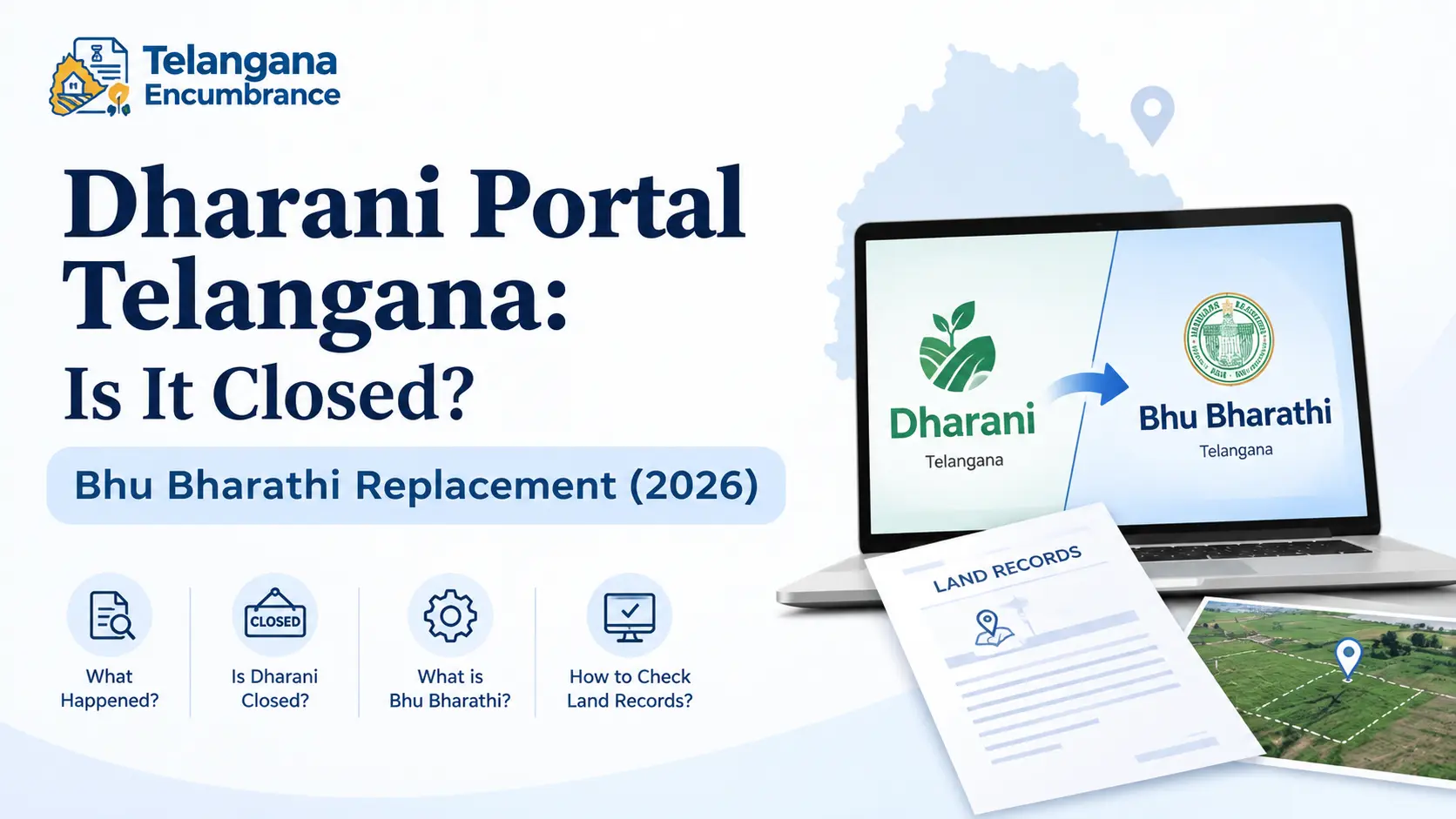
The Dharani portal as a transactional platform is effectively closed. You cannot register agricultural land, process a new mutation, or file a correction through the original Dharani system. The dharani.telangana.gov.in URL now redirects to the Bhu Bharathi platform for most services.
The legacy Dharani database still exists for viewing historical records from the 2020-2025 period, but it is not the active system. All new registrations, mutations, and corrections flow through Bhu Bharathi, which operates under the Telangana Bhu Bharati (Record of Rights in Land) Act, 2025.
One practical consequence: if you’re searching for land records today, you’re using Bhu Bharathi, whether you realize it or not. The old Dharani interface is a shell.
You may also like to read these posts :👇
Bhu Bharathi Portal Telangana 2026:
Karnataka RTC Online & Bhoomi Portal – Full Guide
Bhu Bharathi Land Details Search:
Meebhoomi – How to Check Adangal & Land Records Online
What Is Bhu Bharathi and How Is It Different?
Bhu Bharathi is Telangana’s replacement land administration framework, launched in April 2025. It integrates the Revenue, Survey, and Registration departments into one platform something Dharani never fully accomplished.
The structural changes matter for anyone dealing with land records:
Consolidated services. Dharani ran 33 separate modules, each with its own application process. Bhu Bharathi reduces this to six: Information Services (free viewing), Registration Services, Mutation Services, RoR Correction, NALA Conversion, and Appeals.
A functioning appeal chain. Under Dharani, a wrong entry meant court or nothing. Bhu Bharathi establishes a clear escalation path: Tahsildar → RDO (for cases under ₹5 lakh) → District Collector → Revenue Tribunal or CCLA. This is the single most significant practical improvement.
Map-linked identification. Every land parcel is assigned a Bhudhaar number a 14-digit unique ID tied to GPS and drone-mapped boundaries. Most parcels currently carry a temporary 11-digit version until geo-referencing is complete.
The correction window has closed. Under the Bhu Bharati Act, landowners had one year from the Act’s commencement (April 14, 2025) to file corrections for Dharani-era errors. That deadline lapsed on April 13, 2026.
Entries not challenged by that date are now treated as final under the Act’s “finality of records” clause. If you spot a discrepancy today, the path to fixing it is harder and may require revenue authorities or civil court.
How to Check Your Telangana Land Records in 2026

Land record checks on Bhu Bharathi are free for basic viewing. Here is the process.
Checking Pahani and Land Details
- Go to the official Bhu Bharathi portal (bhubharati.telangana.gov.in) and click “Information Services” no login required for basic searches.
- Select “Land Records” or “Pahani” from the menu.
- Choose your search method: Survey Number, Khata Number, or Pattadar Passbook Number.
- Select District, Mandal, and Village from the dropdowns. These must match official revenue definitions exactly local postal addresses often don’t align with the dropdown options.
- Enter the survey or khata number and click fetch. If your survey number has a sub-division (like 124/A/2), select the exact sub-division.
- Review the record, which shows pattadar name, extent, land classification, water source, and mutation status.
A common pitfall: if you get “No Records Found,” it does not mean your land record was deleted. During the transition, parcels with overlapping claims or unresolved succession disputes were moved to “Part-B” status and hidden from public search to prevent transactions while disputed. If this happens, visit your Mandal Revenue Office MROs can now resolve Part-B cases through on-site verification.
Checking Prohibited Lands and Market Value
Buyers should verify whether a property sits on the prohibited list under Section 22-A of the Registration Act. On Bhu Bharathi, navigate to “Prohibited Lands,” select district, mandal, and village, and fetch details.
As of September 2026, the government has ordered the removal of eligible private properties from the 22-A list roughly 1.41 lakh houses and plots statewide but the cleanup is ongoing.
Thousands of genuine private properties were inadvertently added to the prohibited list during Dharani-era changes, and committees headed by District Collectors are scrutinizing individual cases.
For market value (guideline value), use the IGRS portal’s Market Value Search tool rather than Bhu Bharathi. Stamp duty is calculated on whichever is higher: the guideline value or your actual purchase price.
Common Mistakes That Derail Land Transactions
Name mismatch between Aadhaar and land records. Even a single spelling difference can block registration software. Reports suggest name mismatches cause a significant share of digital mutation rejections. Update your Aadhaar spelling to match revenue records before starting any application.
Assuming a clean portal record means a clean title. The portal shows revenue records, not title. It won’t show pending litigation, unregistered family settlements, or encumbrances. For any purchase, verify the chain of title documents, registered sale deeds, and encumbrance certificates through IGRS.
Missing the correction deadline. The Bhu Bharathi Act’s one-year window for filing RoR corrections closed on April 13, 2026. If you’re buying land and the seller mentions they “filed a correction recently,” verify it was approved and updated before you proceed. A pending correction creates a title dispute you’ll inherit.
Paying middlemen for tasks you can do yourself. Bhu Bharathi is designed for direct citizen access. Basic record viewing is free. Many services that previously required Mee Seva visits and fees are now simplified or free.
Failing to track applications. Under Bhu Bharathi, if officials don’t act within 30 days on certain applications, they are automatically approved on day 31. But you need to track your application status through the portal to ensure it moves forward.
Documents Commonly Required for Land Record Applications
For mutation applications (sale, inheritance, or gift), you will typically need:
- Registered sale deed (for sale transactions)
- Previous Pahani or Record of Rights extract
- Aadhaar card of the applicant
- Death certificate (for inheritance cases)
- Legal heir certificate or succession certificate (for inheritance)
- Pattadar Passbook (if available)
For correction applications, additional documents may include the original registered deed, old passbook, and supporting proof of the correct detail.
Fees vary by service type and land extent. Mutation fees have been reported between ₹100 and ₹2,500 per acre depending on land type, but these figures are revised periodically. Check the official portal for current rates before applying.
You may also like to read these posts :👇
భూ భారతి పోర్టల్ తెలంగాణ: లాగిన్, భూమి రికార్డులు, సేవలు
Tamil Nadu A-Register, Guideline Value & Survey Number Search
Telangana Prohibited Property List – How to Check Online
CCLA Telangana: Chief Commissioner of Land Administration – Services, Land Status & Contact
Frequently Asked Questions
Is the Dharani portal still working for land registration?
No. Dharani is no longer the transactional platform for land registration or mutation. Bhu Bharathi has replaced it for all new services. The old Dharani database remains accessible for viewing historical records from 2020-2025, but you cannot process new transactions through it.
Can I still download my old Dharani pattadar passbook?
Your Dharani-era records have been migrated to Bhu Bharathi. You can access land details through the Bhu Bharathi portal using your survey number or pattadar passbook number. If records are missing or incorrect, you can apply for correction but note the one-year correction window closed in April 2026.
What is the main difference between Dharani and Bhu Bharathi for a farmer?
The appeal mechanism. Under Dharani, correcting a wrong entry meant court or nothing. Under Bhu Bharathi, you can escalate from Tahsildar to RDO to District Collector to CCLA. Additionally, many services are now free, and surveys can be requested online.
Will the government investigate irregularities in the Dharani portal?
Yes. The Telangana Cabinet has constituted a Special Enquiry Team (SET) to probe alleged irregularities in both Dharani and Bhu Bharathi portals, covering tendering, operations, and land transactions from Dharani’s inception to the present. A forensic audit is part of the investigation.
What should I do if my land records are wrong or missing?
You can apply for corrections through Bhu Bharathi, but the one-year correction window under the Bhu Bharati Act closed on April 13, 2026. For discrepancies spotted today, raise the issue with your local revenue office immediately. If the portal cannot resolve it, the appeal chain begins with the Tahsildar.
Is it safe to buy land in Telangana using only online records?
No. Online records are a starting point, not a clearance certificate. The portal may not show pending litigation, unregistered claims, or boundary disputes. Always verify the chain of title, encumbrance certificates, and conduct a physical inspection before completing any purchase.
The transition from Dharani to Bhu Bharathi is still a work in progress. If you’re checking your own records, do it now rather than waiting the longer you delay, the harder corrections become under the Act’s finality provisions.
If you’re buying, build verification time into your timeline: request the seller’s latest Pahani, cross-check it against the Bhudhaar or survey number on Bhu Bharathi, and visit the land yourself. For transactions involving disputed titles or complex inheritance, a property lawyer’s review is worth the cost.

3 Comments
Pingback: Bhu Bharathi Portal Telangana 2026 | Login & Land Records
Pingback: Bhu Bharathi Land Details Search | Easy Guide
Pingback: Pahani Telangana Online | Download via Bhu Bharathi