
You’ve decided to transfer your Hyderabad flat to your daughter, or perhaps your ancestral land in Warangal to your son. The sub-registrar’s office gives you a date three weeks out, and a neighbour mentions casually that you’ll need “around 5% or so” in charges.
Is it 3%? 5%? 7%? The answer depends on one thing most people don’t check before drafting the deed: how Telangana’s stamp law classifies your relationship with the recipient. Getting this wrong means either overpaying by lakhs or having your document returned at the counter.
This guide breaks down the actual gift deed registration charges, the step-by-step registration process, and the documents that need to be in order before your SRO appointment.
What Is a Gift Deed and When Is It Used?
A gift deed transfers ownership of immovable property land, a house, a flat from one person (the donor) to another (the donee) without any monetary exchange. In Telangana, this is governed by the Transfer of Property Act, 1882, and the Registration Act, 1908.
Two conditions make it valid: the donee must accept the gift, and the document must be registered if the property is immovable.
Gift deeds are common between parents and children, spouses, and siblings settling ancestral shares. The financial appeal is straightforward. A ₹1 crore property gifted to a qualifying family member attracts roughly ₹3 lakh in total charges;
the same property sold outright would attract closer to ₹7.5 lakh. That gap over ₹4 lakh is why families choose this route.
You may also like to read these posts : 👇
Property & Land Registration Charges in Andhra Pradesh
How to Check Encumbrance Certificate Status Online
How to Search EC Online in Telangana (Step-by-Step)
Gift Deed Registration Charges in Telangana: What You Actually Pay
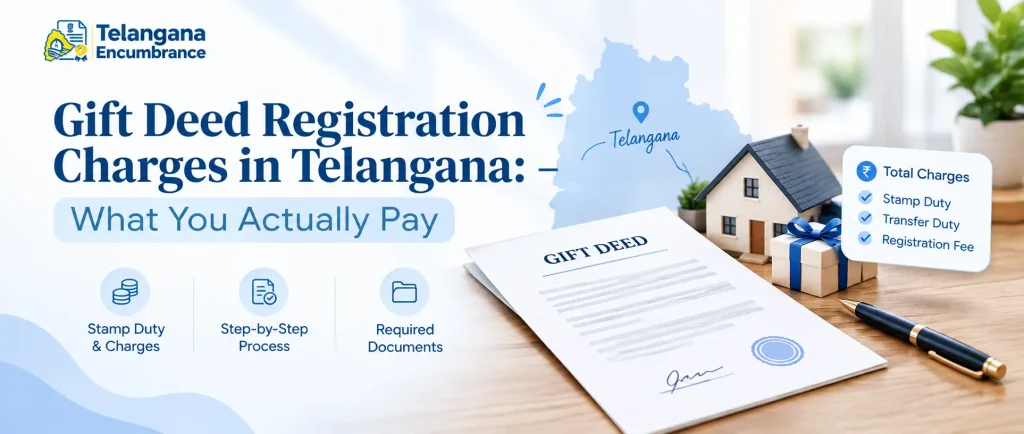
Three components make up the total cost: stamp duty, transfer duty, and the registration fee. The rates split sharply based on whether the donee qualifies as a “family member.”
According to the Telangana Registration & Stamps Department rate structure (per G.O.Ms.No.59, dated 20.07.2021), the applicable rates are:
For Family Members
| Component | Urban Areas | Gram Panchayat Areas |
|---|---|---|
| Stamp Duty | 2% | 2% |
| Transfer Duty | 0.5% | 0% |
| Registration Fee | 0.5% (min ₹2,000, max ₹25,000) | 0.5% + 0.5% (min ₹2,000, max ₹25,000) |
| Approximate Total | ~3% | ~3% |
For Non-Family Members
| Component | Urban Areas | Gram Panchayat Areas |
|---|---|---|
| Stamp Duty | 5% | 5% |
| Transfer Duty | 1.5% | 0% |
| Registration Fee | 0.5% (min ₹2,000, max ₹1,00,000) | 1.5% + 0.5% (min ₹2,000, max ₹1,00,000) |
| Approximate Total | ~7% | ~7% |
These charges are calculated on the higher of the property’s market value or the government’s guideline value (the ready reckoner rate). Even if you gift a property valued below ₹2,000, the minimum registration fee of ₹2,000 applies.
The “family” definition trap: The Income Tax Act defines “relative” broadly spouse, parents, siblings, children, grandparents, even spouse’s siblings. Telangana’s stamp law uses a narrower definition for the concessional rate.t
Assuming your relationship qualifies without checking is the single most common reason people pay the wrong duty or face a returned document. Confirm your specific case at the sub-registrar office or on the IGRS portal before drafting anything.
The Registration Process: Step by Step
Registration in Telangana is not fully online. You can book appointments and pay stamp duty through the IGRS portal (registration.telangana.gov.in), but physical presence at the SRO is mandatory for biometric verification and signing.
Step 1: Draft the Gift Deed
The deed goes on stamp paper of the appropriate value and must state:
- Full details of donor and donee (names, addresses, Aadhaar numbers)
- Complete property description (survey number, plot number, boundaries, area)
- A declaration that the transfer is voluntary and without monetary consideration
- The relationship between the parties
- Acceptance of the gift by the donee
A document writer or advocate can draft this, or you can prepare it yourself if you’re confident about the format. Both donor and donee must sign.
Step 2: Book a Slot on the IGRS Portal
Go to registration.telangana.gov.in, select “Slot Booking for Citizens,” log in (or register), and pick a date and time at the SRO with jurisdiction over the property’s location.
Here’s the pitfall: popular SROs in Hyderabad and other urban centres fill up two to three weeks in advance, and cancelled slots rarely reopen. Book the moment your deed is ready don’t wait until the stamp paper is purchased.
Step 3: Pay Stamp Duty and Registration Fees
Pay online through the IGRS portal using e-stamping, or through designated bank challans. The portal calculates the duty based on property value and relationship. Keep every receipt the SRO counter will ask for them, and a missing challan means a fresh payment and a lost appointment slot.
💳 Big online payment coming up? Stamp duty and registration fees run into lakhs and are paid online via e-challan/SBI ePay. Some buyers route such payments through a rewards credit card (where the portal allows it) to earn NeuCoins on the spend. Compare card options: Tata Neu Card or SBI Credit Card (affiliate links — free for you, support this site).
Step 4: Visit the Sub-Registrar Office
On the appointed date, the donor, donee, and two witnesses must appear with all original documents. At the office:
- Submit the gift deed and supporting documents
- The Sub-Registrar verifies identities and documents
- Donor, donee, and witnesses sign the deed in the Sub-Registrar’s presence
- Biometric verification (fingerprints and photograph) of the parties
The Sub-Registrar may ask questions to confirm the gift is voluntary and the parties are who they claim to be. Answer directly hesitation invites scrutiny.
Step 5: Collect the Registered Deed
A copy of the registered deed is typically handed over immediately. The digital version appears on the IGRS portal within 24 to 48 hours, though technical delays can stretch this to a few working days. Track it using the Document Reference Number (DRN).
Step 6: Update Land Records (Mutation)
Registration changes ownership on paper. It does not change revenue records. Apply for mutation through the relevant portal to get the property recorded in the donee’s name.
Telangana has been transitioning from the older Dharani portal to the newer Bhu Bharati portal(bhubharati.telangana.gov.in) for land record services.
Mutation ensures property tax records and the Pattadar Passbook reflect the new owner skip this step, and you’ll face problems when selling or applying for a loan later.
Documents Required for Gift Deed Registration
Arrange these before your SRO appointment:
- Original Gift Deed on stamp paper of the correct value
- Proof of ownership of the donor: original title deed, sale deed, or prior gift deed
- Identity and address proofs of both parties: Aadhaar card, PAN card, voter ID, passport, or driving licence
- Passport-size photographs of donor and donee
- Encumbrance Certificate (EC) for the property, confirming no legal dues or mortgages
- Two witnesses with valid ID proofs who can appear at the SRO
- No-Objection Certificate (NOC) if applicable from a housing society or co-owners
- PAN card is mandatory for transactions exceeding ₹5 lakh
For inherited or jointly owned property, additional documents such as the previous owner’s death certificate or a partition deed may be required. Check with your specific SRO or the official portal, as requirements can vary by district.
Common Mistakes to Avoid
Not confirming the “family” definition before paying: Assuming your relationship qualifies for the concessional rate without verification can mean paying the wrong duty or having the document returned.
Forgetting mutation after registration: A registered deed establishes legal ownership, but revenue records (Pahani, Pattadar Passbook) still show the old owner’s name until mutation is done. This blocks future sales and loan applications.
Missing the four-month deadline: Under the Registration Act, a document must generally be presented within four months from execution. Delays beyond this may require special permission and additional procedures.
Skipping the Encumbrance Certificate: The EC reveals registered mortgages, liens, or prior transactions. Registering without checking it can create complications if undisclosed encumbrances surface later.
You may also like to read these posts :
EC Search Process – Other States
How to Apply for Encumbrance Certificate Online
Telangana Property Tax Receipt & PTIN Search Online
Frequently Asked Questions
Q1: Can I register a gift deed in Telangana completely online?
No. You can book appointments, pay stamp duty, and track applications through the IGRS portal, but the donor, donee, and witnesses must appear physically at the SRO for biometric verification and signing. Complete online registration is not available.
Q2: Is a gift deed to a blood relative exempt from stamp duty in Telangana?
Not fully exempt. Gifts to family members attract approximately 3% total (2% stamp duty + 0.5% transfer duty + 0.5% registration fee), compared to approximately 7% for non-family recipients. Confirm your specific relationship qualifies with the registering authority.
Q3: Can a gift deed be cancelled after registration?
Generally, a registered gift deed is irrevocable. Cancellation may be possible only under specific circumstances if the deed contains a mutual revocation clause, or if fraud, coercion, or failure of a condition is proven in court. A change of mind is not grounds for cancellation.
Q4: Who pays the stamp duty on a gift deed the donor or the donee?
In practice, the donee typically bears the stamp duty and registration charges. The deed itself doesn’t dictate who pays, but the financial burden usually falls on the recipient.
Q5: What happens if the Sub-Registrar refuses to register the gift deed?
The Sub-Registrar must pass a written refusal order with reasons, not refuse orally. You can then seek remedies under the Registration Act, including filing an appeal before the appropriate authority. High Court guidelines in Telangana require Sub-Registrars to either register documents or issue written refusal orders within one week of presentation.
Q6: How long does the entire gift deed registration take?
In-person registration at the SRO is typically completed the same day, provided documents are in order. The digital copy usually appears on the IGRS portal within 24 to 48 hours. Booking a slot at a busy SRO may require planning two to three weeks ahead.
Final Thoughts
The cost advantage of a gift deed is real, but it hinges on two things people routinely overlook: verifying the family relationship classification before paying stamp duty, and completing mutation after registration. One practical tip if your four-month registration window is closing and your slot is still weeks away, don’t wait.
Approach the SRO directly and explain the deadline; in genuine cases, they can often accommodate an earlier presentation or guide you on the extension process. For everything else, the IGRS portal and your local sub-registrar’s office remain the only sources worth trusting over neighbourhood estimates.

1 Comment
Pingback: Property & Land Registration Charges in Andhra Pradesh