
Introduction
You’ve shortlisted a plot, negotiated a price, and the seller is pushing for a token advance this week. Before you transfer a rupee, you want to know one thing: does the seller actually own this land, and is it free of claims? That’s exactly what this guide answers.
We’ll walk through how to check plot details online in Telangana which portal to use, which numbers to keep ready, and how to read what comes back on screen.
By the end, you’ll know how to confirm ownership, spot a government-assigned parcel before it costs you your savings, and understand why a clean online record is a starting point rather than a finish line.
Plot Number vs. Survey Number: Know Which One You’re Searching
Most buyers confuse these two, and that confusion is where searches fail before they begin.
A plot number exists only inside a layout. When a developer obtains layout approval from the Hyderabad Metropolitan Development Authority (HMDA) or a similar planning body, every individual plot in that layout gets its own number. You’ll see it on the layout plan and in the sale deed.
A survey number sometimes called a plot survey number is a Revenue Department identifier for a much larger parcel of land. One survey number can contain dozens of plots once a layout is carved out of it.
When you search government land records, you almost always need the survey number of the parent land, not the plot number from the brochure.
Two more terms are worth knowing before you search:
Khata number a revenue account number tied to a specific landholding and its recorded owner.
Pattadar Passbook a booklet issued to the recorded landholder listing the land they hold. If you have the passbook number, you can search records without knowing the survey number.
The Record of Rights (RoR) is the output of all this: the official revenue record naming the owner, the survey number, the land extent, its classification (agricultural or non-agricultural), and any recorded liabilities.
You may also like to read these posts :👇
Bhu Bharathi Portal Telangana 2026:
Dharani Portal Telangana: Is It Closed?
Bhu Bharathi Land Details Search:
Bhu Bharathi Survey Number Map: View Telangana Village Maps Online
How to Check Plot Details Online in Telangana: Step-by-Step
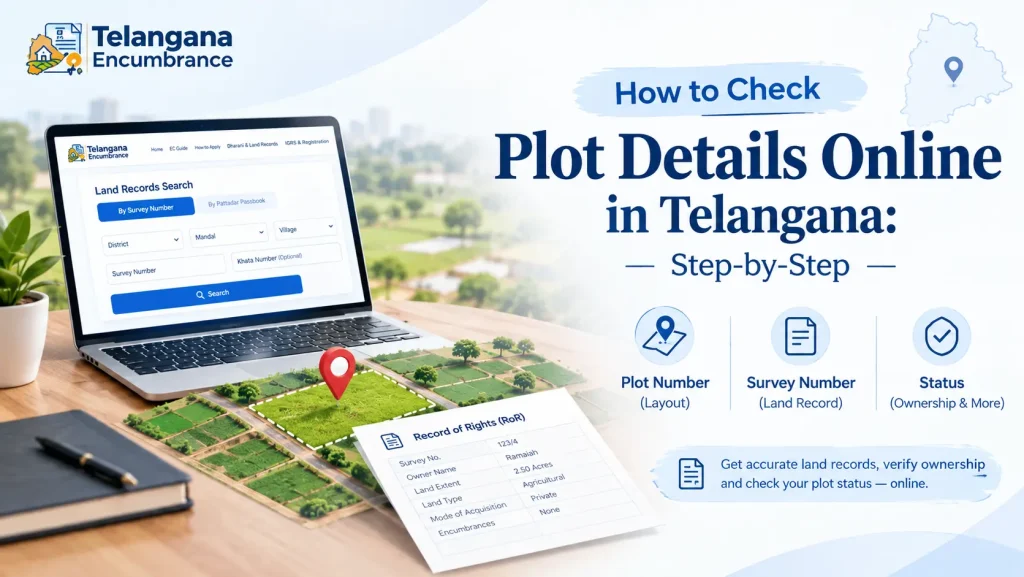
Telangana has been moving its land records from the Dharani portal to the newer Bhu Bharati platform. Dharani was the state’s integrated land records system; Bhu Bharati is its successor.
The workflow below reflects how these portals generally operate always confirm the current process on the official portal, since features and menu names shift as the transition continues.
Step 1: Open the Official Land Records Portal
Go to the Telangana land records website and look for the citizen services section. You’ll typically find options for land record search, encumbrance certificate applications, and related services in one place.
Step 2: Pick Your Search Route
The portal generally offers two ways in:
- By survey number and sub-division number use this when you know the survey number of the parent land.
- By Pattadar Passbook number use this when the seller has shared their passbook details.
Step 3: Enter Location and Land Details
For a survey number search, you’ll usually select district, mandal, and village, then enter the survey number and khata number if you have it.
Here’s the pitfall that catches most people: the survey number on the sale deed and the one on the portal don’t always match because sub-divisions were created, merged, or renumbered over the years.
If your first search returns nothing, don’t assume the land doesn’t exist. Cross-check the number against the seller’s passbook or the village map before you conclude anything.
Step 4: Fetch and Read the Record
Complete any captcha or verification and pull up the details. You should see the survey number and extent, the registered owner’s name, the land classification, whether the land falls under a prohibited category, and any recorded ownership transfers.
Step 5: Cross-Check Against Other Records
The portal gives you ownership. It doesn’t give you the full transaction history. Two more checks matter:
- Encumbrance Certificate (EC) shows registered transactions such as sales, mortgages, and charges over a period you choose. Apply through the Registration and Stamps Department’s MeeSeva service.
- HMDA layout permit if you’re buying inside an approved layout, verify the permit number on HMDA’s development permissions system.
Reading the Result: What Plot Status Actually Tells You
Does the Owner Match the Seller?
If the recorded owner’s name differs from the person selling, stop. Common explanations include an unregistered inheritance, a pending mutation, or a seller who simply isn’t the owner. Ask for the chain of documents connecting the recorded owner to your seller and if that chain doesn’t exist, walk away.
Is the Land Agricultural or Non-Agricultural?
Agricultural land generally needs conversion (NALA) before residential construction is permitted. Buying first and converting later can stall your project for months.
How Was the Land Acquired?
Check the “mode of acquisition” field. If it reads Government Assignment, treat it as a serious warning. Assigned land is generally government land given to landless individuals for cultivation, and it typically cannot be legally sold. This is one of the most common ways buyers in Telangana lose money.
Are There Encumbrances?
Mortgages, bank loans, court attachments, or any other recorded claim will appear here. Each one must be cleared before the title passes cleanly to you.
Is the Property in a Prohibited Category?
Some parcels cannot be registered or sold at all due to government restrictions. The portal usually flags this if it does, there is no transaction to negotiate.
Common Mistakes to Avoid
Searching by plot number alone. Government records are indexed by survey number or passbook number. The plot number only helps you confirm the plot exists in the approved layout plan.
Getting the Sub-Registrar Office wrong. ECs are issued by the SRO with jurisdiction over the land. If your search returns nothing, check the SRO boundaries shifted after the 2016 district reorganisation, and old references are often outdated.
Expecting pre-1983 records online. Online EC data in Telangana generally starts from 1983. For older properties, a physical search at the SRO is usually necessary.
Treating a clean portal record as a clearance certificate. The portal does not show pending court cases, mortgages registered with CERSAI, or disputes that haven’t been formally recorded.
Accepting the developer’s EC copy. Obtain the EC yourself from the official portal or MeeSeva. A document handed to you by the party selling the land proves nothing about the land.
Documents Commonly Required
For an EC application, you’ll typically need the district, Sub-Registrar Office, survey number, and the period you want covered. For land record searches, keep the seller’s Pattadar Passbook number or the survey and khata numbers handy. If you’re verifying a layout plot, the approved layout plan and permit number help.
You may also like to read these posts :👇
భూ భారతి పోర్టల్ తెలంగాణ: లాగిన్, భూమి రికార్డులు, సేవలు
How to Find Survey Number of Land in Telangana
Bhu Bharathi / Dharani Application Status: Track Mutation & Passbook
ధరణి పోర్టల్ తెలంగాణ: భూ భారతిగా మార్పు – పూర్తి వివరాలు
FAQs
Can I check plot details online using just the plot number?
Generally, no. Government records are indexed by survey number or Pattadar Passbook number. The plot number helps you confirm the specific plot exists in the approved layout, but the survey number is what unlocks the record.
What’s the difference between a plot number and a survey number?
A plot number identifies one plot inside an approved layout. A survey number identifies the larger revenue parcel. After a layout is formed, one survey number can contain many plots.
How do I check if a plot is government-assigned land?
Look at the “mode of acquisition” on the RoR or Pahani. If it says Government Assignment, the land was assigned by the government usually to a landless person for cultivation and is generally not freely transferable.
What if the owner’s name on the portal doesn’t match the seller’s?
Don’t proceed until it’s resolved. The seller may need to complete mutation to update revenue records. If they can’t explain the mismatch convincingly, it’s generally safer to walk away.
Can I get an Encumbrance Certificate online in Telangana?
Yes, through MeeSeva. You’ll need the district, SRO, survey number, and the period to be covered. A longer EC period commonly 13 years or more is often recommended, since it captures older transactions.
How far back do online Telangana land records go?
Online EC records generally cover transactions registered after 1983. Anything earlier usually requires a visit to the concerned Sub-Registrar’s Office.
Closing Thoughts
One timing tip worth remembering: start your verification at least two to three weeks before you plan to pay any advance. Mutation corrections, EC applications, and SRO visits rarely happen in a day, and a seller who resists the wait is itself information.
If your search returns nothing or the record contradicts what you were told, don’t try to resolve it yourself take the survey number and the documents to the local Sub-Registrar’s Office and let them confirm what the record actually says.

4 Comments
Pingback: భూ భారతి పోర్టల్ తెలంగాణ | లాగిన్ & సేవలు
Pingback: Bhu Bharathi Login | Registration & Password Reset
Pingback: Land Owner Details Telangana | Quick Online Guide
Pingback: Land Documents Checklist Before Buying Land in Telangana