
Your sale deed is ready, the buyer has paid the token advance, and the Sub-Registrar’s office has given you an appointment. Then the clerk looks up from the computer and says the survey number on your document does not match the government record.
The registration stops there. This is not a rare scenario in Telangana it happens whenever a survey number is typed wrong, a subdivision is missing, or the seller’s documents were never updated after a family partition.
Understanding what a survey number is, how its format works, and how to verify it before you reach the registration counter can save you weeks of running between offices. This guide covers all three, using the current Telangana land records system.
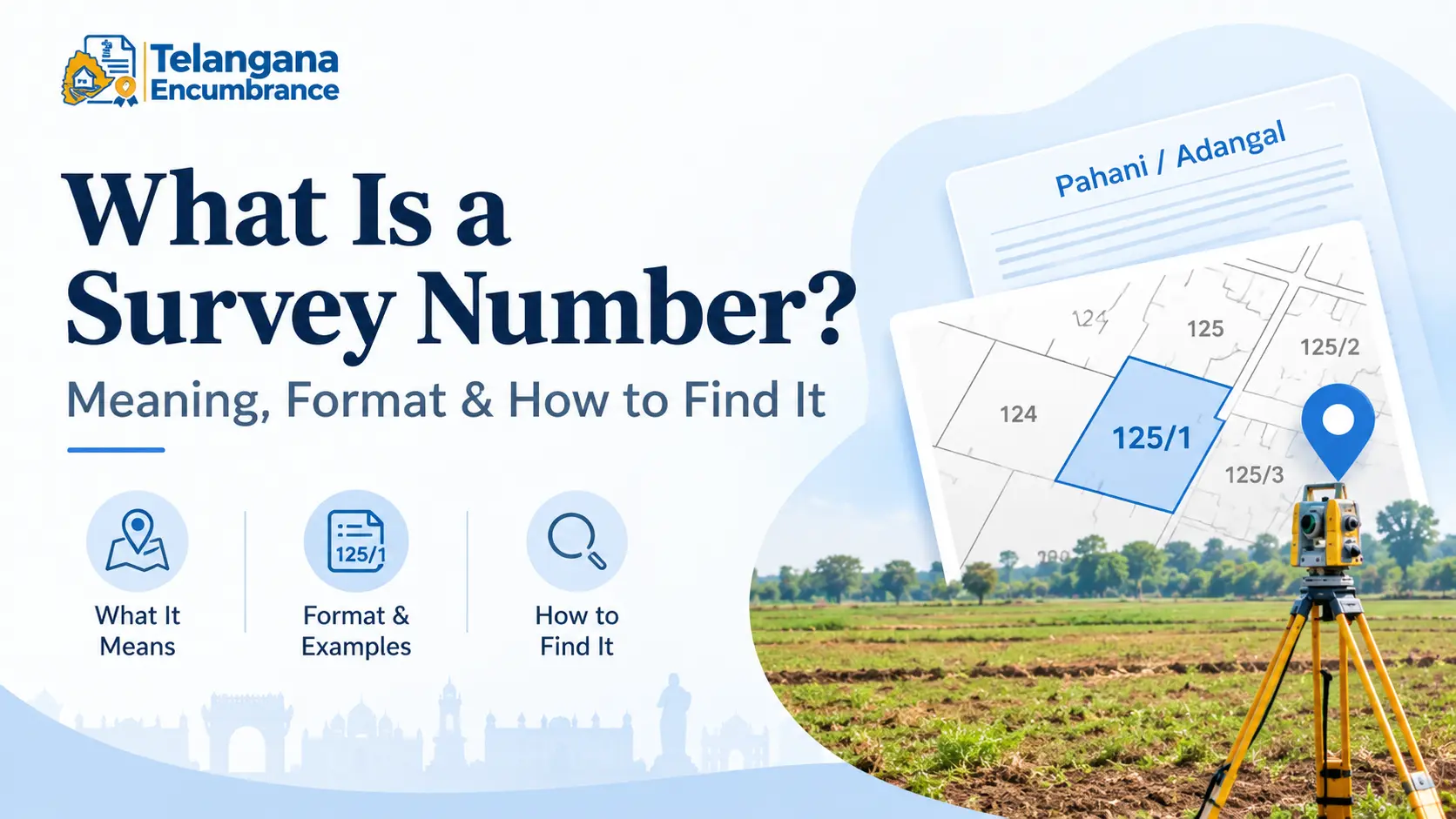
What Is a Survey Number?
A survey number is a unique identifier assigned to a parcel of land during a government survey. When the survey department measures and maps land, every distinct plot receives its own number so that ownership, boundaries, and tax records stay linked to one specific piece of ground.
In Telangana, this number is the thread that runs through every land document. Open a Pahani (the annual Record of Rights), a Pattadar Passbook, or an Encumbrance Certificate, and the survey number is the field connecting them all. Without it, the revenue department has no reliable way to confirm which land you are describing.
Its role breaks down into four practical functions:
- Identification It pinpoints one parcel within a village and mandal.
- Ownership tracking Revenue records tie the number to the current pattadar (landholder).
- Boundary definition Each number corresponds to a plot drawn on the village cadastral map.
- Transaction clearance Before accepting a sale deed, the registration department verifies the number against the land records database.
You may also like to read these posts :👇
How to Check FTL, Buffer Zone & Land Zone in Telangana
Telangana Cadastral Map, Tippon & FMB Sketch: How to Get Copies
Types of Land in Telangana: Patta, Assigned, Inam, Government & Barani
Land Ceiling Act & ULC Clearance in Telangana Explained
Understanding the Format of a Survey Number
A survey number is rarely just a plain figure. Land gets divided through inheritance, partition, and part-sales, and the numbering system expands to reflect that.
Basic Survey Number
An undivided parcel appears as a standalone number for example, Survey No. 125. The entire surveyed plot is identified by that single figure.
Sub-Division Numbers
Once a larger parcel is split, subdivisions are shown with a slash and a number, sometimes followed by a letter:
- Survey No. 125/1
- Survey No. 125/2
- Survey No. 125/2A
The figure after the slash marks a specific portion of the original survey number. The letter indicates a further split of that portion, so 125/2A is a smaller piece carved out of 125/2.
This is where many transactions go wrong. If you buy a portion of land that has not been formally subdivided in the revenue records, you may end up sharing ownership of the entire parent survey number with other parties.
Before paying any advance, confirm that the exact subdivision you are buying down to the letter exists in the official Pahani.
How a Survey Number Differs from Other Property Numbers
Buyers often mix up these identifiers, which leads to wrong searches and rejected documents:
- Survey number Identifies agricultural or revenue land in a village.
- Plot number Identifies a plot within a developed layout; it sits on top of a survey number but does not replace it.
- Town Survey (TS) number Used for urban properties recorded under town survey records rather than village records.
- Pattadar Passbook number Issued to the landowner and linked to the survey number, but not a substitute for it.
How to Find a Survey Number in Telangana
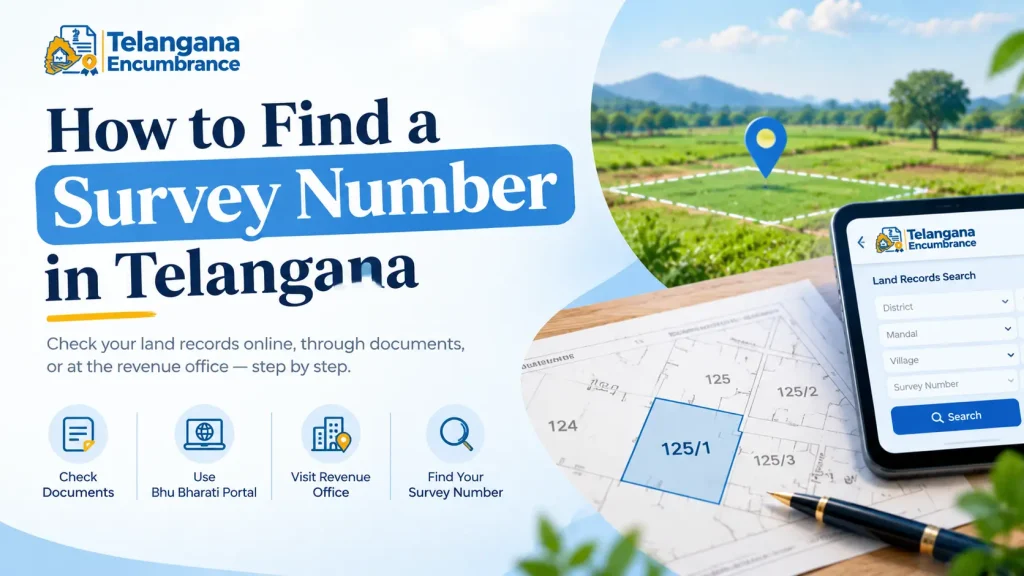
There are three routes: your own documents, the official online portal, and the local revenue office. Start with the first, and move to the others only if the records are missing or unclear.
Method 1: Check Your Property Documents
The survey number is almost always printed somewhere in your existing paperwork:
- Registered sale deed The property description includes the survey number, subdivision, village, mandal, and district.
- Pattadar Passbook Lists the survey number for every parcel the pattadar owns.
- Property tax receipts Municipal or panchayat receipts for non-agricultural land commonly carry the survey number.
- Pahani / Adangal The annual record of rights lists the survey number alongside the owner’s name and land extent.
If you are the buyer, ask the seller for the latest Pahani, not one from a few years ago. Records change with every mutation.
Method 2: Search Online via the Bhu Bharati Portal
Telangana’s land records portal, Bhu Bharati, allows you to pull up land details directly. You can search by survey number, Pattadar Passbook number, or Khata number useful when you know the land but not the exact survey figure.
The process generally works like this:
- Open the Bhu Bharati portal and go to the land records section.
- Select District, Mandal, and Village from the dropdowns. Do not skip this survey numbers are unique only within a village, so the same number exists in dozens of villages across the state.
- Choose your search type Survey Number/Sub-Division Number or Pattadar Passbook Number.
- Enter the number exactly as it appears on the document. If there is a subdivision, pick the correct letter from the adjacent menu (for example, 125/2A, not 125/2).
- Complete the captcha and click fetch.
- Review the displayed record owner’s name, land extent, and nature of land then download or print it.
A pitfall worth knowing: people often select the wrong village because two villages in the same mandal share a similar name, or they enter the parent survey number when they actually need the subdivision.
If the result shows a different owner or a much larger extent than expected, recheck the village and subdivision before assuming the record is wrong.
Method 3: Visit the Village Revenue Office
When the online record is missing, outdated, or shows an error, the local revenue office is the authoritative source. The Village Revenue Officer (VRO) or Mandal Revenue Officer (MRO) maintains the physical records:
- Village map (Tippan) The cadastral map showing survey boundaries.
- Sethwar The settlement record listing survey numbers and original holders.
- Pahani / ROR 1-B The current record of rights.
You can request a certified copy by submitting an application and paying the prescribed fee. Fee amounts vary by district and service type, so confirm the current rate at your local MRO office rather than relying on older information.
Why the Survey Number Matters in Property Transactions
The survey number is not a formality it determines whether your document gets registered at all.
Under Telangana registration rules, a land document cannot be accepted unless the survey number and subdivision are checked against the land records database. If the number is incorrect, fictitious, or simply not found in the records,
the registering officer may return the document for rectification. A wrong digit, a missing subdivision letter, or a spelling variation in the village name is enough to delay or block registration.
The survey number also reveals restrictions that a plain title search may miss. Some parcels are classified as assigned land government land granted to landless poor which generally cannot be sold or transferred.
The Pahani’s “nature of land” column shows this classification. Reading that column before you commit is the difference between a clean purchase and a dispute you inherit along with the land.
Common Mistakes to Avoid When Dealing with Survey Numbers
Most survey number problems trace back to four avoidable errors.
Ignoring the Subdivision
Buying a portion of a survey number without confirming that the subdivision exists in the revenue records is the single most common mistake. If 125/2A is not in the Pahani, you may struggle to get a clear title or a bank loan against the land. Verify the exact subdivision in the official record first.
Relying on Old Records
A Pahani or passbook printout from three years ago will not reflect recent mutations, court stays, or ownership changes. Always work from a record fetched recently from the portal, or a certified copy from the MRO office.
Assuming Survey Numbers Are Universal
Survey No. 125 in one village has no connection to Survey No. 125 in another. Every search and every document must specify the district, mandal, and village along with the number.
Skipping the Land Classification Column
A survey number alone says nothing about whether the land is freehold or restricted. Check the “nature of land” column in the Pahani government land, assigned land, and land under acquisition all appear there—before proceeding with any purchase.
You may also like to read these posts :👇
Telangana Market Value of Land: Dharani, Bhu Bharati, and What Buyers Need to Know
Bhu Bharathi Login: Citizen Registration, Password Reset & Common Errors
Dharani / Bhu Bharathi App: Is There an Official App? Download & Alternatives
ROR-1B & Adangal Telangana: Download 1B Online (Bhu Bharati Update) .
Frequently Asked Questions
Can I find a survey number without any documents?
Yes, if you know the land’s location. Visit the local Village Revenue Office or MRO office, where the village map and physical records can be used to trace the survey number. Online portals generally require you to already know the survey number or Pattadar Passbook number.
What is the difference between a survey number and a subdivision number?
A survey number identifies the original, larger parcel. A subdivision number identifies a specific portion carved out of it, usually after inheritance or a part-sale.
Why does the portal show “No Records Found” for my survey number?
Common causes include selecting the wrong village or district, a data entry error, or records still being synchronized between databases. If repeated attempts fail, check the physical records at the MRO or Tahsildar office.
Is the survey number mentioned in the Encumbrance Certificate?
Yes. An EC typically lists the survey number and subdivision for each transaction affecting the land, which is how it helps you confirm there is no undisclosed mortgage or lien.
What should I do if the survey number on my sale deed is incorrect?
A mismatch between your registered document and the official records may require a rectification application with the Sub-Registrar or revenue authorities. The procedure depends on the type of error, so confirm the steps at your local Sub-Registrar office for your specific case.
Can a survey number change over time?
Yes, during government resurveys or when large parcels are reorganized. Telangana is also moving toward a Land Parcel Map (LPM) system that assigns each parcel a GPS-based unique identifier. Traditional survey numbers continue to exist alongside LPM numbers for legacy records, so both may appear on newer documents.
A Final Note
If you are preparing for a registration, pull the latest Pahani from the Bhu Bharati portal or the MRO office in the same week as your appointment not the month you signed the agreement. Mutations, stays, and corrections can quietly change a record in between.
And if the portal and your documents disagree, treat the physical record at the revenue office as the version to reconcile against, because that is the record the registering officer will ultimately check.
