
Your home loan is sanctioned, the agreement is signed, and then your banker mentions one more document: the MOD. Miss it, delay it, or misunderstand it, and your disbursement can stall for weeks. Worse, an old MOD that was never properly released can block the sale of your property years later.
This article explains the MOD full form, what it actually does to your property rights, how registration works in Telangana, and what to check before you sign or before you buy someone else’s mortgaged flat.
What Is MOD? Full Form and Simple Meaning
MOD stands for Memorandum of Deposit. In home loan paperwork, you will often see the longer version: Memorandum of Deposit of Title Deed (MODT).
The document records a simple fact that you have handed over the original title deeds of your property to the lender as security against the loan.
What it creates is an equitable mortgage. That sounds technical, but the idea is plain: the bank gets a legal claim over your property without ownership being transferred through a registered sale deed.
You remain the owner. The bank simply holds your title documents and a registered charge until the last EMI is paid.
In effect, the MOD announces to the registration records: this property is pledged until the loan is cleared.
MOD Full Form in Bank and Loan Context
On loan statements and sanction letters, MOD full form in bank documentation almost always points to this same Memorandum of Deposit.
Banks are not consistent with terminology HDFC, SBI, LIC Housing and others may print MOD or MODT depending on their internal drafting but the legal effect is identical.
For readers searching mod meaning in hindi, the explanation is the same in any language: a document giving the bank a right over the property until repayment.
Similarly, land mod meaning in tamil queries usually come from Tamil-speaking residents in Telangana who meet the term in cross-state property transactions. The label changes; the security interest does not.
How MOD Works Through the Life of a Home Loan
The MOD protects both sides. For the lender, it is the legal lever to auction the property if you default. For you, it is a written record of exactly what the bank can and cannot do and an obligation on the bank to return your documents once the loan closes.
The sequence typically runs like this:
- Sanction and agreement the lender drafts the MOD after your loan is approved.
- Deposit of title deeds you surrender the original property documents to the bank.
- Execution and registration both parties sign, and the MOD is registered at the local sub-registrar office.
- Repayment you pay EMIs until the loan is fully cleared.
- Release the MOD is cancelled and your title deeds come back to you.
The MOD cannot be cancelled before full repayment. That single fact is why anyone buying a resale flat in Hyderabad should treat an unreleased MOD as a red flag, not a formality.
You may also like to read these posts : 👇
CERSAI Registration – Full Form, Meaning & Charges Explained
Encumbrance Certificate AP: Why It Matters and How to Get Yours Online
Release Deed vs Relinquishment Deed Meaning, Stamp Duty & Registration
MOD Registration in Telangana: Step by Step
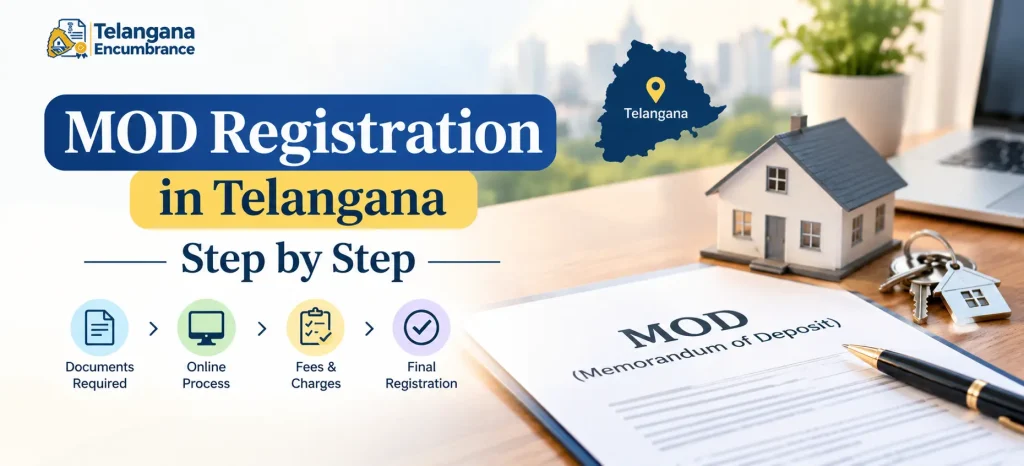
Registration rules differ by land type. For apartments and house plots (non-agricultural property), the process runs through the local Sub-Registrar Office (SRO). For agricultural land, it may route through the Dharani portal, Telangana’s integrated land records system,
which includes a mortgage registration service (TM8) for agricultural parcels. Dharani has seen litigation and procedural changes in recent years, so confirm the current route with your Tahsildar office before starting.
The SRO Process for Non-Agricultural Property
- The lender drafts the MOD with loan details, the property schedule, and borrower/lender particulars.
- Pay stamp duty commonly through Telangana’s e-Stamping system. The amount depends on your loan value; check the official registration portal for current rates rather than relying on old figures.
- Confirm the correct SRO this is where most people stumble. A single locality in Hyderabad or Rangareddy can fall under different sub-registrar jurisdictions depending on the village and survey number. Registering at the wrong office means starting over.
- Attend in person with witnesses biometric authentication is required. Carry the stamped MOD, KYC documents, the loan sanction letter, and the property papers.
- Pay registration fees by demand draft, online payment, or cash where the office accepts it. Collect the acknowledgment receipt.
- Collect the registered MOD the original typically stays with the lender until loan closure.
Budget a full working day for steps 4 and 5. SRO queues in growing suburbs can be long, and a single missing signature on the witness page sends you home to reschedule.
Is MOD Registration Online Possible?
Partly. E-stamping and challan generation happen online. The registration itself does not biometric authentication at the SRO is still mandatory for most property types in Telangana. Anyone promising a fully online MOD registration is overselling.
Documents Commonly Required
Requirements vary by lender and property type, but the standard set includes:
- Original title deed of the property
- Loan sanction letter
- MOD document on stamp paper or with e-stamping
- PAN and Aadhaar of all borrowers
- Passport-size photographs
- Current-year property tax receipt
- Previous sale deed or chain of ownership documents
- NOC from the housing society or builder, where applicable
- Identification for witnesses
Confirm the exact list with your lender and the SRO before your appointment. A missing property tax receipt is a surprisingly common cause of rescheduling.
MOD Charges: What You Actually Pay
MOD charges in home loan transactions are separate from the processing fee and are normally borne by the borrower.
Lenders typically calculate them as a small percentage of the sanctioned amount, and some apply a maximum cap.
Because rates and caps are revised from time to time, check your lender’s current schedule rather than budgeting from older figures you find online.
Two things worth knowing. First, the MOD charge covers creating and registering the memorandum it is not the stamp duty on your sale deed, which is a far larger, separate cost.
Second, some lenders fold the MOD charge into a bundled fee while others bill it separately. Ask for a line-item breakdown before signing, so a surprise deduction at disbursement does not derail your plan.
Common Mistakes That Cost Buyers and Borrowers
Buying a Resale Property Without Checking the EC
Pull a fresh Encumbrance Certificate before finalising any resale purchase. If a MOD entry still appears, the seller’s previous loan was never properly released in the records. Insist on a loan closure letter, NOC, and a registered release deed before you pay.
Assuming the MOD Cancels Itself After the Last EMI
It does not. You must request an NOC and follow up until the mortgage is formally released from the registration records. Until that entry disappears from the EC, your property looks encumbered to every future buyer and lender.
Skipping the SRO Jurisdiction Check
Filing at the wrong sub-registrar office is one of the most common and avoidable delays in Telangana registrations. Verify jurisdiction through the official registration department portal or ask your lender’s legal team, which handles these filings daily.
You may also like to read these posts : 👇
Partition Deed – Meaning, Format, Documents & Registration Process
How to Verify Original Property Documents & Spot Fake Property Papers
Mortgage Deed & Equitable Mortgage Registration Stamp Duty Explained
Frequently Asked Questions
What is the MOD full form in property transactions?
MOD stands for Memorandum of Deposit, also written as MODT (Memorandum of Deposit of Title Deed). It records the deposit of your original title deeds with a lender as loan security.
What does MOD registration meaning refer to?
It means formally recording the Memorandum of Deposit at the Sub-Registrar Office, creating a public record of the lender’s charge so future buyers and lenders can see it.
Is MOD full form in home loan the same as MODT?
Yes. MOD and MODT describe the same document. Banks simply differ in which abbreviation they print. The legal effect is identical.
Can I sell my property while a MOD is active?
It is difficult. The buyer’s lender will normally require the existing loan to be closed and the MOD released first. Some transactions use a tripartite arrangement where the buyer’s payment goes directly to the seller’s bank, but this needs both lenders coordinating closely.
How do I cancel the MOD after repaying my home loan?
Request an NOC from your lender after full repayment, then complete the release deed formalities as directed. Finally, pull a fresh EC to confirm the MOD entry has been removed do not assume it happened.
Why do searches for mod full form in tamil and mod meaning in hindi appear alongside Telangana queries?
Because property transactions cross language lines. A Tamil-speaking buyer purchasing land in Telangana, or a Hindi-speaking borrower reading a bank document, encounters the same English term. The meaning does not change with the language of the reader.
A Final Word on Timing
If you are close to closing a home loan, start the release paperwork the same month you make your final payment not after.
Lenders process NOCs faster when the file is fresh, and the registration department’s records update more reliably when the request is recent.
The borrowers who run into trouble are usually the ones who paid off the loan three years ago and only discovered the unreleased MOD when a buyer’s lawyer flagged it.

6 Comments
Pingback: CERSAI Registration | Full Form & Charges Guide
Pingback: Release Deed vs Relinquishment Deed | Key Differences
Pingback: How to Verify Original Property Documents | Easy Guide
Pingback: Mortgage Deed & Equitable Mortgage Registration | Guide
Pingback: Telangana EC Search by Document Number | Easy Guide
Pingback: Telangana EC Search Online Free | Quick Guide