

You have found a property that fits your budget and requirements. The location is excellent, the price is right, and the seller seems genuine.
But before you sign any agreement or hand over a single rupee, there is one document you absolutely must obtain: an Encumbrance Certificate AP.
Banks reject loan applications without it. Property deals fall apart when it reveals hidden mortgages.
And yet, many buyers only discover they need this certificate when it is almost too late.
This guide walks you through everything about the ec ap process in Andhra Pradesh—what the certificate actually shows, how to get it online through
the official IGRS portal, which details you need to have ready, and the common mistakes that cause applications to fail.
By the end, you will know exactly what to do and what pitfalls to watch for.
What Does an Encumbrance Certificate Actually Show?
An encumbrance certificate Andhra Pradesh is a transaction history of a property, issued by the Registration and Stamps Department.
Every time a property is sold, mortgaged, gifted, or leased through a registered document, that transaction gets recorded.
The certificate pulls together all such events for a specific time period.
If the property is free of financial or legal claims, the encumbrance certificate ap will reflect that clearly.
If there are multiple sales, loans, or court orders attached, the certificate will list them in chronological order.
This is why the document is non-negotiable for due diligence.
Form 15 and Form 16 Explained
When you apply for an ec andhra pradesh, the system generates one of two forms based on the search results:
- Form 15: Issued when the property has registered transactions during the chosen period. This includes sale deeds, mortgage deeds, gift deeds, lease agreements, or release deeds.
- Form 16: Issued when there are no registered transactions during that period. This is also called a “Nil Encumbrance Certificate. ” It confirms that no financial or legal activity involving the property was registered with the sub-registrar’s office within those dates.
Both forms serve different purposes. A Form 16 is useful for loan applications where the property has not been transacted recently,
but it does not guarantee that the property is free from disputes outside the registered records.
You may also like to read these posts : 👇
Encumbrance Certificate Telangana – Complete Guide
Encumbrance Certificate Karnataka: Your Complete Guide to EC Online Karnataka
Encumbrance Certificate – Meaning in Regional Languages
Why You Cannot Skip the EC AP in Any Property Deal
The ec certificate ap is a mandatory document in virtually every property transaction. Here is why it matters for different stakeholders:
- For property buyers: The certificate is your primary tool to verify that the seller holds clear title. If the property was mortgaged to a bank and the loan was never repaid, that mortgage will appear in the EC. If there are multiple sale deeds in a short span, it could indicate black money transactions or disputed ownership.
- For home loan applicants: Banks and housing finance companies refuse to process loans without a recent ec land ap. The certificate assures the lender that the property is not already pledged as collateral to another institution.
- For sellers: Having a clean EC ready before listing the property speeds up the sale process. Buyers and their legal advisors will ask for it upfront. Being prepared builds trust and avoids last-minute delays.
A critical detail to remember: the online ap land ec system in Andhra Pradesh generally contains records from the year 1983 onwards.
For properties registered before that year, the records may not be digitised. In such cases, a physical search at the concerned Sub-Registrar Office becomes necessary.
How to Get Encumbrance Certificate AP Online: A Step-by-Step Guide
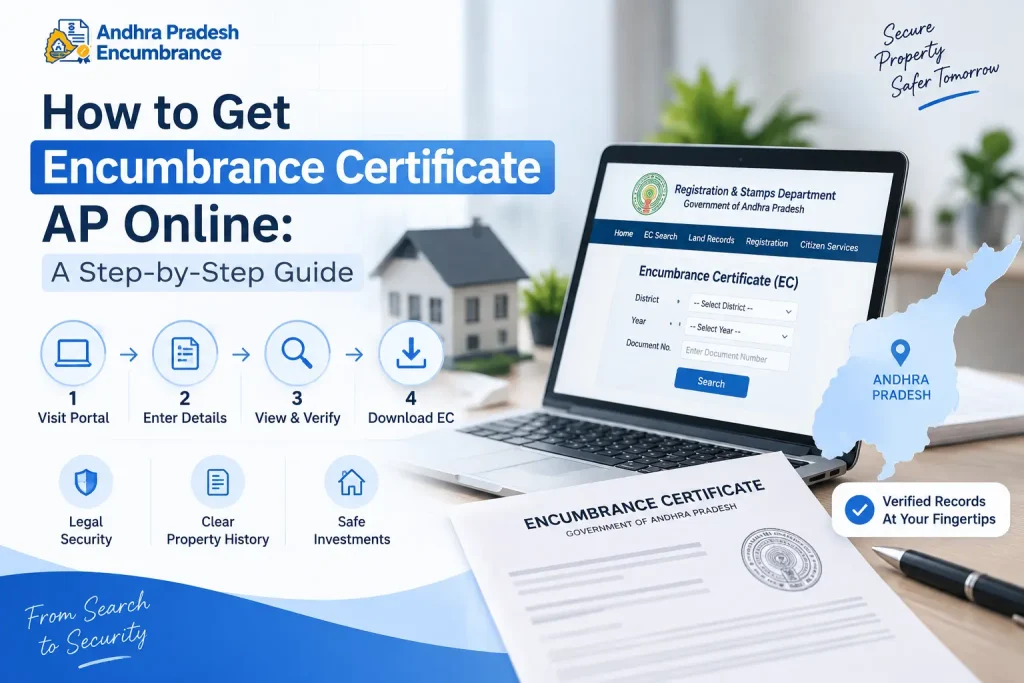
The Andhra Pradesh government provides a web portal for citizens to access registration records. Follow these steps carefully to obtain your ec andhra pradesh online.
Step 1: Open the Correct Portal
Go to registration.ap.gov.in. This is the official website of the Registration and Stamps Department of Andhra Pradesh. Be careful—this is not the Dharani portal (which is for Telangana) or
the Meebhoomi portal (which handles land revenue records). Using the wrong website is a common and avoidable mistake.
Step 2: Locate the Encumbrance Certificate Service
On the homepage, look for an option labelled “Encumbrance Certificate,” “EC & CC Services,” or something similar.
It is usually placed under the “Citizen Services” section. You will see two types of certificates available:
- EC for Information Only: A view-only copy that you can generate instantly for your reference.
- Signed EC: A digitally signed version. To download this, you will typically need to create a login ID or use an existing account.
If you need the certificate for a bank or court, always choose the “Signed EC” option.
Step 3: Select Your Search Method
You have two main ways to find the property records:
- By Document Number: This is the most accurate method. You will need the registered document number and the year of registration. This information is printed on the sale deed or the registered mortgage document.
- By Survey Number: If you do not have the document number, you can search using the property’s survey number. This is a common backup method, but it may return multiple results if the survey number covers a large area.
Step 4: Enter District, SRO, and Time Period
This step is where most applicants trip up. You must provide:
- District: Select the district where the property is registered. Note that Andhra Pradesh underwent district reorganisation in 2022. If your property is in a district that was recently renamed or split, choose the new district name that corresponds to your town or village.
- Sub-Registrar Office (SRO): This is critical. The system indexes records by the specific SRO where the original deed was registered. If you select the wrong SRO, the portal will show “no records found” even when records exist. Always verify the SRO name from the sale deed itself.
- Search Period: Select the “From” and “To” dates. For property purchase due diligence, legal advisors generally recommend searching for at least 13 years, ideally up to 30 years. This longer timeframe helps establish an unbroken chain of ownership.
Step 5: Submit, Verify, and Download
Enter the CAPTCHA, click “Submit,” and wait for the results. If the system finds registered transactions, it will display the encumbrance certificate AP (Form 15) on your screen.
Download the PDF and save a copy for your records. If you applied for the signed version, the download will include a digital signature that makes it legally valid.
One last reminder: the IGRS portal only shows registered transactions. For land ownership details like the Record of Rights (RoR 1-B) or Adangal (cultivation records),
you must visit the Meebhoomi portal. Do not confuse these two separate systems.
Information and Documents You Will Need
Before you start the online application, gather these details. Having them ready will save you from repeated attempts.
- Property identifiers: Survey number or plot number. If you are searching a flat or apartment, you may need the door number as well.
- Registration details: Document number and the year of registration, if you have access to the sale deed.
- Location details: Correct district name and the exact Sub-Registrar Office name.
- Applicant identity: Aadhaar number or PAN card. For offline applications, you may also need a copy of the title deed and a power of attorney if you are applying on someone else’s behalf.
If you are making an offline application at the SRO, carry photocopies of the sale deed and your identity proof. The SRO staff may ask for these to verify your request.
Fee Structure for EC AP
The fee varies based on how far back you need the search to go. Based on currently available guidelines:
- Service charge: Approximately ₹25.
- Search up to 30 years: Approximately ₹200.
- Search beyond 30 years: Approximately ₹500.
These figures are subject to change. Always check the official IGRS AP portal for the current fee structure before making any payment.
Frequent Pitfalls That Derail EC Applications
Even a simple online process can go wrong. Here are the most common errors and how to avoid them.
Using the Wrong Portal
This happens more often than you would think. Citizens looking for AP records accidentally land on the Dharani portal meant for Telangana,
or they end up on Meebhoomi and wonder why registration records are missing. Bookmark registration.ap.gov.in to stay on the right page.
Selecting the Incorrect Sub-Registrar Office
The system is unforgiving here. If you choose an SRO that does not hold the property’s registration records, your search will come back empty.
Always cross-check the SRO name on your sale deed. If you do not have the deed, ask the seller or your lawyer to confirm.
Assuming Form 16 Means a Completely Clear Property
A Nil Encumbrance Certificate (Form 16) only confirms that no registered transactions took place during the chosen period. It does not rule out:
- Unregistered agreements or power of attorney transactions.
- Pending property tax dues.
- Possession disputes that were never registered.
- Oral family settlements that never made it to a deed.
Use the EC as one piece of the due diligence puzzle, not the complete picture.
Searching Too Short a Period
Some applicants search only for 3 to 5 years to save on fees. This is a risky shortcut. If the property was mortgaged 12 years ago and
the loan was never repaid, that mortgage will still be active. A 5-year search would miss it entirely. Always go back at least 13 years, and prefer 30 years when possible.
You may also like to read these posts : 👇
Encumbrance Certificate Tamil Nadu: Your Complete Guide to TN EC Online
Encumbrance Certificate in Bangalore: Your Step-by-Step Guide to a Safe Property Deal
Encumbrance Certificate Kerala: How to Apply Online, Check Status & Download EC
Frequently Asked Questions About Encumbrance Certificate AP
1. What is the difference between IGRS AP and Meebhoomi?
IGRS AP is operated by the Registration Department and contains records of registered property transactions like sale deeds and mortgages.
Meebhoomi is run by the Revenue Department and contains land ownership details such as
the Record of Rights (RoR 1-B) and cultivation records (Adangal). Both are important but serve different purposes.
2. Can I get an encumbrance certificate AP online for agricultural land?
The online EC system is primarily designed for non-agricultural properties. Agricultural land transactions may appear in the EC in some cases,
but for a comprehensive view, you should also check the Meebhoomi portal for RoR and Adangal records.
3. What should I do if online records are not found?
If the portal shows no records, double-check that you selected the correct district and SRO.
If everything is correct and records still do not appear, the property may have been registered before 1983, when digitisation began.
In that case, visit the concerned Sub-Registrar Office in person and request a manual search of the old registers.
4. How long does it take to get an encumbrance certificate AP?
The “EC for Information Only” version is available instantly. The digitally signed “Signed EC” takes a couple of working days to process.
If you apply offline at the SRO, expect 2 to 3 working days, depending on the office’s workload.
5. Is the signed EC from the portal legally valid?
Yes. The digitally signed Encumbrance Certificate downloaded from the IGRS AP portal is legally admissible and accepted by banks, courts, and government departments.
6. What if the Encumbrance Certificate shows a mortgage but no release deed?
That usually means the property is still under lien. Even if the borrower claims the loan was repaid, the release deed must be registered to clear the title.
Contact the bank that issued the loan to confirm the closure status, and ensure the release deed is registered before proceeding with any property transaction.
Timing Your EC Application Right
Plan your EC application early in the property purchase process, not at the last minute.
If you are applying for a home loan, the bank will typically accept an EC that is no more than three to six months old.
Getting the certificate too early may mean you have to apply again closer to the final registration date.
Conversely, waiting until the final week can cause delays if the online system is down or if the signed certificate takes longer than expected.
Apply at the right time—after your initial due diligence but with enough buffer for contingencies.
A clean EC obtained well in advance gives you confidence and leverage in negotiations,
while a missing or problematic EC gives you the opportunity to walk away before you are financially committed.

7 Comments
Pingback: Encumbrance Certificate Telangana | Complete Online Guide
Pingback: Encumbrance Certificate Karnataka | Easy EC Online Guide
Pingback: Encumbrance Certificate - Meaning in Regional Languages | Easy Guide
Pingback: Encumbrance Certificate Tamil Nadu | TN EC Online Guide
Pingback: Encumbrance Certificate in Bangalore | Easy Online Guide
Pingback: Encumbrance Certificate Kerala: Complete Online Guide | Apply, Check & Download
Pingback: MOD Full Form & Meaning | Property Loan Guide