
Your home loan application just came back with a query: “Submit a fresh EC for the property.” Or you are three days away from registering a plot in Shamshabad and the seller’s EC shows a mortgage that nobody mentioned. Either way, you need to know how to pull the encumbrance certificate yourself, without paying a middleman.
This guide walks through the ec search telangana online free process on the official IGRS portal, explains what Form 15 and Form 16 actually mean, and flags the mistakes that catch buyers even after they have the PDF in hand.
What Exactly Is an Encumbrance Certificate?
An Encumbrance Certificate is a record of every registered transaction attached to a property over a chosen period. “Encumbrance” simply means a legal or financial liability tied to the land a mortgage, a sale, a gift deed, a lease, or a court attachment.
When you request an EC, the Sub-Registrar Office (SRO) searches its registers and lists every transaction involving that property within the dates you selected.
If transactions exist, you get Form 15, which lists them one by one. If nothing is registered for that period, you get Form 16 commonly called a “nil encumbrance certificate.”
A nil EC is reassuring, but it is not a guarantee of clean title. It only means no registered transactions appeared in the window you searched.
Why the EC Matters More Than Most Buyers Realise
Banks and housing finance companies typically will not sanction a loan without an EC, because they need to confirm no other lender already holds a charge on the property.
But the EC matters just as much if you are paying cash. It reveals whether the seller actually has the legal right to sell, whether an old mortgage was properly discharged, and whether a family partition was ever registered or only discussed.
A property with a clean EC can still have problems the certificate does not capture. Unregistered agreements, oral family arrangements, and pending court cases never appear in the encumbrance register.
That is why the EC is best read alongside the Pahani (land revenue record) and the chain of sale deeds, not on its own.
You may also like to read these posts : 👇
TS EC Download: How to Download Encumbrance Certificate Telangana
Encumbrance Meaning in Regional Languages (Hindi/Tamil/Telugu/Marathi)
Encumbrance Meaning – Simple Explanation & Types
What is an Encumbrance Certificate? Full Explanation
Where to Check Telangana EC Online: IGRS vs Bhu Bharati
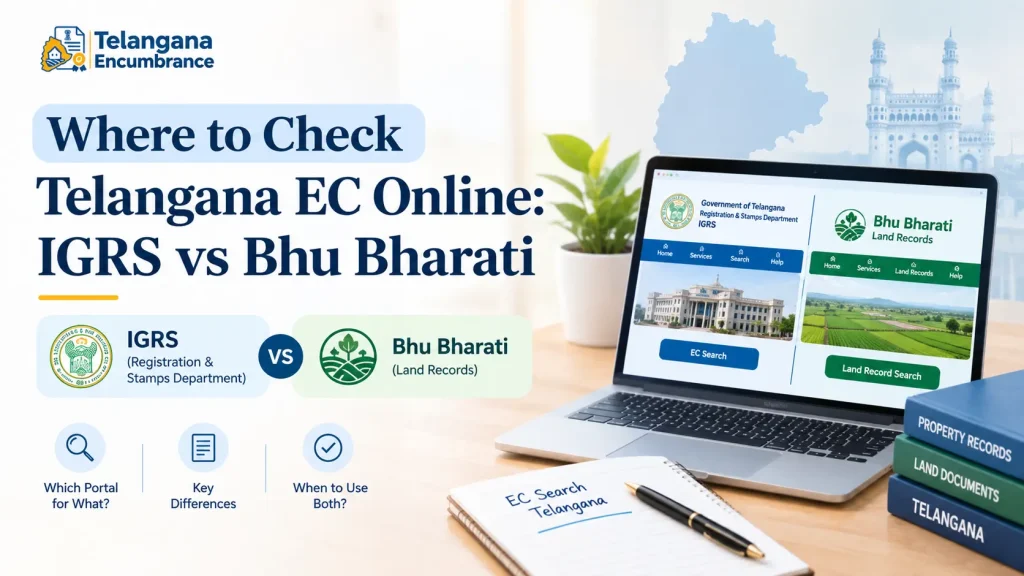
The most common confusion among Telangana property buyers is which portal to use. The short answer: the IGRS Telangana portal (registration.telangana.gov.in) is the primary place for encumbrance search on registered properties.
The Bhu Bharati portal which replaced the older Dharani portal for agricultural land records handles Pahani and agricultural land details, but the EC search itself is generally done through the registration department’s system.
For urban or non-agricultural property, start with IGRS. For agricultural land, you may still need Bhu Bharati for the land record context, while the registered transaction history for the EC comes from the registration system.
If the parcel sits in a semi-urban area that started as agricultural land and was later converted, checking both is a sensible precaution.
Step-by-Step: How to Do a Telangana EC Search Online
The exact layout of the portal shifts from time to time, but the flow stays consistent. Here is how it works in practice.
Step 1: Gather Your Property Identifiers First
Before you touch the portal, collect the correct details. For a plotted property, that means the survey number and sub-division number. For an apartment or house, you may need the document number from the original sale deed.
You also need to know which Sub-Registrar Office has jurisdiction this is usually the SRO named in the original registration document, not the one closest to where you live now.
If you do not know the SRO, the IGRS portal typically has a “Know Your SRO” tool where you enter the district, mandal, and village to find the right office.
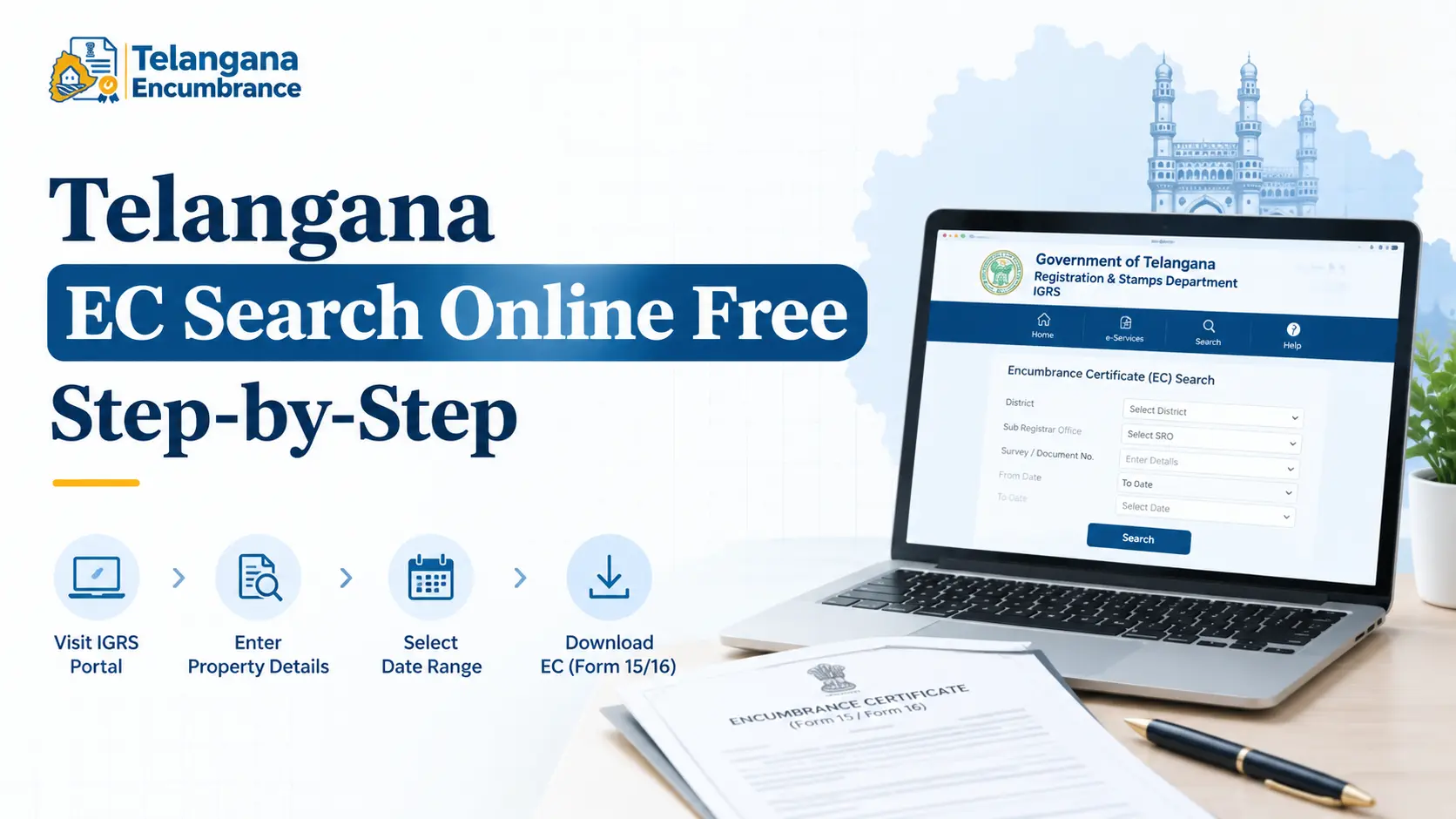
Step 2: Visit the IGRS Telangana Portal
Go to registration.telangana.gov.in and look for “Encumbrance Search” or “EC Search,” usually listed under Online Services or Citizen Services.
Step 3: Select District and Sub-Registrar Office
Choose the district where the property is located, then pick the correct SRO from the dropdown. If you are unsure, check the original sale deed the SRO name and registration number are printed there.
Step 4: Enter Property Details
You can typically search by document number, survey number, or house/plot number. For land, entering the survey number and sub-division number is the most precise route. Watch the digits closely.
A transposed number can return a different parcel’s EC or no results at all without flagging an error. This is the single most common reason people conclude, wrongly, that a property has no encumbrances.
Step 5: Set the Search Period
This is where many buyers make their biggest mistake. You can request an EC for any number of years, but a short window say two or five years can miss an old mortgage that is still legally active.
For a property purchase, a minimum of 13 years is standard practice because it covers one full limitation cycle. Many lawyers and lenders now recommend pulling 30 years for older properties or ancestral land.
Step 6: Submit and View the Results
Enter the captcha and click Fetch or Submit. The portal returns either a list of registered transactions (Form 15) or a nil result (Form 16). You can usually download the result as a PDF directly from the screen.
Step 7: Apply for a Certified Copy If Needed
The online search result is useful for your own due diligence. If you need a formally certified EC for a bank, registration, or legal purpose, you may need to apply for a certified copy through the portal or at the SRO,
depending on the specific requirement. A plain downloaded PDF is often accepted for preliminary checks, but not always for loan sanction.
Details You Need Ready Before You Start
To avoid multiple attempts, keep these accessible:
- Survey number or plot number precise, including any sub-division
- District, mandal, and village for locating the correct SRO
- Document number and year from the original sale deed, if available
- The SRO name printed on the registration document
- Search period start year and end year you want covered
- A valid mobile number or email for login or OTP, if the portal requires it
For an agricultural parcel, having the Pattadar Passbook number or Khata number helps cross-verify land details on Bhu Bharati.
Form 15 vs Form 16: What Your EC Result Means
The search ends in one of two outcomes, and the difference matters.
Form 15 lists every registered transaction found within your chosen period. Each entry shows the document number, the year, the nature of the transaction (sale, mortgage, gift, release), and the parties involved. If you see a mortgage entry, a lender has a registered charge on the land.
The seller may insist it was repaid years ago, but unless a Release Deed was registered and appears in the EC, the charge remains on record.
Form 16 means no registered transactions were found for the period you searched. It is a positive sign, but not absolute proof of clean title.
If the property is old and changed hands through inheritance or unregistered family arrangements, a nil EC may simply mean nothing was ever formally registered not that nothing ever happened.
Common Mistakes That Catch Buyers Out
Searching too short a period. A one-year or five-year EC will not show a mortgage from twelve years ago, even if it is still legally enforceable. Pull at least 13 years, and 30 for older properties.
Treating a nil EC as a clean title. Form 16 only confirms no registered transactions in the searched window. Unregistered agreements, oral partitions, and pending litigation never appear on an EC. Cross-check with the Pahani and, where relevant, court records.
Searching the wrong parcel. A small typo in the survey number can pull a different plot’s EC entirely. Always match the property description on the EC against the sale deed schedule.
Ignoring the Pahani liabilities column. Some mortgages are recorded at the Mandal Revenue Office level in the Pahani, even when never registered as a deed at the SRO. A clean EC with a non-clean Pahani means the property may still carry a charge.
Relying on an old EC. An EC from six months ago will not show a mortgage registered last month. Pull a fresh one as close to the transaction date as possible.
You may also like to read these posts : 👇
CERSAI Registration – Full Form, Meaning & Charges Explained
MOD (Memorandum of Deposit) Full Form & Meaning in Property Loans
Release Deed vs Relinquishment Deed Meaning, Stamp Duty & Registration
Partition Deed – Meaning, Format, Documents & Registration Process
Frequently Asked Questions
Is the Telangana EC search online actually free?
The basic search and viewing of results on the IGRS portal is generally available without a substantial upfront charge. If you need a certified copy for official purposes, or a printed certificate through a MeeSeva centre, service charges apply. Check the official portal for current rates, as fees are subject to revision.
Can I check EC for agricultural land on Bhu Bharati?
Bhu Bharati handles agricultural land records, including Pahani and ownership details. However, the registered transaction history an EC reflects is generally pulled from the registration system. For agricultural parcels, checking both the Bhu Bharati land record and the IGRS EC gives a more complete picture.
What period should I choose for the EC search?
For a property purchase, 30 years is the safest choice, especially for older or ancestral land. A minimum of 13 years is often accepted by lenders and lawyers, but a shorter window can hide old mortgages that are still legally alive.
Does a nil EC mean the property has no disputes?
No. A nil EC means no registered transactions were found in the period you searched. Unregistered loans, oral agreements, family disputes, and pending court cases do not appear on an EC. Always verify the Pahani and, if the stakes are high, check for litigation separately.
What if the online EC shows no results for a property I know has transactions?
This usually means the wrong SRO was selected, the survey or document number was entered incorrectly, or the records for that period are not digitised. Online EC records in Telangana generally go back to 1983. For transactions before that, a physical search at the SRO is required.
Can NRIs check Telangana EC online?
Yes. NRIs can access the IGRS portal and perform an EC search the same way domestic users do, provided they have the correct property details and SRO information. Having a local representative or family member with the original documents helps if the portal requires verification steps.
A Final Word Before You Rely on That PDF
An EC is a starting point, not a final answer. It tells you what has been formally registered, which is valuable. It does not tell you what was agreed over a cup of tea, what is sitting in a court file, or what the Pahani might reveal. Pull the EC yourself, pull it for a long enough period, and read it alongside the land revenue record and the chain of sale deeds.
One practical tip: download a fresh EC within a week of registration, not a month before. Property charges can be registered right up to the day of sale, and a certificate that felt clean in January can look very different by March. For anything involving significant money, a local lawyer who knows the SRO and the village records is worth the fee.
