

Your mother’s name is on the pahani along with your three uncles. You want to sell your share, but the buyer’s lawyer says the title is unclear because no document ever separated your mother’s portion from the rest. This is the situation a partition deed resolves.
Whether you are dividing ancestral agricultural land in Nalgonda, a family house in Hyderabad, or jointly purchased plots in Warangal, a registered partition deed converts an undivided family share into a clear, individually owned piece of property.
This guide covers the partition deed format, what the document must contain, the documents typically required in Telangana, and how registration works through IGRS and Bhu Bharati.
What is a Partition Deed?
A partition deed meaning is simple: it records how co-owners divide jointly held property into separate, individually owned portions. Each person gives up their undivided share in the whole and receives exclusive ownership of a specific portion. The deed is the proof that joint ownership has ended and each party now holds title to their allotted share.
Partition differs from a sale or a gift. In a sale, ownership transfers to a stranger for consideration. In a gift, it transfers without payment. In a partition, the same people who already had a stake are converting joint rights into defined, separate rights. No new owner enters the picture.
That distinction has a direct financial consequence. In Telangana, partition among family members typically attracts concessional stamp duty compared to a regular sale deed, because the property is not being sold outside the family it is being divided among people who already hold a legal claim to it.
Why Registration of a Partition Deed is Essential
Partition deed registration is not optional paperwork. Under the Registration Act, 1908, any non-testamentary instrument that creates, declares, assigns,
or extinguishes rights in immovable property above a threshold value must be registered. A partition deed does exactly this it extinguishes the joint right and creates exclusive rights.
An unregistered partition deed generally cannot be used as evidence to prove the severance of joint status or the specific shares allotted.
Courts have held that when parties reduce an oral partition into a formal written document intended to serve as evidence of that partition,
the document requires compulsory registration. Without it, the deed may be inadmissible for proving the partition itself.
The practical consequence hits sooner than most people expect. Revenue authorities in Telangana, through the Bhu Bharati portal (which replaced Dharani),
require a registered document to update land records and issue a pattadar passbook in individual names. Without a registered partition deed, the mutation usually cannot proceed and neither can a clean sale.
The Validity of a Registered Partition Deed
The validity of registered partition deed rests on three pillars. First, the deed must be properly stamped. In Telangana, partition among family members generally attracts stamp duty of 0.5% on
the value of the separated share, subject to a cap, plus a registration fee. Under-stamped documents face objections at the registration stage.
Second, every co-owner must be a party and must sign. A partition imposed on an unwilling co-owner is not valid without a court decree.
Third, the division must be by metes and bounds each share must be physically identifiable, with survey numbers, boundaries, or measurements described clearly.
A document that states only percentages, without identifying which specific portion goes to whom, may not qualify as a completed partition.
Once registered, the deed becomes a public record. Anyone searching the encumbrance certificate or the registered document database can see the division.That public notice is what makes the deed enforceable against future purchasers or creditors.
Key Elements of a Partition Deed Format
A workable partition deed format contains the following sections. The exact language can vary, but these components are what the Sub-Registrar Office expects to see.
Title and Date: The deed is titled “Partition Deed” and dated on the day of execution. It should identify the Sub-Registrar Office under whose jurisdiction the property falls.
Parties and Description: All co-owners are listed with names, ages, addresses, and their relationship to each other. Their current undivided share in the joint property is stated.
Property Schedule: The most critical section. The joint property is described in full survey number, village, mandal, district, extent, and boundaries.
Then the specific portion allotted to each party is described separately, again with survey numbers and measurements.
Recitals: A brief background explaining how the property came to be jointly owned through inheritance, joint purchase, or otherwise. This establishes the legitimacy of the co-ownership being divided.
Allotment Clause: Clear language stating that each party is allotted the specific share described, and that the others relinquish their rights over that portion. Joint status is declared severed from the date of the deed.
Possession Clause: A statement that possession of the respective shares has been handed over to each party.
Signatures and Witnesses: All parties sign, and at least two witnesses attest. Witnesses cannot be parties to the deed.
Documents Required for Partition Deed Registration
Gathering the documents required for partition deed before visiting the Sub-Registrar Office prevents the delays that come from return visits. The following are typically needed in Telangana.
Title deed of the joint property: The original registered document proving how the co-owners acquired the property a previous sale deed, gift deed, or inheritance document.
Encumbrance Certificate (EC): Shows whether the property has registered mortgages, liens, or claims. An EC covering the relevant period confirms there are no undisclosed encumbrances that would complicate the partition.
Identity and address proof of all parties: Aadhaar card, PAN card, voter ID, or passport. PAN is generally required for transactions above certain value thresholds.
Pattadar passbook and pahani: For agricultural land, the current pattadar passbook and pahani (record of rights) showing joint names or the names of legal heirs.
Draft partition deed: The prepared document on stamp paper of the required value, ideally reviewed by a local advocate familiar with Telangana registration practices before execution.
Market value certificate: The property’s market value for stamp duty calculation can be checked through the IGRS portal or the Bhu Bharati portal.
Two witnesses: Present at registration with identity proofs. Parties to the deed cannot act as witnesses.
You may also like to read these posts :👇
CERSAI Registration – Full Form, Meaning & Charges Explained
MOD (Memorandum of Deposit) Full Form & Meaning in Property Loans
Release Deed vs Relinquishment Deed Meaning, Stamp Duty & Registration
Step-by-Step Registration Process
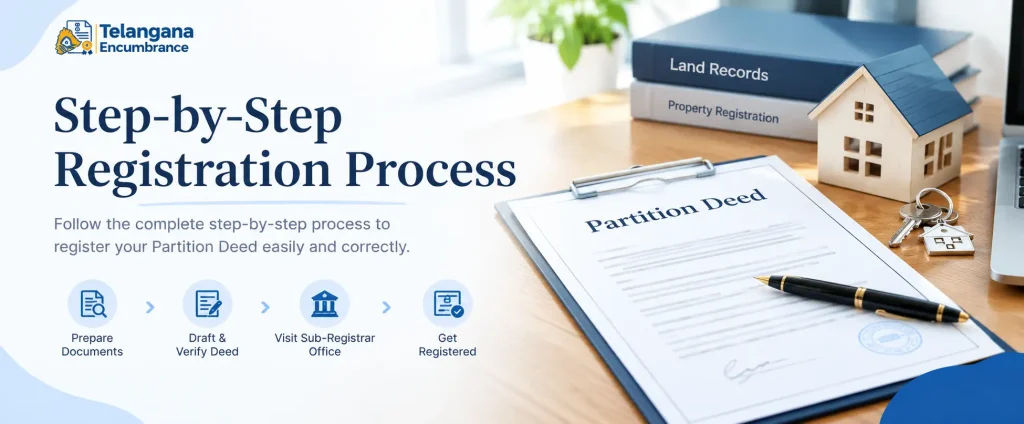
Registration in Telangana runs through the IGRS (Integrated Government Registration System) portal, with land record verification on the Bhu Bharati portal. Exact steps can vary by Sub-Registrar Office, but the general flow is as follows.
Step 1: Verify property records and 22-A status. Before drafting anything, verify the survey number and ownership details, and check whether the property appears in the Section 22-A prohibited list, which restricts registration of certain land categories.
The Bhu Bharati portal allows searches by survey number or pattadar passbook number. Skipping this step is the single most common reason families waste weeks on a deed that cannot be registered at all.
Step 2: Draft the partition deed. Engage an advocate or document writer. The draft must clearly describe the joint property, the shares being allotted, and the boundaries of each divided portion. Errors in survey numbers or party names are a frequent cause of registration delays.
Step 3: Calculate and pay stamp duty. Stamp duty is paid through an e-stamp certificate purchased from an authorised vendor or online. For family partitions in Telangana,
the rate is generally 0.5% on the value of the separated share, subject to a maximum, plus a registration fee. Check the IGRS portal for the current applicable rate for your case.
Step 4: Book an appointment at the SRO. Appointments are typically booked online through the IGRS portal. Select the Sub-Registrar Office based on the property’s location a deed presented at the wrong office will not be accepted.
Step 5: Visit the SRO with all parties and documents. On the appointed date, all co-owners and two witnesses must be present. Biometric verification (thumbprint and photograph) is done for the parties. Original documents and the e-stamp certificate are submitted.
A pitfall here: if even one co-owner cannot attend in person, the registration cannot proceed plan the date around everyone’s availability, including relatives travelling from other cities.
Step 6: Pay the registration fee and collect the registered deed. The SRO registers the document. The registered partition deed is typically available for download from the IGRS portal within a few days, or a physical copy can be collected.
Step 7: Update land records. After registration, apply for mutation on the Bhu Bharati portal to update the record of rights in the individual names of the parties. A registered partition deed is generally required for this mutation.
Common Mistakes to Avoid
Ignoring the 22-A list. If the survey number appears on the prohibited list, registration may be blocked regardless of family consent. Verify the 22-A status before drafting the deed, not after.
Incorrect survey numbers or boundaries. Clerical errors in property descriptions cause rejections or create future title disputes. Cross-check every survey number against the pahani and the previous title deed.
Omitting a co-owner. If any legal heir or co-owner is left out, the partition can be challenged later. Include every person with a vested interest.
Under-valuing the property. Stamp duty is calculated on the higher of the transaction value or the government market value. Under-declaring value invites deficit stamp duty notices.
Delaying registration. Documents must generally be registered within four months of execution. Beyond that, penalties may apply, and after eight months, registration may not be permitted without special procedures.
You may also like to read these posts :👇
Encumbrance Certificate – Meaning in Regional Languages
How to Verify Original Property Documents & Spot Fake Property Papers
Mortgage Deed & Equitable Mortgage Registration Stamp Duty Explained
FAQs
What is the difference between a partition deed and a family settlement?
A partition deed formally divides property by metes and bounds and is compulsorily registrable. A family settlement can be broader and may include arrangements beyond property division. However, if a family settlement is reduced to writing and evidences a partition, it may still require registration.
Can a partition deed be executed on plain paper?
No. It must be executed on stamp paper of the required value, or with an e-stamp certificate, and then registered. A plain paper document will not be accepted at the Sub-Registrar Office.
How long does a registered partition deed remain valid?
A registered partition deed does not expire. It remains valid indefinitely. However, if the property is later sold, mortgaged, or disputed, the deed may be examined for correctness and stamp duty compliance.
Can I register a partition deed if the property has an existing mortgage?
Generally yes, but the mortgage holder’s consent may be required. Obtain a No Objection Certificate from the lender or disclose the mortgage in the deed.
What is the stamp duty for partition among non-family co-owners in Telangana?
For co-owners who are not family members, the rate is typically higher than the family rate. Check the IGRS portal or consult the Sub-Registrar Office for the current rate applicable to your relationship and property value.
Is an oral partition valid in Telangana?
Oral partitions may have been recognised historically in certain contexts, but a registered deed is strongly recommended for any property of significant value. Revenue authorities generally require a registered document for mutation, and courts are reluctant to treat unregistered partitions as evidence of title.
If a co-owner refuses to sign, or a legal heir has passed away and their children’s names are not yet on the pahani, sort that out before drafting the deed those are succession problems, not partition problems, and mixing the two is what turns a three-week process into a three-year court case.
Once the deed is registered and mutation is complete, keep certified copies with each family branch; the copy you don’t keep is the one that gets asked for at the worst possible moment.

2 Comments
Pingback: How to Verify Original Property Documents | Easy Guide
Pingback: How to Search Encumbrance Certificate by Name in Telangana |