
Your home loan application is stuck. The bank’s credit team wants an Encumbrance Certificate covering 30 years, and the one you submitted covers 12. Or worse you’ve already paid a token advance on a plot, and the seller is dodging your request for an EC. Either way, you need a TS EC download quickly, and you need it to be accurate.
This guide covers what an EC actually reveals (and what it hides), which Telangana portal holds your property’s records, and the exact steps to download a certified certificate for both urban and agricultural land.
What an Encumbrance Certificate Actually Shows
An EC is a record of every transaction registered against a specific property during a chosen period. Requesting one is essentially asking the registration department: was this property sold, mortgaged, gifted, leased, or attached by a court between these years?
If a bank holds a charge on the property, it appears in the EC. If the plot changed hands three times, each registered transfer shows up as a separate entry. Sale deeds, mortgage deeds, gift deeds, lease agreements, and court attachments all get captured.
What doesn’t appear matters just as much. Unregistered agreements, oral arrangements, family inheritance disputes, and litigation that was never formally recorded at the registrar’s office won’t show up. That’s why an EC is treated as one layer of due diligence not proof of a clean title. Pair it with a title search and verification of the original sale deeds before you commit money.
Form 15 vs Form 16: What Your EC Will Say
Telangana issues the EC in two formats, and the difference matters when a bank or lawyer reviews your document.
Form 15 is issued when the search finds registered transactions. Each entry typically lists the document number and year, transaction type (sale, mortgage, release), parties involved, registration date, and consideration value. Buying a property with an existing home loan? You’ll likely see a mortgage entry here.
Form 16 is the nil encumbrance certificate issued when no registered transactions turn up for the requested period. Form 16 does not mean the property is absolutely free of claims. It means nothing was formally registered in the government’s records for those years.
Most lenders and buyers ask for at least 13 years, which aligns with the limitation period for many property disputes. For older properties or ancestral land, a 30-year search is commonly recommended.
You may also like to read these posts : 👇
How to Search Encumbrance Certificate by Name in Telangana
Telangana EC Search by Document/Registration Number
Encumbrance Certificate Meaning in Telugu (EC అంటే ఏమిటి?)
Encumbrance Certificate Meaning in Hindi (EC Kya Hota Hai?)
Which Portal to Use: IGRS, Dharani, or Bhu Bharati
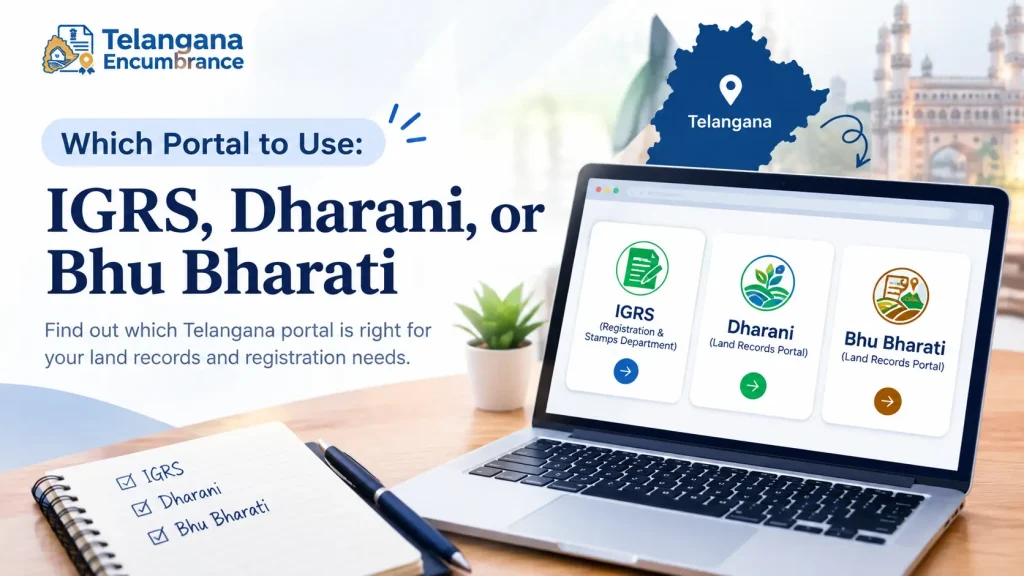
Telangana’s land records are spread across multiple platforms, and picking the wrong one wastes time.
The IGRS portal (Integrated Grievance Redressal System) is the primary online platform of the Telangana Registration and Stamps Department. It handles EC searches for registered documents, including urban properties and many agricultural lands. Digital records on IGRS generally go back to around 1983 for most districts.
The Dharani portal was built to integrate land administration and registration, particularly for agricultural land. Properties registered after 2020, especially agricultural parcels, are typically found through Dharani’s EC search.
The newer Bhu Bharati portal is part of an ongoing effort to modernize land records further. Some land record services are being positioned to move to it alongside or in place of older systems.
For urban property EC downloads, IGRS remains the standard starting point. For agricultural land especially recent registrations check Dharani or Bhu Bharati. If you’re unsure which portal holds your records, the registration details on your sale deed or the local sub-registrar office will clarify it.
Step-by-Step: How to Download EC Online Through IGRS Telangana
These steps describe the general IGRS process for properties with digital records. Interfaces change, so treat this as a guide rather than a fixed script.
Step 1: Go to the official IGRS Telangana website. Navigate to the Registration and Stamps Department portal and find the “Encumbrance Search” or “EC” option under online services.
Step 2: Accept the terms and conditions. The portal shows a disclaimer before you can proceed.
Step 3: Select your district and sub-registrar office. Pick the district where the property is located, then the specific Sub-Registrar Office (SRO) under which it was originally registered. This is where most people go wrong.The SRO that registered your sale deed may not be the one nearest to the property today.
If a search returns nothing for a property you know has been transacted, pull out the original deed and check which SRO registered it or try the adjacent offices.
Step 4: Enter property search details. Search using the document number and year, the survey number, or the house/plot number. The more specific your identifier, the cleaner the result.
Survey numbers with sub-divisions (like 45/A versus 45/AA) are a frequent source of mismatched results enter them exactly as they appear on the deed.
Step 5: Specify the search period. Enter the “from year” and “to year.” Thirteen years is common for loan applications; 30 years is advisable for older properties. The portal searches its digital records within this range.
Step 6: Submit and review results. If transactions exist, you’ll see entries with document details. If not, the result indicates nil encumbrance.
Step 7: Pay the fee and download. Viewing basic results is often free. A certified, digitally signed EC — the version banks and courts accept carries a fee.
Rates change, so check the official portal for the current schedule rather than relying on outdated figures. After payment, the signed PDF is usually available immediately.
Getting an EC for Agricultural Land Through Dharani
For agricultural properties registered after 2020, Dharani is often the relevant system.
Access the Dharani portal and select the EC or encumbrance search option. You may need to log in through a citizen account; new users typically sign up first. Once in, enter the district, mandal, village,
subdivision number, and khata number the land record identifiers used for agricultural parcels. Submit, and the portal displays the encumbrance statement for that parcel.
Dharani’s coverage has been evolving. Some older agricultural transactions, particularly those before 2020, may still require checking IGRS or visiting the sub-registrar office directly.
Documents and Details You Need Before Starting
Gathering these beforehand prevents repeated searches and wasted fees.
- Property identifiers: Survey number, plot number, flat number, or house number. For agricultural land, the khata number and subdivision details.
- Sub-Registrar Office details: The SRO under which the property falls usually mentioned on the original sale deed.
- Registered document details: Document number and year from any previous sale or mortgage deed. This gives the most precise search.
- Owner name: As it appears in registered records, to cross-verify against results.
- Search period: Start and end years. Decide whether 13 or 30 years suits your purpose before you pay.
- Payment method: Debit card, credit card, or net banking for the certified download.
For in-person applications at a sub-registrar office, you’ll commonly need Aadhaar or another identity proof, a filled application form, and photocopies of previous deeds.
Common Mistakes to Avoid When Getting Your EC
Searching the wrong sub-registrar office. If a search returns no results for a property you know has been transacted, try adjacent SRO offices or check the deed for the correct jurisdiction.
Requesting too short a period. A five-year EC can miss an older mortgage or court attachment registered a decade ago. For purchases, 13 years is often a minimum; 30 years gives more confidence on older titles.
Treating a nil EC as proof of no disputes. Form 16 confirms no registered encumbrances were found. Unregistered claims, family disputes, and unrecorded litigation won’t appear.
Ignoring mismatches in property details. If the survey number or owner name in the EC doesn’t match the sale deed, registration or loan processing can stall. Catch these early.
Expecting pre-1983 records online. IGRS digital records generally start around 1983. Older transaction histories typically need a manual search at the sub-registrar office.
You may also like to read these posts : 👇
Encumbrance Meaning in Regional Languages (Hindi/Tamil/Telugu/Marathi)
Encumbrance Meaning – Simple Explanation & Types
What is an Encumbrance Certificate? Full Explanation
Telangana EC Search Online Free: Step-by-Step
Frequently Asked Questions
Is the Telangana EC download free?
Viewing basic search results is usually free. A certified, digitally signed EC the version banks and courts require carries a fee. The fee has historically been nominal and based on years searched, but rates change. Verify the current fee on the official portal before paying.
How long does it take to get an EC in Telangana?
For properties with digital records, an online search returns results within minutes, and the certified PDF is typically available immediately after payment. If a manual search at the sub-registrar office is needed common for pre-1983 records or survey number discrepancies expect several working days to a few weeks, depending on the office’s workload.
Can I download an EC for a property I don’t own?
Yes. The EC search is generally open to anyone who knows the property identifiers. You don’t need to be the owner. This is why buyers, lenders, and lawyers routinely pull ECs during due diligence.
What is the difference between Form 15 and Form 16?
Form 15 is issued when the search finds one or more registered transactions in the requested period. Form 16 is the nil encumbrance certificate, issued when no registered transactions are found. Form 15 lists each encumbrance; Form 16 confirms a clean registered record for that period.
Can I get an EC for agricultural land on the IGRS portal?
Some agricultural land records are available through IGRS, especially older registrations. Agricultural properties registered after 2020 are more commonly accessed through Dharani. If you’re unsure which portal applies, check the registration details or ask at the local land records office.
Does an EC expire?
There’s no formal expiration date, but its value for due diligence fades over time. Lenders and buyers typically expect an EC dated within the last few months. If significant time has passed, get a fresh one covering the intervening period.
Final Thoughts
Timing matters more than most people realise. If you’re in the middle of a property negotiation, pull the EC before paying any advance not after. Once money changes hands, your leverage to walk away from a mortgage-laden property disappears.
And if the online search returns nothing for a property you know has a transaction history, don’t assume it’s clean; head to the sub-registrar office and ask for a manual search. That visit will settle in an hour what a week of portal retries won’t.

1 Comment
Pingback: Telangana EC Search Online Free | Quick Guide