


You’ve found the plot. Negotiated the price. Paid the token advance. Then your bank’s legal team sends back a one-line rejection: “Title not clear mortgage entry unresolved.”
The deal stalls, the seller gets defensive, and your advance sits in limbo. This happens more often than most buyers realise, and it almost always traces back to skipped verification.
A legal opinion for property in Karnataka is the document that prevents this scenario an advocate’s written assessment of whether the seller actually holds a clean, marketable title.
This guide walks through what that opinion covers, how to verify records on Bhoomi, Kaveri 2.0, and municipal portals, and the specific mistakes that cause loans to be rejected.
What a Property Legal Opinion Actually Covers
A legal opinion is not a single certificate. It is a written report an advocate prepares after reading the documents and cross-checking them against government records.
The report answers one question: can this property be bought and sold without legal risk?
In Karnataka, that question is harder to answer than in most states, because land records sit in three separate systems that don’t always agree with each other. Agricultural land lives on Bhoomi. Registered transactions live on Kaveri 2.0.
Urban property tax and building records live with the municipal body BBMP in Bengaluru, and equivalent corporations elsewhere.
A plot can look perfectly clean on Bhoomi while carrying an undisclosed mortgage on Kaveri, or show a matching name on the sale deed while the Khata still sits in a deceased relative’s name.
The opinion typically examines four things: an unbroken title chain (commonly going back 30 years), registered encumbrances such as mortgages and liens,
compliance with zoning and building regulations, and any pending litigation or government acquisition notices affecting the property.
Banks rarely sanction a home loan without this. Most insist on a Legal Search Report (LSR) or Title Search Report from an advocate on their empanelled list they need to know the property can be repossessed and resold if you default.
If you’re paying cash, the opinion matters just as much. It’s the difference between finding a problem before you pay and finding it three years later when you try to sell.
Why Seller-Provided Documents Aren’t Enough
Sellers show you what supports the sale. They rarely volunteer what complicates it.
A seller might present a clean 2022 sale deed while the 1998 partition deed the one where a sibling’s signature is missing sits in a drawer.
Or the EC might show a mortgage from 2016 that was repaid but never formally discharged at the Sub-Registrar’s office. On paper, that lender still has a claim.
There’s also the classification problem. Plots on the outskirts of Bengaluru and Mysuru are frequently marketed as “residential sites” while still recorded as agricultural land on Bhoomi.
Without a DC Conversion Order, you cannot legally build on them, and banks will not lend against them. Buyers discover this only when the loan application comes back rejected.
Independent verification catches these issues while you still have leverage before the full payment, before registration, before possession.
You may also like to read these posts : 👇
IGRS Telangana: Complete Guide to Registration & Stamps
Telangana Registration Charges: What You Actually Pay When Buying Property
Sub-Registrar Office (SRO) Telangana – List & Contact
Step-by-Step: How the Verification Process Works
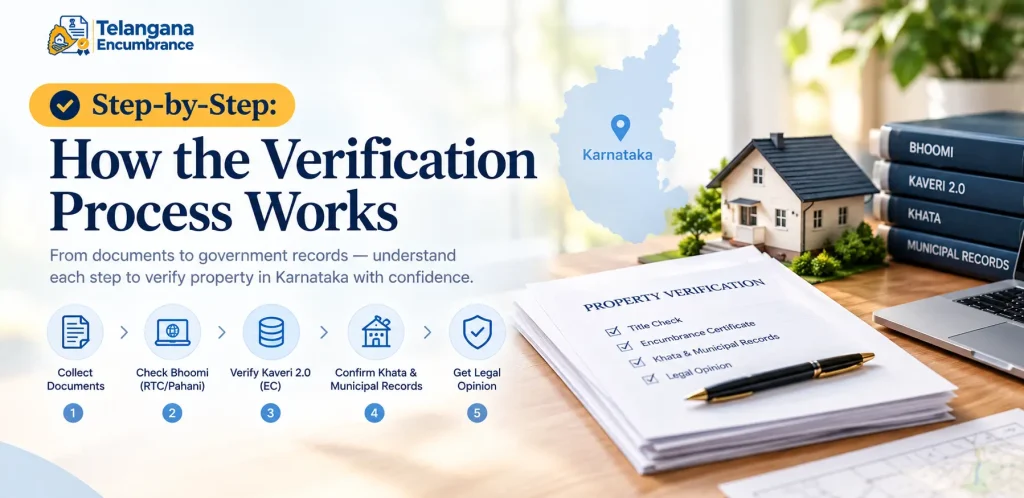
The exact scope depends on property type and the advocate you engage. The sequence below reflects how a thorough verification generally proceeds.
Step 1: Assemble the full document set
Collect everything from the seller, not just the latest deed. Ask for the current sale deed, all prior title deeds in the chain, the Encumbrance Certificate, Khata certificate and extract, recent property tax receipts,
and for apartments the building plan approval and occupancy certificate. For agricultural land, add the RTC (Record of Rights, Tenancy and Crops) and mutation records.
Pitfall: Sellers often hand over photocopies and promise “originals at registration.” Insist on seeing originals, and for older deeds in the chain,
obtain certified copies directly from the Sub-Registrar’s office. Photocopies can be altered; certified copies cannot.
Step 2: Pull the RTC/Pahani on Bhoomi
For agricultural or revenue land, Bhoomi (landrecords.karnataka.gov.in) is the starting point. The RTC shows the current owner’s name, survey number, land extent, and critically the land classification.
Check the Mutation Register (MR) as well, which records ownership changes from sale, inheritance, or gift.
Pitfall: If the mutation entry still shows the previous owner’s name, it usually means a prior transaction was never recorded. That gap becomes your problem at resale, not the seller’s.
Step 3: Apply for the EC on Kaveri 2.0
Kaveri Online Services (kaveri2.karnataka.gov.in) issues the Encumbrance Certificate.
The EC lists every registered transaction against the property sales, mortgages, gifts, leases for the period you request.
A Form 15 EC shows transactions found; a Form 16 (NIL EC) confirms none were found.
Pitfall: Request a 30-year search, not the 10–15 years many buyers settle for. Older mortgages and partition disputes fall outside short windows. And if the EC shows a mortgage, look specifically for a corresponding discharge or satisfaction entry.
No discharge entry means the lender’s charge may still be live, even if the seller insists the loan was closed years ago.
Step 4: Verify Khata and municipal records
For urban property, the Khata certificate and extract confirm the property is registered in municipal tax records and identify who is liable for tax.
In Bengaluru, e-Khata has become mandatory for registered properties, and you can verify details through BBMP e-Aasthi.
The A-Khata versus B-Khata distinction matters enormously here. A-Khata means the property complies with municipal regulations.
B-Khata is essentially a tax-collection record for properties that don’t meet all legal standards and banks generally won’t lend against them.
Confirm the Khata sits in the seller’s name and that no improvement charges or tax arrears are pending, since those liabilities follow the property, not the person.
Step 5: Trace the title chain and mother deed
The advocate reads through successive sale deeds to confirm each transfer was properly registered, that survey numbers and boundaries stay consistent across documents, and that no names are missing.
Inheritance cases are where this gets messy if a property passed through three heirs and only two signed the partition deed, the third heir retains a claim.
Step 6: Search for litigation and acquisition notices
Check Karnataka High Court and district court records for pending cases involving the property or seller.
Separately, verify whether the land falls under any government acquisition notification for roads, rail, or infrastructure.
Such properties can legally be sold but you’d be buying something the government may later take at a price it determines, not a price you negotiated.
Step 7: Obtain the written opinion
Once document review and portal checks are done, the advocate issues the written report: title status, identified risks, missing documents, and a recommendation.
If you’re financing the purchase, confirm the required format with your lender before the advocate drafts it banks have their own templates, and a report in the wrong format means paying for it twice.
Documents Commonly Required
The list varies by property type. These are the documents most often requested:
| Document | What it establishes |
|---|---|
| Sale Deed (current and previous) | Ownership transfer; title chain links |
| Mother Deed / Title Chain | Ownership history, typically 30 years |
| Encumbrance Certificate | Registered mortgages, liens, transactions |
| Khata Certificate & Extract | Municipal property registration |
| Property Tax Receipts | Tax payment status; pending dues |
| RTC / Pahani (agricultural land) | Ownership and land classification |
| Mutation Register (MR) | Ownership updates in government records |
| Building Plan Approval | Construction legality |
| Occupancy Certificate (OC) | Building fitness for habitation |
| DC Conversion Order | Agricultural-to-non-agricultural conversion |
| RERA Registration (projects) | Project compliance |
| Seller’s identity proof | Confirms seller identity against records |
Common Mistakes That Sink Property Deals
Trusting the seller’s EC printout. Always pull the EC yourself on Kaveri 2.0. Discrepancies between what the seller shows and what the portal returns are one of the most common signs of a problem.
Buying B-Khata property without understanding the consequences. Beyond loan rejection, B-Khata properties face difficulties with building approvals and resale.
Some buyers negotiate a discount and assume they can regularise later the process is neither quick nor guaranteed.
Accepting possession with an active mortgage on record. Never take possession while a bank’s charge remains undischarged. Get the lender’s No Objection Certificate and confirm the discharge entry appears in the EC before you pay the balance.
Running a short EC search to save time. A 10-year EC can miss a partition dispute from 2004 or an unregistered transfer from 1996. Thirty years is the practical standard.
Assuming agricultural land can be built on. Without a DC Conversion Order, construction on agricultural land invites penalties and, in some cases, demolition. Verify classification on Bhoomi before you commit.
You may also like to read these posts : 👇
Telangana Market Value of Land – How to Check on IGRS
Telangana Stamp Duty & E-Stamp – Complete Guide
Non-Agricultural Property Registration Telangana: A Complete Guide
Frequently Asked Questions
How long does a property legal opinion take in Karnataka?
A straightforward opinion can take a few working days. A full Legal Search Report 30-year title chain, multiple portal verifications, court searches typically takes longer,
depending on how complete the seller’s documents are. Missing links in the chain are the main cause of delay.
Can I verify property ownership in Karnataka myself?
Partially. Bhoomi shows RTC/Pahani records for agricultural land, Kaveri 2.0 issues the EC, and BBMP e-Aasthi covers Bengaluru Khata details.
What you cannot do yourself is interpret what those records mean when they conflict which is where an advocate’s opinion adds value.
What is the difference between A-Khata and B-Khata?
A-Khata confirms the property complies with municipal regulations and is fully legal. B-Khata is a tax record for properties that don’t meet all legal standards. Banks generally do not sanction home loans against B-Khata properties.
Is a legal opinion mandatory for a home loan in Karnataka?
Most banks require a legal opinion or title search report before sanctioning a loan, usually from an advocate on their empanelled list.
Requirements and formats vary by lender confirm with your bank before engaging an advocate, so the report isn’t rejected on format grounds.
What happens if the legal opinion flags a problem?
The report should state the issue and its severity. Depending on what it is, you may renegotiate price, require the seller to resolve it before registration, or walk away.
For anything involving an active dispute, consult a qualified advocate about your specific case before proceeding.
Does a legal opinion guarantee no future disputes?
No. It is a point-in-time assessment based on available records. Fraud, unregistered interests, or claims not reflected in government records may not surface through standard verification. Re-verify records close to registration rather than relying on a report prepared months earlier.
A Final Word on Timing
Get the legal opinion before you pay anything beyond a token advance and if the deal drags on for months, re-pull the EC just before registration, because a mortgage or lien can be registered against the property after your initial verification.
If the opinion does flag something, treat it as useful information rather than a dead end; many issues, from an undischarged mortgage to a missing heir signature, can be resolved with the seller’s cooperation before registration. What you cannot do is resolve them afterwards.

8 Comments
Pingback: How to Search EC Online in Telangana | Step-by-Step Guide
Pingback: IGRS Telangana: EC Search, Registration & Land Records Guide
Pingback: Telangana Registration Charges | Complete Cost Guide
Pingback: Sub-Registrar Office (SRO) Telangana | List & Contact
Pingback: Telangana Market Value of Land | Check IGRS Rates Online
Pingback: Telangana Stamp Duty & E-Stamp | 2026 Rates & Guide
Pingback: Non-Agricultural Property Registration Telangana | Guide
Pingback: IGRS Telangana Guide – Registration & Search