

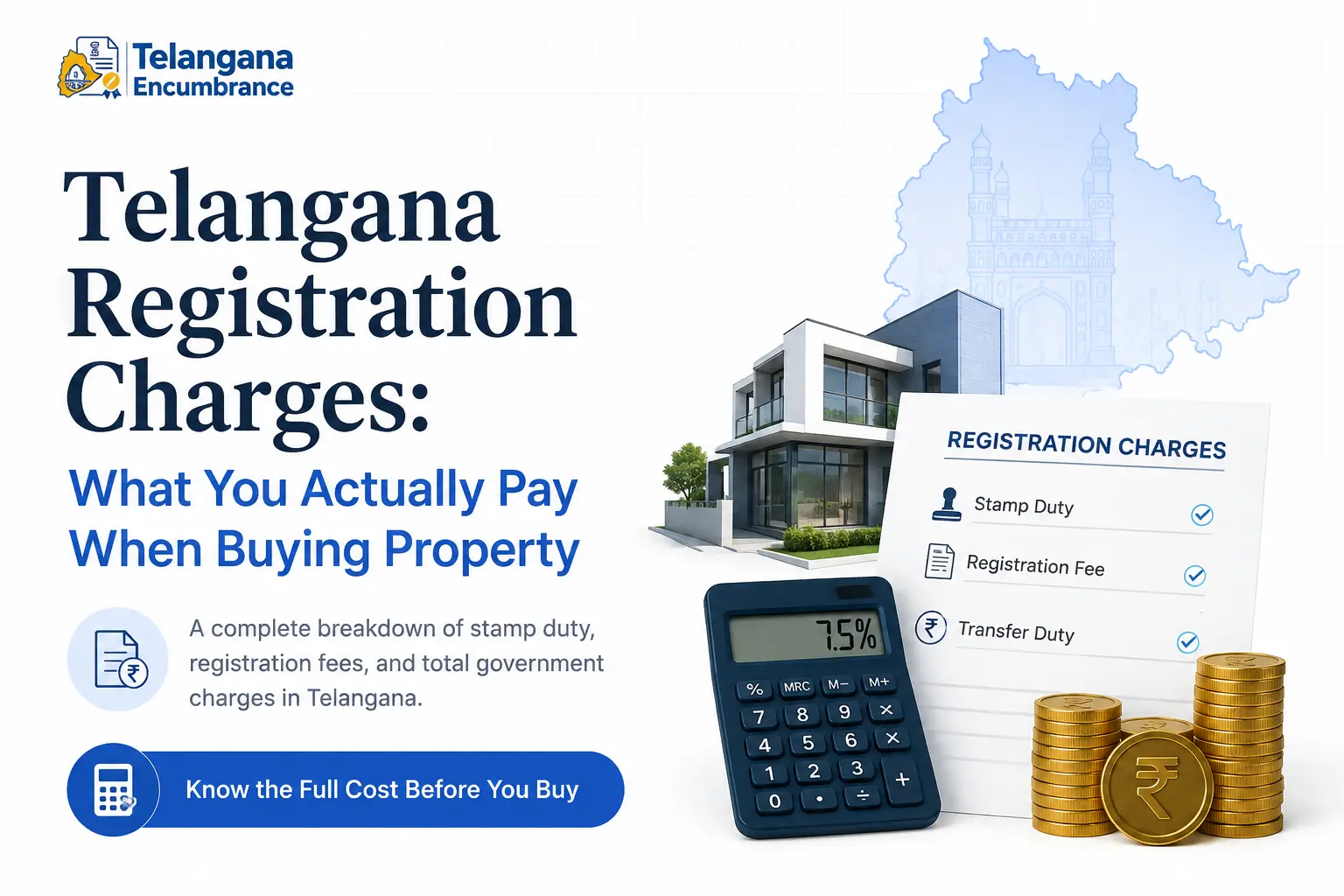
Buying property in Telangana? The registration fee is only one part of what you pay. You also pay stamp duty and, in urban areas, transfer duty.This guide shows the rate for each deed type, a worked example, and the step-by-step process at the Sub-Registrar Office.
Quick Answer : For a sale deed in urban Telangana, you pay about 7.5% of the higher of the market (guideline) value or the sale price: 5.5% stamp duty + 1.5% transfer duty + 0.5% registration fee.In Gram Panchayat areas the total is also about 7.5% (5.5% stamp duty + 2% registration fee, no transfer duty).
- Sale deed (urban): 5.5% stamp duty + 1.5% transfer duty + 0.5% registration fee
- Sale deed (Gram Panchayat): 5.5% stamp duty + 2% registration fee, no transfer duty
- Gift to spouse, parents or children: 2% stamp duty + 0.5% transfer duty + 0.5% registration fee
- Gift to anyone else: 5% stamp duty + 1.5% transfer duty
What Are Registration Charges in Telangana?
Registration charges are the government fee for officially recording a property transfer. Think of it as the cost of making your ownership legally public and binding.
In Telangana, registration is governed by the Registration Act, 1908, and administered by the Registration & Stamps Department through its IGRS portal.
The registration fee is 0.5% of the value for a sale deed. Check the official fee schedule for the minimum and maximum. But this is only one part of the total.
Stamp duty (a tax on the transaction itself) and transfer duty add substantially more. For a sale deed, all three together come to about 7.5% of the higher of the guideline value or the sale price.
You may also like to read these posts : 👇
IGRS Telangana: Complete Guide to Registration & Stamps
Sub-Registrar Office (SRO) Telangana – List & Contact
Legal Opinion for Property – Karnataka Verification Guide
Stamp Duty vs. Registration Charges: The Real Cost Breakdown
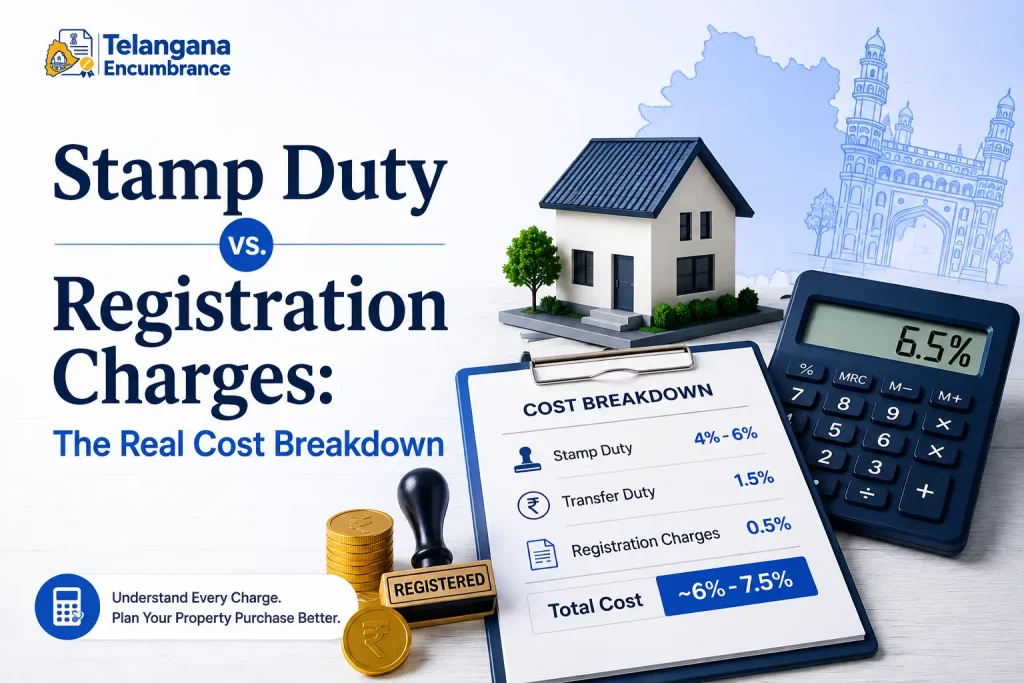
Stamp duty is the tax paid to the state on the transaction itself. The registration fee is what you pay to have the deed legally recorded. Both are paid at the time of registration.
Example: an ₹80 lakh flat in an urban area. Stamp duty 5.5% = ₹4,40,000. Transfer duty 1.5% = ₹1,20,000. Registration fee 0.5% = ₹40,000 (subject to any cap on the official schedule). Total ≈ ₹6,00,000, or 7.5%.
Is se galat calculation (₹4,00,000 aur ₹8.4–8.8 lakh) hat gayi. Yeh sabse important fix hai.ot pocket change it’s a cost that needs to be part of your upfront planning.
What You’ll Pay for Different Property Types
House and Flat Registration
Whether you’re buying a house or an apartment, the registration charges in Telangana for flat and house are identical: 0.5% of the market value.
A ready-to-move property in GHMC limits attracts stamp duty at 4%–6% and transfer duty at 1.5%.
The exact stamp duty percentage depends on the property’s location and whether it’s within municipal corporation limits.
Land and Open Plots
Land registration charges in Telangana for vacant plots and agricultural land follow the same 0.5% formula. However, agricultural land has different stamp duty rates and additional documentation like land passbooks.
Always check the Dharani portal—Telangana’s official land records system—for the specific rate applicable to agricultural transactions.
Don’t rely on the same rates you’d use for a residential plot in a municipal area.
Gift Deed
Transferring property as a gift? The gift deed registration charges in Telangana are calculated exactly like a sale deed—0.5% of the property’s market value.
There’s no discount just because money isn’t changing hands. You’ll still need to register the gift deed at
the sub-registrar’s office, and stamp duty applies at the same rate as a sale transaction.
Will Deed
A will deed registration charges in Telangana are lower because a will only takes effect after death. Registration of a will isn’t mandatory—you can register it or keep it unregistered.
If you choose to register, the fee is minimal, but verify the current rate at your local sub-registrar’s office because it varies by document length.
Lease, Partition, and Release Deeds
Lease agreements of 12 months or longer require registration. Lease deed registration charges in Telangana are calculated on the average annual rent or the property’s market value, whichever is higher.
Partition and release deeds follow similar logic—the fee is based on the market value of the share being transferred.
Step-by-Step Registration Process: A Reality Check
Based on actual experience dealing with Telangana sub-registrar offices, here’s the process you’ll go through—along with the pitfalls that trip people up.
Step 1: Check the Guideline Value Online
Visit the IGRS Telangana website and look up the guideline value (also called market value) for your property’s location. This is the minimum valuation the government will accept for calculating fees.
Critical pitfall: If your sale price is lower than the guideline value, you’ll still pay charges on the higher guideline value.
Many buyers assume they can save money by showing a lower transaction price—this doesn’t work.
Step 2: Get Your Encumbrance Certificate First
Before you do anything else, obtain an Encumbrance Certificate (EC) from the sub-registrar’s office covering the last 13 years.
This document confirms the property has no existing loans, disputes, or legal claims.
Skip this step, and you could be buying a property with unresolved litigation or an outstanding bank loan.
- You can apply for an EC online through the IGRS portal or offline at the sub-registrar’s office.
- Processing typically takes 3–5 working days.
Step 3: Pay the Charges Online or at a Designated Bank
Use the registration charges in Telangana calculator on the IGRS portal to estimate your total fees.
You can pay stamp duty and registration charges online through the portal or at authorized banks.
💳 Big online payment coming up? Stamp duty and registration fees run into lakhs and are paid online via e-challan/SBI ePay. Some buyers route such payments through a rewards credit card (where the portal allows it) to earn NeuCoins on the spend. Compare card options: Tata Neu Card or SBI Credit Card (affiliate links — free for you, support this site).
Print the payment acknowledgment—you’ll need it at the sub-registrar’s office.
Step 4: Visit the Sub-Registrar’s Office—Both Parties Must Be Present
Both buyer and seller must appear in person at the sub-registrar’s office where the property is located. If either party cannot attend,
they need to execute a Power of Attorney (POA) in favor of someone who can represent them. Real-world issue:
The POA must be registered; a notarized POA isn’t sufficient for property registration in Telangana.
Bring original documents:
- Sale deed (printed on non-judicial stamp paper of appropriate value)
- Payment receipts
- Identity proofs (Aadhaar and PAN are mandatory)
- Photographs (passport-sized, recent)
Step 5: Document Verification and Signing
The registering officer verifies the documents, checks the identity of both parties, and confirms the payment.
Once satisfied, both parties sign the deed in front of the officer. You’ll receive an acknowledgment receipt with a reference number.
Step 6: Collect the Registered Document
The registered document is typically available for collection within 3–7 working days.
Alternatively, you can download a digitally signed copy from the IGRS portal once it’s uploaded.
Documents You’ll Actually Need
Gather these before you even think about visiting the sub-registrar’s office:
- Original sale deed or gift deed – Printed on non-judicial stamp paper of the required value
- Encumbrance Certificate – For the last 13 years, covering the period of the seller’s ownership
- Khata Certificate and Khata Extract – From the local municipal corporation (GHMC for Hyderabad properties)
- Property tax paid receipt – From the most recent financial year
- Aadhaar card – Mandatory for both buyer and seller
- PAN card – Mandatory for transactions above a specified threshold
- Passport-sized photographs – Two recent photographs of both parties
- Power of Attorney – If either party cannot attend in person (must be registered, not just notarized)
For agricultural land, you’ll additionally need:
- Land passbook (Pahani or Patta)
- Classification certificate (to confirm the land’s agricultural status)
- Survey map (FMB sketch)
Telangana vs. Andhra Pradesh vs. Tamil Nadu: A Quick Comparison
Many buyers with property interests across states find this comparison useful:
| State | Registration Charge | Stamp Duty | Total Approx. |
|---|---|---|---|
| Telangana | 0.5% (₹5,000–₹20,000) | 4%–6% | 6%–7.5% |
| Andhra Pradesh | 0.5%–1% | 5%–7% | 6.5%–8% |
| Tamil Nadu | 2%–4% (apartments), up to 7% (houses) | ~7% (Chennai) | 7%–10% |
Registration charges in Andhra Pradesh for house and flat properties are comparable to Telangana, but transfer duty rates differ.
In Tamil Nadu, property registration charges are generally higher, especially for independent houses. If you’re buying property in Pondicherry,
land registration charges in Pondicherry typically range from 5%–7% of the market value.
Always verify current rates on the respective state’s official portal—rates change periodically and vary by district and property category.
Common Mistakes That Cost Buyers Time and Money
Mistake 1: Paying Based on the Sale Price Instead of Guideline Value
The government calculates charges on the higher of the sale price or the guideline value. Even if you negotiate a lower price, you’ll pay fees on the guideline value if it’s higher.
Check the guideline value before you negotiate—it’ll affect your total budget.
Mistake 2: Assuming the Encumbrance Certificate Is Optional
An EC is not optional—it’s essential. Without it, you won’t know if the property has an outstanding loan or a pending legal case. Buyers who skip this step often end up in litigation years later.
Mistake 3: Arriving Without Both Parties or the Correct POA
The sub-registrar will not proceed unless both parties are physically present.
If the seller isn’t in town, they must execute a registered Power of Attorney. A simple notarized POA will be rejected.
Mistake 4: Using Outdated Fee Estimates
The telangana registration charges hike is often discussed in news reports, and rates have changed over the years.
Always use the registration charges in Telangana calculator on the IGRS portal for current figures—don’t rely on what someone paid in 2021.
Mistake 5: Forgetting GST and Municipal Transfer Fees
GST may apply to under-construction properties if the developer isn’t paying it.
Additionally, the municipal corporation charges a transfer fee when you change the khata to your name. Factor these in.
You may also like to read these posts : 👇
Telangana Market Value of Land – How to Check on IGRS
Telangana Stamp Duty & E-Stamp – Complete Guide
Non-Agricultural Property Registration Telangana: A Complete Guide
FAQs About Telangana Registration Charges
1. What are the current registration charges in Telangana?
The registration charge is 0.5% of the property’s market value, with a minimum of ₹5,000 and a maximum of ₹20,000. Stamp duty (4%–6%) and transfer duty (1.5%) are additional.
2. How do I calculate registration charges online?
Use the registration charges in Telangana calculator on the official IGRS Telangana website. Enter the property’s market value or sale price, and the tool estimates stamp duty, transfer duty, and registration charges.
3. Are agricultural land registration charges different?
Yes. While the registration charge remains 0.5%, agricultural land has different stamp duty rates and requires additional documents like land passbooks. Check the Dharani portal for the precise rates.
4. What’s the difference between stamp duty and registration charges?
Stamp duty is the tax paid to the state government on the transaction itself. Registration charges are the fee for legally recording the deed. Both are paid at the time of registration.
5. Can I register a gift deed with the same charges as a sale deed?
Yes. Gift deed registration charges in Telangana are calculated the same way as a sale deed—0.5% of the market value. Stamp duty also applies at the same rate.
6. What happens if I don’t register my property?
Under the Registration Act, 1908, unregistered properties have no legal validity for transactions above ₹100.
If you don’t register, you don’t have legal ownership—even if you’ve paid the full price. Registration is mandatory.
A final practical tip: If you’re planning to register property in Telangana, aim to complete the process during a week when the sub-registrar’s office isn’t overloaded—avoid financial year-end (March) and festive season rushes.
Offices get crowded, document processing slows down, and you may have to make multiple visits. And always verify rates on the IGRS portal on the same day you pay—rates can change with
the government’s financial announcements without warning. A quick five-minute check can save you from overpaying or facing a rejected application.

8 Comments
Pingback: IGRS Telangana: Complete Guide | Easy Registration & Stamps
Pingback: Sub-Registrar Office (SRO) Telangana - List & Contact | Complete Guide
Pingback: Telangana Market Value of Land | Check IGRS Rates Online
Pingback: Telangana Stamp Duty & E-Stamp | 2026 Rates & Guide
Pingback: Non-Agricultural Property Registration Telangana | Step-by-Step Guide
Pingback: IGRS Full Form & Meaning | Simple Guide
Pingback: IGRS Telangana Full Form and Meaning Explained
Pingback: IGRS Telangana Guide – Registration & Search