
Your bank rejected the EC. Or the seller’s name doesn’t match what’s on the deed. Or you’re standing in a Sub-Registrar queue being told the record you need is somewhere in a register from 1994.
These are the moments that push people toward a name-based EC search often the only option when you have a family name, a vague property reference, and no document number to work with.
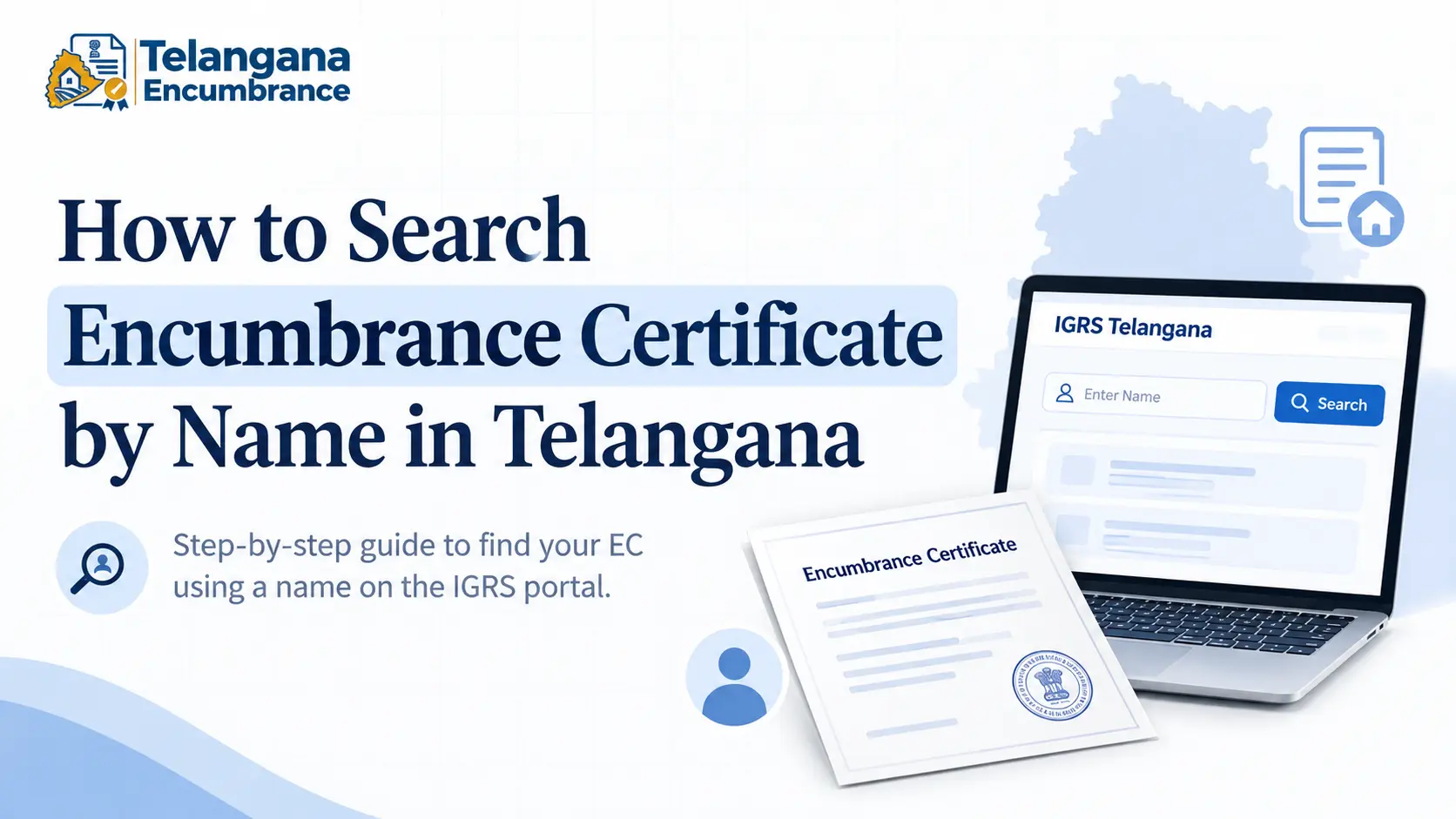
This guide covers the EC Telangana online search by name process on the IGRS portal, what it can and cannot tell you, and how to work around the dead ends you’ll likely hit.
If you’ve already tried a search and got “no data found,” the reasons below will explain why and what to do next.
An Encumbrance Certificate lists every registered transaction tied to a property over a chosen period: mortgages, liens, court attachments, sale deeds.
Lenders require it before sanctioning a loan; buyers use it to check for hidden liabilities. When you don’t have the document number, a name search becomes the fallback. It’s a useful fallback, but a fragile one.
What the Telangana IGRS Portal Actually Lets You Search
The Telangana Registration and Stamps Department’s portal (registration.telangana.gov.in), known as IGRS, is the primary source for EC records. It offers several search paths: document number, form entry details, and party name.
The party name search returns deeds where the entered name appears as either buyer or seller. This is a different animal from searching by property details, where you enter a plot or survey number and get every transaction tied to that land, regardless of who owned it.
The name search is the weakest of these options. It matches names exactly as they were typed at registration nothing more, nothing less. A single extra letter, a missing middle name,
or initials substituted for a full name will return zero results even when the transaction exists. Treat a “no records found” message as inconclusive, not as proof of a clean title.
Step-by-Step: Searching EC by Name on IGRS Telangana
- Open the portal. Go to registration.telangana.gov.in and find the “Encumbrance Search” option under online services.
- Accept the disclaimer. The portal displays a notice about the scope and limits of online EC data. Read it once the limitations it describes are the same ones that cause most failed searches.
- Choose “Party Name” as your search method. This is the option that matches on buyer or seller name rather than property identifiers.
- Enter the name as it likely appeared in the deed. This is where most people go wrong. If the deed was registered in 1987, the name on it may follow an older spelling convention. Try the full name first, then variants. If the original used initials “K. Venkatesh” rather than “Kota Venkatesh”—enter it that way.
- Select the district and Sub-Registrar Office. The EC database is indexed by the SRO that registered the original transaction, not the property’s current location. If you don’t know which SRO applies, use the portal’s “Know Your SRO” tool to find it by district, mandal, and village. A common pitfall: people search the SRO nearest to the property today, get a nil result, and conclude nothing is registered. The correct SRO is often the one covering the village where the deed was originally registered sometimes a different district entirely after reorganisation.
- Set your search period. Enter the From and To years. Banks commonly ask for 15 to 30 years of history. If you don’t know when the property last changed hands, start wider than you think you need.
- Submit and review. The portal lists matching transactions or displays “no data found.” Second common pitfall: a nil result on a name search is not a clearance. It means the name didn’t match nothing more.
- Download or note the details. If results appear, you can typically view them on screen for free and download a PDF after payment. Save the reference number; you’ll need it if you request a certified copy later.
You may also like to read these posts : 👇
Telangana EC Search by Document/Registration Number
Encumbrance Certificate Meaning in Telugu (EC అంటే ఏమిటి?)
Encumbrance Certificate Meaning in Hindi (EC Kya Hota Hai?)
Why Name-Based EC Searches Fail
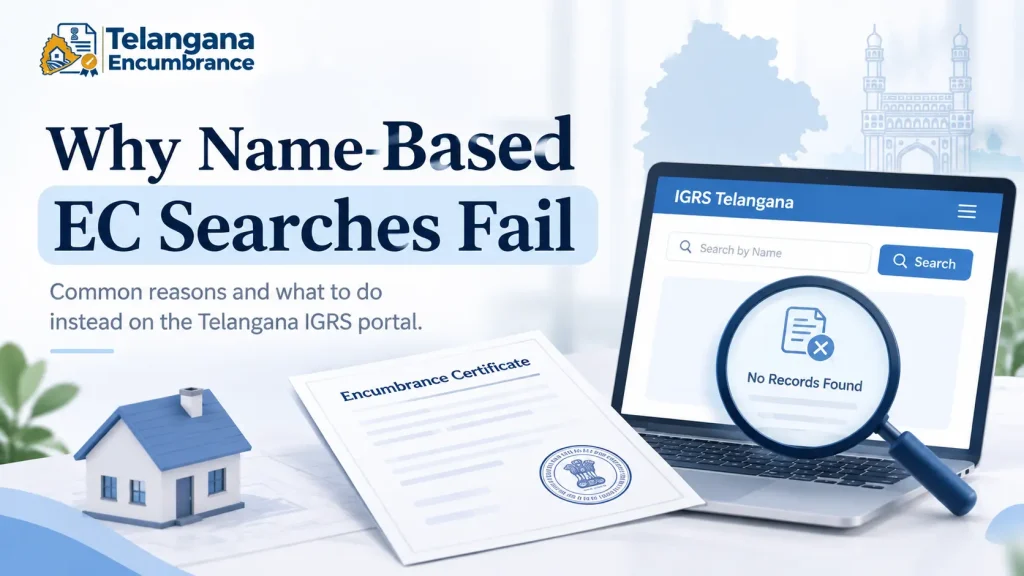
Spelling and transliteration. Telugu names rendered in English have no single correct form. “Krishna” can appear as “Krishnaiah,” “Kistna,” or with initials. The portal doesn’t fuzzy-match. It compares strings.
Name changes. A property registered in a maiden name before marriage, or a name altered by legal process, won’t surface under the current name.
Only registered transactions appear. Unregistered agreements, informal family loans, and oral partitions leave no trace in the EC under any search method.
Wrong SRO. The most common cause of a false nil. SRO boundaries have shifted over the decades, and districts carved out after Telangana’s 2016 reorganisation may require searching under both the parent and successor district.
Pre-computerisation records. Online data generally begins around 1983, though coverage varies by SRO. Anything earlier lives in manual registers at the Sub-Registrar’s office.
Better Options When You Only Have a Name
Search by Survey Number or Document Number
Dig out an old sale deed, property tax receipt, or even a family partition document. Any survey number or document number you find will outperform a name search every time. The survey number EC search matches on land identifiers, which don’t suffer from spelling drift.
Village-Wise EC Search on Dharani
For agricultural land, the Dharani portal (dharani.telangana.gov.in) supports village-wise EC search using district, mandal, village, survey number, and khata number. This is more precise for farm land than any name-based approach.
Cross-Reference What You Have
If you suspect a specific transaction exists, use the name search to confirm it then verify against a survey or document number from another source. A name search is a lead generator, not a verification tool.
Documents and Details to Keep Ready
For an online EC search you’ll need to log in with a mobile number and password. For an offline application at the SRO, commonly required items include:
- Property identifiers: survey number, plot number, house number, or document number if available
- Owner details: full name as recorded, plus any known spelling variations
- SRO details: district and office where the property was originally registered
- Search period: the From and To years you need covered
- Identification: Aadhaar or another valid photo ID
- Application form: Form 22 for offline EC requests
Fees vary by search period and property type. Check the official portal or your SRO for current rates rather than relying on figures from older sources.
Common Mistakes to Avoid
Reading a nil result as a clean title. A name search returning nothing tells you the name didn’t match. It does not confirm the property is unencumbered.
Searching only the nearest SRO. The relevant office is the one that registered the original transaction—not the one closest to the property today.
Cutting the search period short. A 10-year EC can miss a mortgage from 25 years ago. Banks typically want 30 years; for peace of mind, match their standard.
Ignoring manual records. If the property was registered before computerisation roughly pre-1983, though it varies by SRO the online portal will show nothing. A manual application is the only route.
You may also like to read these posts : 👇
CERSAI Registration – Full Form, Meaning & Charges Explained
MOD (Memorandum of Deposit) Full Form & Meaning in Property Loans
Release Deed vs Relinquishment Deed Meaning, Stamp Duty & Registration
Partition Deed – Meaning, Format, Documents & Registration Process
Frequently Asked Questions
Can I search Telangana EC online by name without a document number?
Yes. The IGRS portal has a party name search. It’s less reliable than a document or survey number search because it depends on an exact match with the name as typed at registration.
Why does my name search show no results when I know a transaction exists?
Usually one of three reasons: the registered spelling differs from what you entered, you searched the wrong SRO, or the transaction predates the digitised records. Try spelling variants, check nearby SROs, and consider a manual search for older periods.
How many years of EC history can I check online?
Online records generally start around 1983, with variation by SRO. Anything earlier requires a manual application at the Sub-Registrar office or District Registrar’s record room.
What’s the difference between IGRS EC and Dharani EC?
IGRS EC covers registered transaction history for all property types via registration.telangana.gov.in. Dharani handles agricultural land administration and supports EC searches using survey and khata details. For farm land, Dharani is often the more direct route.
Can I get an EC for a property registered before 1983?
Not online. Pre-computerisation records sit in manual registers. You can apply for a manual EC with the prescribed form and fee, or file an RTI request for a certified copy.
Is a name-based EC search enough for a bank loan?
Usually not. Lenders typically want an EC tied to reliable property identifiers like survey or document numbers. Confirm your lender’s requirements before submitting a name-only result.
Final Thoughts
If your name search returns nothing and you’re under time pressure say, a sale deadline the fastest way forward is often a trip to the SRO with whatever partial details you have. Staff there can search manual indexes that the online portal never digitised, and they can confirm which SRO holds the original record.
Budget a few working days for that, and start the search earlier than the deal timeline suggests. Name-based EC searches reward patience and punish urgency.

4 Comments
Pingback: Telangana EC Search by Document Number | Easy Guide
Pingback: Encumbrance Certificate Meaning in Telugu | Easy Guide
Pingback: Encumbrance Certificate Meaning in Hindi | EC Explained
Pingback: TS EC Download | Telangana EC Guide