
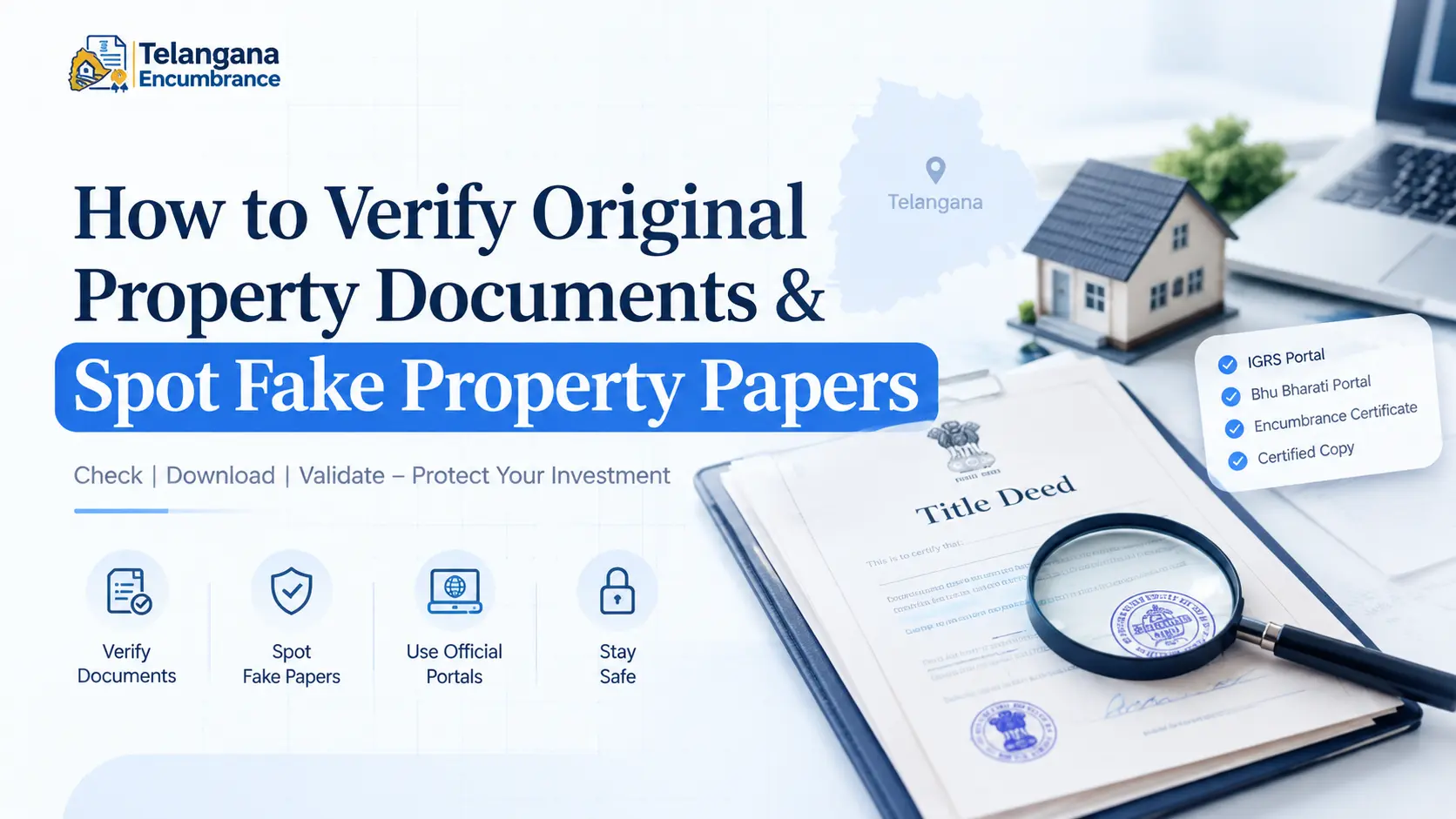
A seller hands you a crisp title deed, complete with stamps and a Sub-Registrar’s seal. Everything looks right. But in Telangana, where fake property documents have become sophisticated enough to fool experienced buyers, “looks right” is not the same as “is right.”The difference between the two can cost you your entire investment.
This guide walks you through how to verify original property documents using official Telangana portals,how to spot the warning signs of forged papers, and what to do if you are dealing with duplicate land records or have lost property documents.
Why Verification Gaps Lead to Property Fraud in Telangana
Most property fraud does not begin with an obviously fake document. It begins with a real-looking photocopy and a buyer who never checked the registered record.
The registration department’s copy is the only version that legally counts what the seller prints at a local shop does not.
Telangana’s land records system has shifted significantly in recent years. The Dharani portal once handled all agricultural land records in the state. It has since been replaced by the Bhu Bharati portal, which now manages those services and includes a stronger grievance redressal mechanism.
Urban property transactions sale deeds, mortgages, encumbrance certificates continue to be handled by the Registration and Stamps Department through its IGRS portal.
Knowing which portal applies to your property is the first practical step. Using the wrong one wastes time and, worse, can give you a false sense of security.
You may also like to read these posts : 👇
CERSAI Registration – Full Form, Meaning & Charges Explained
MOD (Memorandum of Deposit) Full Form & Meaning in Property Loans
Release Deed vs Relinquishment Deed Meaning, Stamp Duty & Registration
How to Verify Original Property Documents Through Official Portals
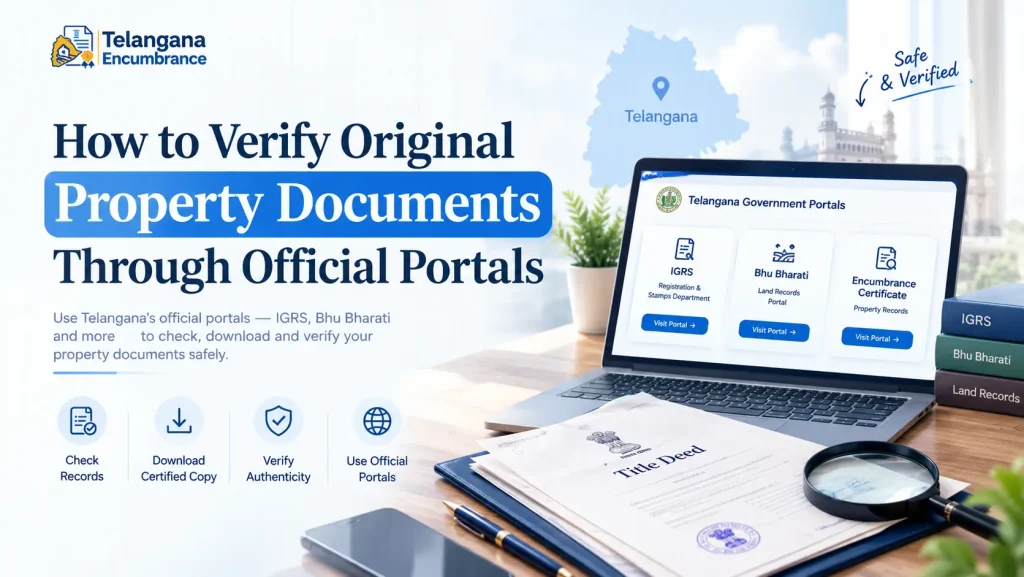
Cross-checking a document against government records is the only reliable way to confirm it is genuine. Here is how the process actually works in Telangana.
Step 1: Match the Property Type to the Right Portal
Agricultural land—fields, farm plots, village holdings is recorded on the Bhu Bharati portal (bhubharati.telangana.gov.in). Registered sale deeds and encumbrance certificates for any property type are available on the IGRS Telangana portal (registration.telangana.gov.in).
If you are unsure which category your property falls under, start with IGRS, since it covers registered transactions across both urban and rural areas.
Step 2: Search Using the Document’s Unique Identifiers
Every registered document carries a set of identifiers: the document number, the year of registration, the district, and the Sub-Registrar Office (SRO) where it was registered. On the IGRS portal, enter these details to pull up the registered document’s summary.
If the names, property description, and survey number match the physical document in your hand, that is a good sign but it is not the end of the process.
For agricultural land, search Bhu Bharati using the survey number or the Pattadar Passbook number to see who is recorded as the current owner.
A common pitfall here: survey numbers are sometimes entered incorrectly on older documents, or the same plot may have been subdivided without the document being updated.
If the search returns no result, do not assume fraud check with the local revenue office first.
Step 3: Download the Certified Copy, Not the Photocopy
A photocopy provided by a seller has no evidentiary value. What you need is a certified copy an official duplicate issued by the registration department, sometimes called a Nakal.
For deeds registered in Telangana after 1999, you can download the certified copy directly from the IGRS portal. For older documents, you will need to apply at the concerned SRO in person.
This is where many buyers slip up. They accept a scanned PDF from the seller, compare it to the physical document, and conclude everything is fine.
But a skilled forger can produce a document that matches a scanned copy perfectly. Only the department-issued certified copy confirms what was actually registered.
Step 4: Pull the Encumbrance Certificate and Read It Carefully
An Encumbrance Certificate (EC) lists every registered transaction on a property over a chosen period sales, mortgages, liens, court attachments. A clean EC is one of the strongest signals that the property carries no hidden liabilities.
Apply for the EC through IGRS or Bhu Bharati, depending on the property type. For a serious purchase, request a search period of at least 13 to 30 years; for high-value properties, go further back. When the EC arrives, read it line by line.
If it shows a mortgage the seller never mentioned, or a transaction dated after the seller claims to have acquired the property, stop and get an explanation before proceeding.
Red Flags That Suggest Fake Property Documents
A document can pass a casual glance and still be forged. These are the signs that should slow you down.
Physical Inconsistencies
Genuine registered documents carry the Sub-Registrar’s signature and seal, stamp duty markings, and a book or serial number. Check for fonts that change mid-page, uneven stamp impressions,
or a seal that looks printed rather than stamped. A document that is suspiciously pristine no folds, no age marks on a supposedly decades-old deed warrants a closer look.
Details That Do Not Match Other Records
The seller’s name on the title deed should match their Aadhaar, PAN, or voter ID. The property’s measurements, boundaries, and survey number should match municipal or revenue records.
If the survey number does not exist in the Bhu Bharati database, or if the registered owner’s name differs from the seller’s, pause the transaction immediately.
In inherited properties, ask for the succession certificate or legal heir certificate without it, the chain of title is incomplete.
Seller Behaviour That Does Not Add Up
A genuine seller will not object to independent verification. If the seller refuses to let you inspect the original documents, pushes you to close quickly, or offers only photocopies without allowing a certified copy check, treat those as serious warning signs.
The same applies if the seller is not the registered owner and is acting through a Power of Attorney (POA). Verify the POA at the Sub-Registrar’s office do not rely on a photocopy, since forged and expired POAs are a common fraud tool.
What to Do If You Have Lost Property Documents
Losing original property documents feels catastrophic, but ownership does not disappear with the paper. The registration department holds its own record, and you can obtain a certified copy to replace what was lost.
For documents registered in Telangana after 1999, download the certified copy from the IGRS portal using the district, SRO, year, and document number. For older deeds, visit the concerned Sub-Registrar Office and apply in person.
You will commonly be asked for your Aadhaar card, a copy of the FIR if the documents were stolen, and proof connecting you to the property such as a property tax receipt or the previous deed in the chain.
A certified copy carries the same legal validity as the original for most purposes, including loan applications and legal proceedings.Keep it in a safe deposit locker or a secure digital backup, and inform your legal heirs where it is stored.
Common Mistakes to Avoid During Verification
Trusting a photocopy. A photocopy proves nothing about what was registered. Always obtain a certified copy from the department.
Skipping the EC because the title deed looks clean. The deed shows the transfer; the EC shows what else has been done to the property mortgages, liens, attachments. They are not substitutes for each other.
Not matching the seller’s identity to the deed. Verify the name on the title deed against a government-issued photo ID. In inheritance cases, confirm the legal heir certificate before accepting the seller’s claim to ownership.
Assuming the bank’s legal check protects you. If you are taking a home loan, the bank’s lawyer reviews the title to protect the bank’s money, not yours. Independent verification remains your responsibility.
Ignoring measurement mismatches. If the physical boundaries or area of the property do not match the document, the discrepancy could indicate encroachment or a forged deed. Get it resolved before paying any advance.
You may also like to read these posts : 👇
Partition Deed – Meaning, Format, Documents & Registration Process
Encumbrance Certificate Tamil Nadu: Your Complete Guide to TN EC Online
Mortgage Deed & Equitable Mortgage Registration Stamp Duty Explained
Frequently Asked Questions
How can I check if a property document is registered in Telangana?
Use the IGRS Telangana portal and enter the document number, year, district, and Sub-Registrar Office details. For agricultural land ownership records, search the Bhu Bharati portal by survey number or Pattadar Passbook number.
What is the difference between Dharani and Bhu Bharati?
Dharani was Telangana’s earlier integrated land records portal. Bhu Bharati replaced it, with a focus on decentralised services and grievance redressal. Some legacy records may still be accessible through Dharani-era links, but Bhu Bharati is now the primary portal for agricultural land records.
Can I get a duplicate copy of my sale deed if I lost the original?
Yes. For deeds registered after 1999, download a certified copy from the IGRS portal. For older documents, apply in person at the Sub-Registrar Office where the deed was registered. The certified copy is legally valid for most purposes.
How far back should an Encumbrance Certificate cover?
A search period of 13 to 30 years is generally recommended to capture long-standing mortgages or charges. For high-value or inherited properties, a longer period provides greater assurance.
What should I do if I suspect a document is forged?
Do not proceed with the transaction or pay any advance. Consult a property lawyer, report the matter to the local police and the Sub-Registrar’s office, and file a grievance through the Bhu Bharati portal if the property is agricultural land.
Is a certified copy of a sale deed legally valid?
Yes. A certified copy issued by the registration department is an official duplicate and is commonly accepted for loan applications, legal proceedings, and property verification when the original is unavailable.
When to Bring In a Professional
Basic portal checks will catch most obvious problems, but some transactions need a trained eye. Inherited agricultural land with an unclear chain of title, properties with multiple legal heirs,
or high-value urban real estate are all situations where a property lawyer’s title search adds real protection. Treat professional scrutiny as a complement to your own verification, not a replacement for it.
One last thing worth knowing: verification takes time, and sellers sometimes use urgency as a tactic. If a deal is genuine, it will survive a week’s delay while you pull certified copies and a proper EC.
If the seller cannot tolerate that delay, that itself tells you something. And if you discover a problem after money has changed hands, act quickly file a police complaint and consult a lawyer before the trail cools.

1 Comment
Pingback: Mortgage Deed & Equitable Mortgage Registration | Guide