
A seller hands you a Pattadar Passbook, an EC that looks clean, and a sale deed with his grandfather’s name on it. Three months after registration, you discover the land was mortgaged to a cooperative bank in 2004 and the mortgage was never released.
This is not a rare story in Telangana. It happens because buyers treat a single land document as proof of ownership, when ownership is actually established by a chain of records that must agree with each other.
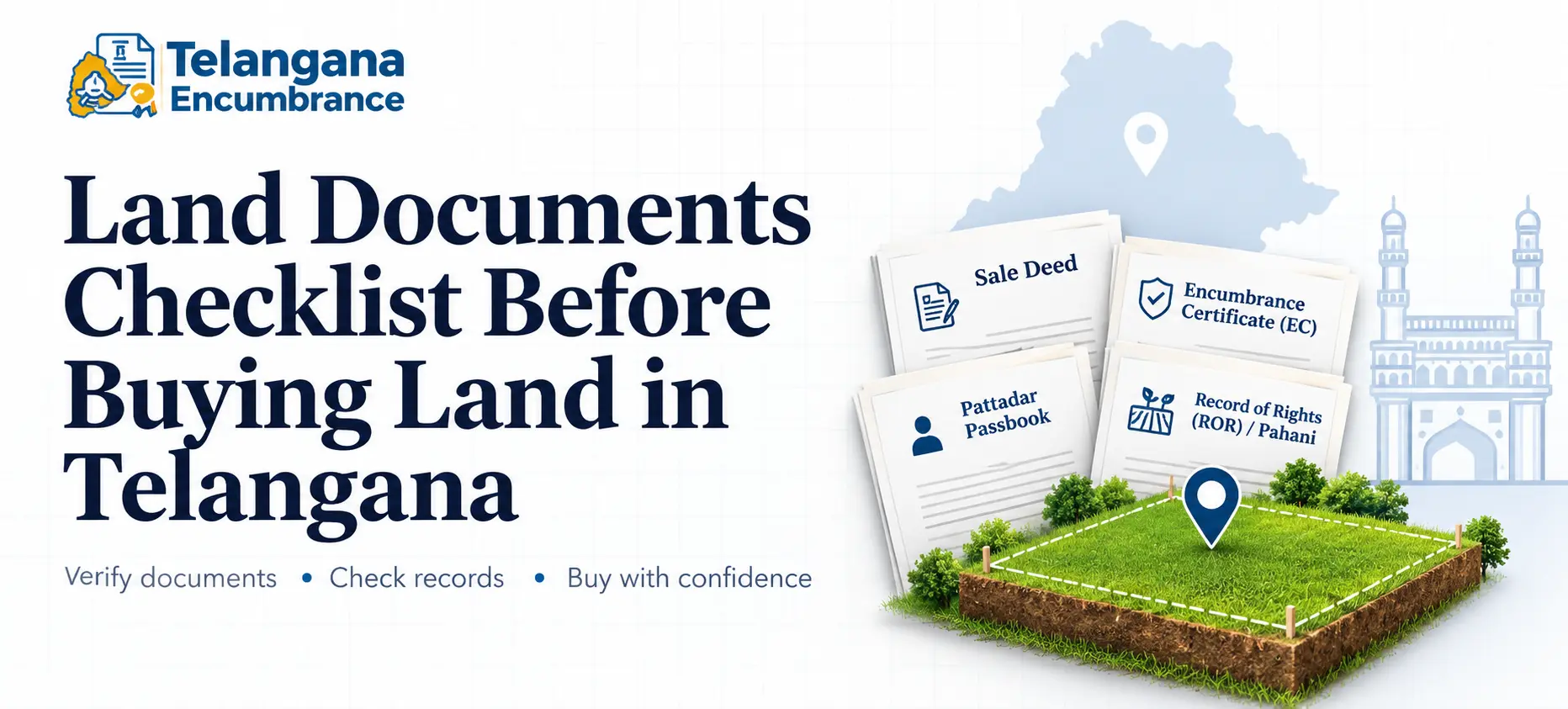
This checklist covers the documents that matter, how to verify them on IGRS and Bhu Bharati, and the mismatches that should stop you from paying a token advance.
What Changed in Telangana’s Land Records And Why It Affects You
Telangana’s land administration has shifted twice in recent years. Dharani centralised agricultural land records and made Pattadar Passbooks digitally verifiable. Bhu Bharati has since taken over most of those functions, including land details search and prohibitory land checks. If you are working from a checklist written before this transition, some of the portal names in it are already outdated.
The practical consequence: a land certificate like the Encumbrance Certificate records only registered transactions. An unregistered agreement to sell, a family partition never reduced to a registered deed,or a pending suit that was never entered into the registration index will not appear on it. One document is never enough. Your protection comes from making four or five records confirm the same story about the same parcel.
This matters most in two situations. Old land parcels that have passed through two or three generations often has succession gaps that no portal will flag for you. And village land, identified by survey number rather than plot number, frequently involves undivided family shares, where the person selling may own only a fraction of what he is selling.
You may also like to read these posts :👇
House Number Search in Telangana: Find Assessment / Property Tax Number
How to Check Plot Details Online: Plot Number, Survey No. & Status
How to Check FTL, Buffer Zone & Land Zone in Telangana
Telangana Cadastral Map, Tippon & FMB Sketch: How to Get Copies
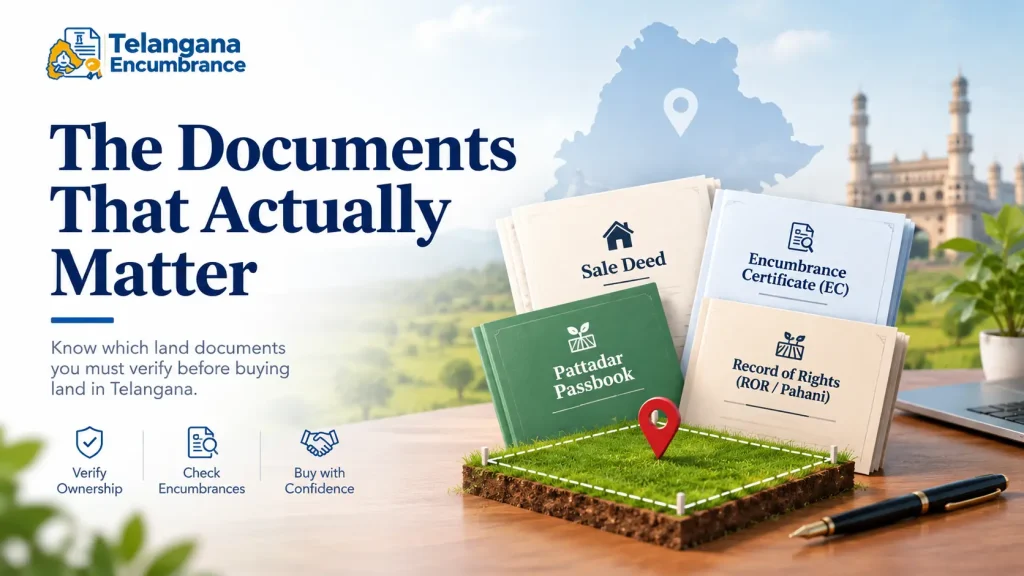
The Documents That Actually Matter
Mother Deed and the Chain of Title
The mother deed is the document that first brought the property into the seller’s family line. Everything after it sales, gifts, partitions, inheritances must connect to it in an unbroken sequence.
For most urban plots, a 30-year chain is adequate. For agricultural land with inheritance history, go back further if the records exist. What you are looking for is not a thick file but an unbroken one.
A single missing link say, a father’s death in 1998 with no registered partition among his three sons means every subsequent sale by one son is legally questionable unless the other heirs are brought on record.
Encumbrance Certificate (EC)
The EC lists registered transactions against a property over a chosen period: mortgages, sales, gifts, leases, and court attachments registered with the Sub-Registrar Office.
Telangana issues it in two forms:
- Form 15 lists the encumbrances found during the search period.
- Form 16 a Nil EC, confirming nothing was registered in that window.
Request a search period of at least 30 years where records allow. A five-year EC on a property that has been in a family since the 1980s tells you almost nothing.
Pattadar Passbook (Agricultural Land)
For agricultural land, the Pattadar Passbook cum Title Deed is the primary ownership record under the Telangana Rights in Land and Pattadar Pass Books Act, 2020. It carries the landholder’s name, survey number, extent, and land classification.
Verify it on Bhu Bharati using the survey number, the passbook number, or the land khata number. The khata is a revenue account identifier it links a specific holding to a specific owner in government records, which makes it the fastest way to confirm you are looking at the same parcel the seller is describing.
Record of Rights (ROR) / Pahani
The ROR, commonly called Pahani, is the revenue department’s record of who holds and cultivates the land. It shows survey number, extent, classification (wet, dry, assigned), and every person with a recorded interest.
Pull the ROR from Bhu Bharati and read it against the sale deed. If the deed says 1.5 acres and the ROR says 1.2, resolve that before registration not after.
Survey Number and Land Identification
Every agricultural parcel in Telangana carries a survey number, and larger surveys are subdivided into sub-division numbers. This is how land identification works in practice: not by address, not by boundaries drawn on a rough sketch, but by survey and sub-division number matching across every document.
A mismatch usually means one of three things you are looking at the wrong parcel, the land was re-surveyed without records being updated, or someone has been selling land they do not own.
Layout Approval and Building Permissions (Plotted Land)
For plots in a layout, confirm approval from the relevant planning authority HMDA, GHMC, or the local municipality. Unapproved layouts commonly run into trouble later with building permissions, water and electricity connections, and regularization.
Property Tax and Utility Receipts
For urban property, recent property tax receipts, water bills, and electricity bills show the seller has been maintaining the property and that no dues are pending. Unpaid arrears can follow the property, not the seller.
How to Verify Records Online
Encumbrance Certificate on IGRS
- Go to the IGRS Telangana portal at registration.telangana.gov.in.
- Open Encumbrance Search (EC) under Online Services.
- Pick your search method by document number if you have the prior deed, or by property details (survey number, house number, flat number).
- Select the district and the Sub-Registrar Office that has jurisdiction over the property.
- Enter the search period. Use 30 years where the records allow.
- Submit. A clean property returns Form 16; anything registered returns Form 15.
- Download the PDF.
The pitfall: online EC data generally begins from 1983. If the property was mortgaged in 1979 and released in 1985, an online search starting at 1983 may show a release with no visible mortgage behind it. For pre-1983 history, you need the SRO’s physical registers.
The second pitfall: the EC follows the SRO, not the district. A property on a mandal border may have been registered at a different SRO decades ago. Search more than one if the property sits near a boundary.
Agricultural Land Records on Bhu Bharati
- Go to the Bhu Bharati portal at bhubharati.telangana.gov.in.
- Open the Land Records or Land Details Search section.
- Search by survey number and sub-division, khata number, or Pattadar Passbook number.
- Read the result carefully owner name, extent, classification, and any prohibitory flags. Section 22A lands, which are barred from registration, are flagged here.
- Put the portal output beside the seller’s documents and compare line by line.
The pitfall: Dharani and Bhu Bharati records do not always agree with the physical passbook in the seller’s hand, particularly for holdings updated during the transition. When they conflict, the portal record is what the registering authority will act on so treat the discrepancy as a problem to solve, not a clerical error to ignore.
Details You’ll Need Ready Before You Apply
Keep these on hand before starting any search:
- Property identifiers survey number, sub-division number, plot number, ward or locality, village, mandal, district
- Owner name exactly as it appears in government records
- Prior deed reference document number and year, if you have it
- Search period start and end dates
- Applicant details identity proof and contact information
For an offline EC at the Sub-Registrar Office, you will commonly need a written application specifying the property and search period, photocopies of prior deeds if available, and identity proof.
Mistakes That Cost Buyers Money
A short EC period. A five-year certificate can look spotless while a 20-year-old mortgage sits unreleased behind it.
Accepting photocopies. Verify against the portal or the SRO’s own records. A photocopy proves nothing about what is on file.
Ignoring classification. Agricultural land cannot be used for residential purposes without formal conversion. Assigned and government lands are generally non-transferable.
Skipping the site visit. Records will not show you an encroachment, a blocked access road, or a neighbour who believes the boundary sits three feet further in.
Missing Section 22A status. Certain lands are barred from sale or registration. Both portals flag this, but only if you look.
Paying an advance before verification. Once money changes hands, your leverage disappears. Verify first, negotiate after.
You may also like to read these posts :👇
Old Pahani, Sethwar & Khasra Pahani (1954-55) Telangana: How to Get a Copy
Types of Land in Telangana: Patta, Assigned, Inam, Government & Barani
Land Ceiling Act & ULC Clearance in Telangana Explained
Telangana Market Value of Land: Dharani, Bhu Bharati, and What Buyers Need to Know
Frequently Asked Questions
How far back should I check the title in Telangana?
Twenty to thirty years is the common benchmark for urban plots, and longer for agricultural land with inheritance history. The aim is a continuous chain from the mother deed to the present seller, with no unexplained gaps.
What is the difference between Form 15 and Form 16 EC?
Form 15 lists registered encumbrances found during your search period. Form 16 is a Nil EC it confirms nothing was registered in that window.
Can I get an EC for transactions before 2000?
Online records typically go back to 1983. Anything earlier usually requires a visit to the Sub-Registrar Office or a check of village revenue records.
What is a land khata?
A khata number is a revenue account identifier that ties a specific landholding to a specific owner in government records. It is used for taxation and record-keeping, and it is one of the quickest ways to confirm you are verifying the right parcel.
Is Dharani still in use?
Bhu Bharati has taken over most land record services. Some older references and records still point to Dharani, so expect to see both names during a search.
Do I need a lawyer?
Not legally required, but for high-value or inherited land it is worth the cost. A property lawyer can run a deeper title search and flag risks that portal records alone will not reveal.
One Last Thing
If you take away a single habit from this checklist, make it this: verify before you pay, not after. The token advance is where buyers lose their bargaining position once it is paid, every discrepancy becomes a negotiation instead of a dealbreaker.
And if you find a mismatch you cannot explain, walk into the local Sub-Registrar Office and ask. A ten-minute conversation with the person who maintains the register will tell you more than a week of comparing photocopies at home.

1 Comment
Pingback: How to Check FTL & Buffer Zone in Telangana | Guide