

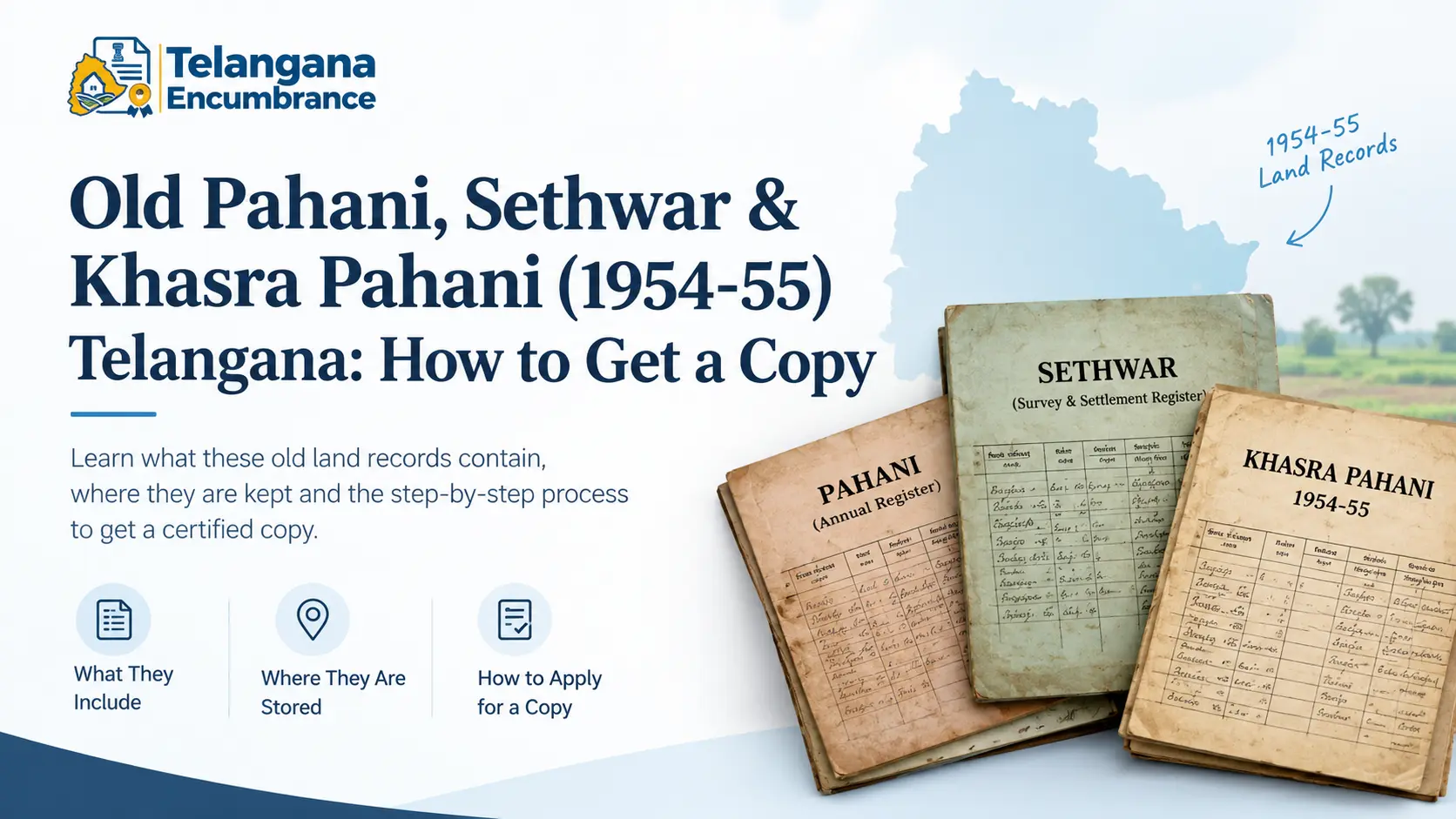
Your sale deed is registered. The survey number matches. And then the buyer’s advocate asks for the 1954-55 Khasra Pahani entry and the deal stalls because nobody in the family has seen that document in decades.This is a familiar deadlock in Telangana,
where ancestral land often traces back to the post-Hyderabad State settlement, and where the old pahani Telangana records from that era still decide who is treated as the original pattadar.
This article explains what the Khasra Pahani, Sethwar, and early Pahani records actually contain, where they are physically stored today, and how to apply for a certified copy without wasting trips to the wrong office.
What Are Pahani, Sethwar, and Khasra Pahani?
Telangana’s land records grew out of the Hyderabad State’s administrative system, which continued largely intact after 1948. The Khasra Pahani of 1954-55 was the first comprehensive record of rights prepared after the abolition of the jagirdari and other intermediary tenures. Revenue authorities treat it as the base document against which later record-of-rights exercises were built.
The Sethwar is a survey and settlement register sometimes called the “king of all registers” in Telangana’s land administration. For each survey number, it records the khatedar (landholder), total area, pot kharab (uncultivable land), assessment rate, and irrigation source. It was finalised only after survey errors and appeals were settled, which is why it carries weight as a settled record rather than a working one.
The Pahani is different in nature. It is the annual village account, listing the pattadar (recorded owner), the cultivator or occupant, the extent of land, and how it was acquired. Khasra Pahani is one specific document from 1954-55; “Pahani” on its own refers to the running record that revenue officials update year after year.
Why the 1954-55 Khasra Pahani Still Matters
Courts in Telangana have repeatedly used Khasra Pahani entries to establish who the original pattadar was and whether a plot was agricultural land at the time the Land Ceiling Act applied. In some disputes, it has been treated as the foundational record that later Pahanis and Sethwar entries either confirm or contradict.
For families, the practical value is narrower but sharper. You will typically need this record when:
- Legal heirs are fighting over ancestral land and the oldest available document is from the 1970s or later.
- Land was assigned or purchased in the 1950s and the original papers are lost.
- A temple, endowment, or private party claims ownership based on historical records.
- You need to prove the land’s character at a specific point in time, not just its current status.
One caution: the Khasra Pahani is a revenue record with a presumption of correctness. It is not a title deed, and it can be challenged or corrected through proper legal procedure.
You may also like to read these posts :👇
Pattadar Passbook Telangana: Download, Status & How to Apply Online
Pahani Telangana Online: How to Download Pahani via Bhu Bharathi
Maa Bhoomi, Bhumata & Webland Telangana: What Happened & Where to Check
Bhu Bharathi / Dharani Application Status: Track Mutation & Passbook
Where These Records Are Physically Kept
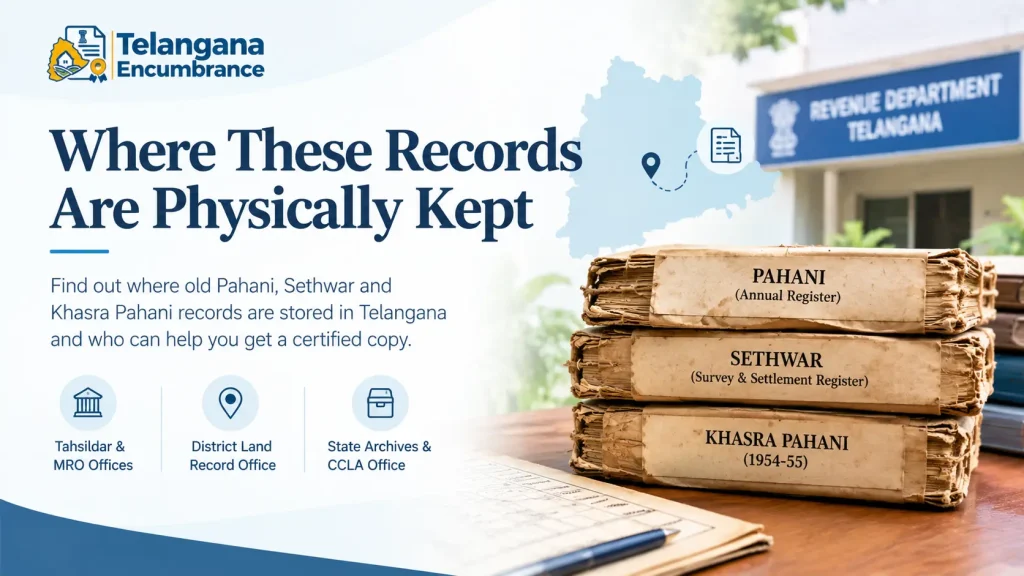
None of this is sitting on a portal. Dharani and the newer Bhu Bharati platform host current or recently updated records the 1954-55 registers exist only on paper, in most cases.
- Village and mandal level: Old Pahani patrikas are commonly held at the Tahsildar or Mandal Revenue Office (MRO) for the concerned mandal.
- District level: Sethwar registers and Wasool Baqi registers the correlation registers that link old survey numbers to new ones are usually kept at the District Land Record Office or the Collectorate.
- Archives: Some very old material has been moved to the State Archives or the office of the Chief Commissioner of Land Administration (CCLA).
Because these registers are fragile and sometimes water-damaged, access is often restricted, and most offices will not entertain a request without a written application.
How to Get a Copy: Step-by-Step
The process is entirely offline. It varies by district and by how old the record is, but the sequence below reflects how it generally works.
Step 1: Pin Down the Right Office Before Anything Else
This is where most applications die. A request filed at the wrong office can sit for weeks before someone tells you it belongs elsewhere. For agricultural records from the 1950s to 1970s, start with the MRO or Tahsildar of the mandal where the land sits.
For Sethwar and settlement records, the District Land Record Office or Collectorate is usually the correct authority. If you genuinely don’t know, walk into the Tahsildar office first they will redirect you faster than any online search.
Step 2: Write the Application Yourself
Address it to the Tahsildar or the relevant Revenue Divisional Officer (RDO). The application should state your name and contact details, your relationship to the land (owner, legal heir, power of attorney holder),
the village, mandal and district, the survey number(s), the exact document and year you want (for example, “Khasra Pahani 1954-55” or “Sethwar of 1354 Fasli”), and the purpose of the request.
Step 3: Attach the Supporting Papers
Commonly required documents include:
- Identity proof Aadhaar, voter ID, or passport.
- Proof connecting you to the land or the original owner sale deed, ancestral property documents, or a legal heir certificate.
- Any older land record copies you already hold, which help staff trace the correct file.
Step 4: Pay the Prescribed Fee
Certified extracts are issued on payment of a prescribed fee, but the amount and mode of payment (court fee stamp or cash) change from time to time and from office to office. Confirm the current rate at the counter where you apply rather than relying on figures you’ve heard from someone else.
Step 5: Submit and Get an Acknowledgement
Hand over the application at the designated counter and insist on a receipt or acknowledgement with an application number. Without it, follow-up becomes guesswork.
Step 6: Follow Up in Person and Collect
Retrieval of old registers takes time days to weeks is normal, and longer if the record has to be pulled from a district archive. When you collect the copy, check that it is signed and attested by the authorised officer, typically the MRO or Tahsildar. An unattested extract carries no official weight.
Two pitfalls worth knowing in advance. First, an application filed without proof of connection to the land is almost always rejected at the counter if you are a legal heir, sort out the heir certificate or family pedigree before you apply, not after.
Second, if the survey number has changed since the 1950s, staff will need the Wasool Baqi register to map the old number to the current one; mention both numbers in your application if you know them.
Documents Commonly Required
| Document | Why It’s Needed |
|---|---|
| Written application | States the request and its purpose |
| Identity proof (Aadhaar, voter ID, passport) | Establishes who is applying |
| Sale deed, ancestral documents, or legal heir certificate | Proves your connection to the land |
| Survey number details (old and current, if known) | Helps staff locate the right register |
| Previous land record copies, if any | Assists in tracing the correct file |
| Court fee stamp or payment receipt | As per the prescribed fee |
For legal heirs, the heir certificate or pedigree showing the link to the original pattadar is often the deciding factor. Missing it is the single most common reason applications are turned away.
Common Hurdles and How to Handle Them
Nothing is digitised. Pre-1980s records are not online, so expect to visit the office, possibly more than once. Plan for it rather than being surprised by it.
Registers are damaged or untraceable. If the specific volume cannot be found, ask the office in writing for alternative records covering the same period Wasool Baqi or Chowfasla registers often fill the gap.
Numbers don’t match across records. It is common for the extent or names to differ between the Khasra Pahani, the Sethwar, and later Pahanis. These discrepancies are a frequent trigger for disputes and may require a formal correction application, which is a separate process.
Jurisdiction has shifted. After Telangana’s district reorganisation, some records moved to new offices. Confirm the current jurisdiction before you travel.
You may also like to read these posts :👇
How to Find Survey Number of Land in Telangana
Bhu Bharathi / Dharani Application Status: Track Mutation & Passbook
ధరణి పోర్టల్ తెలంగాణ: భూ భారతిగా మార్పు – పూర్తి వివరాలు
Dharani EC Search: How to Get an Encumbrance Certificate in Telangana
Frequently Asked Questions
Can I download the 1954 Pahani in Telangana as a PDF online?
No. The 1954-55 Khasra Pahani is not available for download. You must apply for a certified copy from the Tahsildar or the relevant revenue office. Dharani and Bhu Bharati host current records, not historical ones.
What is the difference between Sethwar and Pahani?
Sethwar is a settled survey and settlement register listing finalised details for each survey number. Pahani is the annual village account recording the pattadar and cultivator for a given year. The Sethwar stays largely static; the Pahani is revised periodically.
Can I get a Sethwar copy from MeeSeva?
MeeSeva centres generally handle current Pahani and ROR 1B extracts. Old Sethwar and Khasra Pahani records normally require a direct application at the Tahsildar or District Land Record Office.
What if the old record cannot be traced?
Ask the office for a written response confirming that. You may then need to rely on later Pahanis, sale deeds, or court records and in some cases, a survey or settlement officer’s report.
Is the Khasra Pahani proof of ownership?
It carries a presumption of correctness and has evidentiary value, but it is not an absolute title deed. Courts have both relied on and questioned its entries depending on the facts.
How long does a certified copy take?
There is no fixed timeline. It depends on how accessible the register is and the office’s workload. Days to weeks is typical for records not in active use, and in-person follow-up is usually necessary.
A Final Word on Timing
If you are midway through a property transaction, start the record request before you need it, not after the buyer’s advocate raises a query old registers are pulled from storage at the office’s convenience, not yours.
And if a discrepancy surfaces between the Khasra Pahani and a later record, treat it as a signal to get legal help early rather than something you can argue your way through at the counter.

4 Comments
Pingback: Dharani EC Search | Get Encumbrance Certificate Online
Pingback: ROR-1B & Adangal Telangana | 1B Download Guide
Pingback: Revenue Maps & Cadastral Maps Online | State Guide
Pingback: Telangana Revenue Department | Services & Contacts