
Your property papers are ready, the buyer has paid the token advance, and then your lawyer asks for an EC from IGRS Telangana. You have no idea what that means, which portal to visit, or why a single missing transaction entry could stall the entire sale.
This guide answers all three: what the IGRS Telangana full form actually stands for, what the portal does, and how to pull an encumbrance certificate without wasting a week on trial and error.
What Does IGRS Stand For?
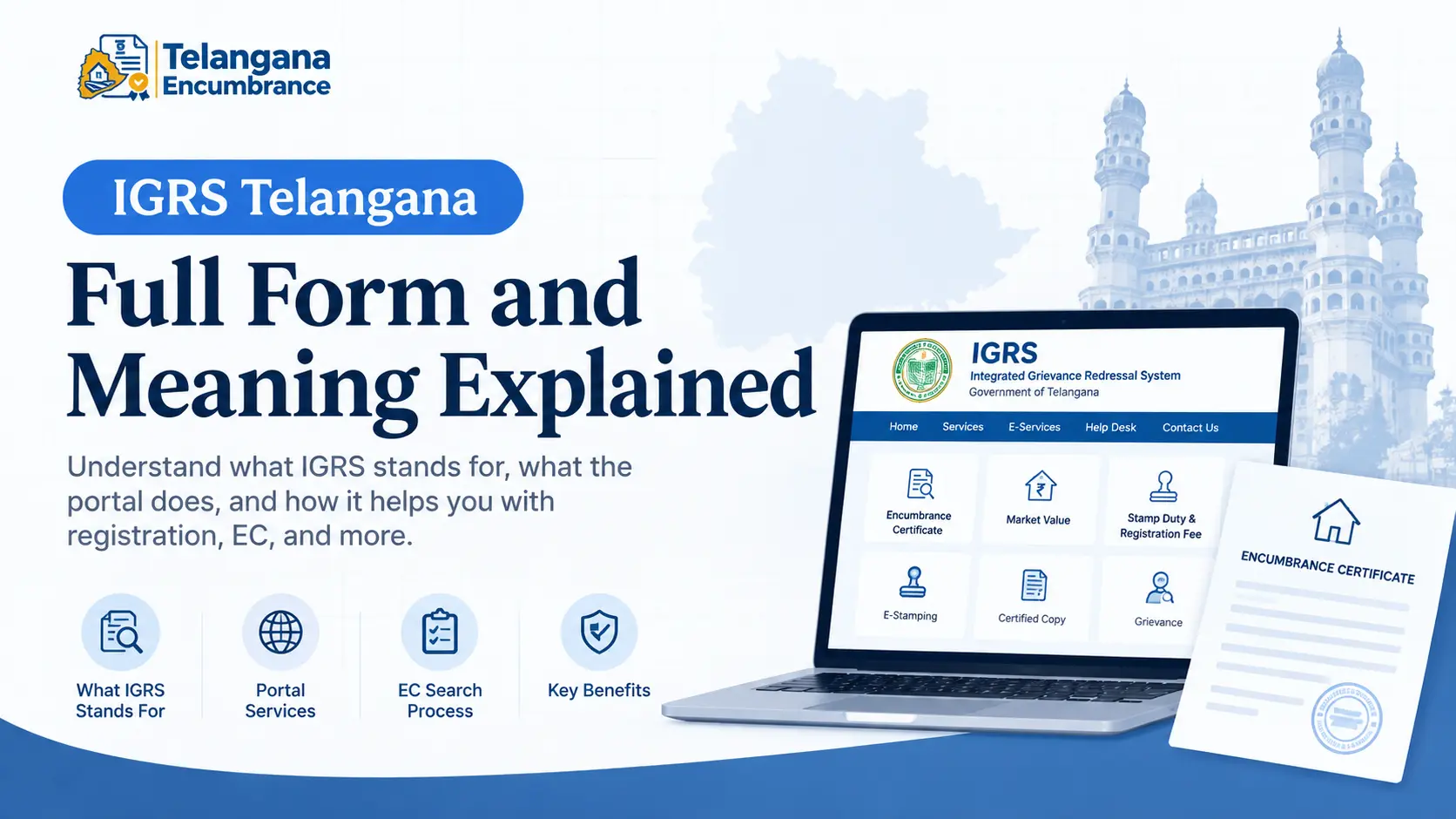
IGRS expands to Integrated Grievance Redressal System the name of the Telangana Registration and Stamps Department’s online platform. The confusion starts because the same four letters also stand for Inspector General of Registration and Stamps, the officer who heads the department.So when a sub-registrar says “IGRS,” they may mean the portal or their boss, depending on context.
The IGRS full form meaning shifts by state, too. Andhra Pradesh commonly uses the acronym for Inspector-General of Revenue and Stamps. Telangana’s portal carries the grievance redressal name because it does two jobs: deliver registration services and give citizens a channel to complain when those services fail.
What Exactly Does the IGRS Telangana Portal Do?
Think of it as the registration department’s front desk, moved online. Instead of queueing at a Sub-Registrar Office (SRO) for routine queries, you handle them from a browser:
- Encumbrance Certificate (EC) search and download the document that reveals registered loans, mortgages, and claims attached to a property
- Market value lookup government-notified land rates by district, mandal, and village, which set the floor for stamp duty
- Stamp duty and registration fee payment calculated and paid online rather than through physical stamp paper
- E-stamping electronic stamp certificates for transactions that need them
- Certified copy applications requesting duplicates of deeds registered earlier
- Marriage and society registrations services the department also administers
Each of these replaces a trip to an office. The grievance window matters just as much if a registration stalls or a record shows an error, you file a complaint through the portal and track it, rather than chasing clerks in person.
You may also like to read these posts : 👇
IGRS Telangana: Complete Guide to Registration & Stamps
Telangana Registration Charges: What You Actually Pay When Buying Property
Sub-Registrar Office (SRO) Telangana – List & Contact
The IGRS Objective: Why the System Exists
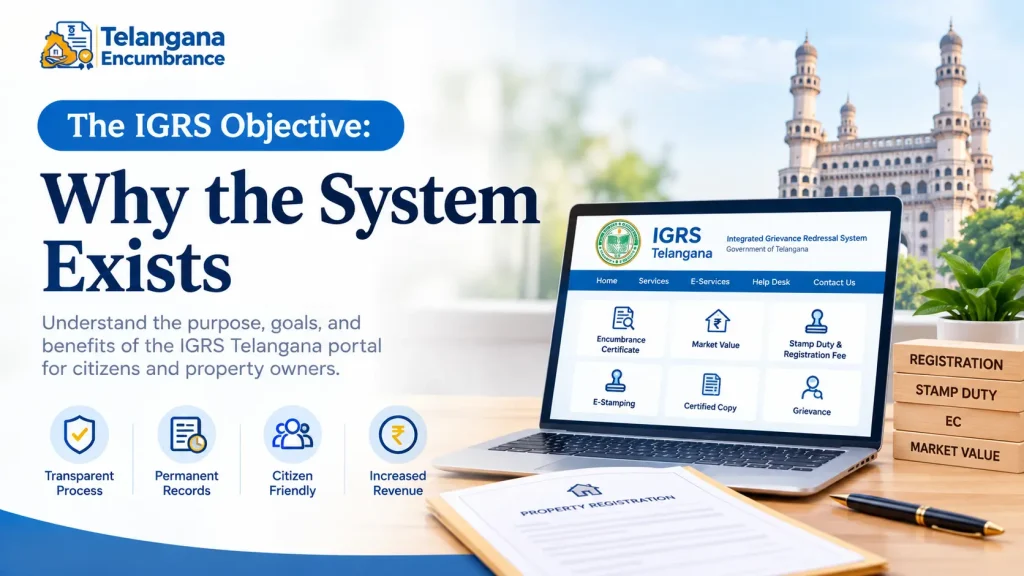
Property registration is one of Telangana’s steadiest revenue sources, through stamp duty, transfer duty, and registration fees. The portal’s stated purpose is to collect that revenue transparently while cutting the discretion that historically made registration slow and unpredictable.
The broader objectives:
- Preserve records permanently registered deeds serve as evidence in disputes decades later
- Let anyone verify a property title, rights, and obligations should be checkable without insider help
- Reduce repeat office visits most queries resolved online
- Make the process citizen-friendly fewer middlemen, fewer informal payments
Who Runs the IGRS Department?
The IGRS department sits within the Telangana Registration and Stamps Department, under the Inspector General of Registration and Stamps, reporting to the state government.
Records are maintained at district and sub-registrar level. The portal is the digital face; the legal registration itself still happens at your jurisdictional SRO.
Here’s where people trip up: agricultural land records live on a different system. The Revenue Department runs Dharani, launched in 2020 for agricultural land records, passbooks, and cultivation details.
Urban property transactions and their ECs generally flow through IGRS. Agricultural land registered after 2020 typically routes through Dharani. Searching the wrong portal returns nothing, and “nothing” gets misread as “clean property.”
How to Search for an Encumbrance Certificate on IGRS Telangana
This is the task that brings most people to the portal. The interface changes occasionally, but the logic holds:
- Open the official IGRS Telangana portal through the Telangana Registration and Stamps Department website. Avoid lookalike sites that charge extra for a free search.
- Find the Encumbrance Search option usually under Services or Quick Links on the homepage.
- Pick the district and the correct SRO. The EC database is indexed by the office where the original transaction was registered, not the one nearest your property today. If you don’t know your SRO, use the portal’s “Know Your SRO” feature.
- Enter property identifiers. Document number works if you hold the registered deed. Otherwise use survey number, plot number, or door number. For urban flats, door number search helps when survey subdivisions have changed. For agricultural land, the survey number is the most reliable handle.
- Set the search period. Lenders commonly ask for 13 to 30 years. Thirty years gives a fuller history; thirteen usually satisfies a home loan requirement.
- Submit and read the result. No transactions found means a nil EC, sometimes called Form 16. Transactions listed means Form 15 read every entry, not just the first page.
- Download the PDF and keep a copy for your lender and lawyer.
Two pitfalls worth knowing before you start. First, survey number formats vary across old deeds if 45/B/1 returns nothing, try 45B1, 45B/1, and 45/1B before concluding the record is missing.
Second, the SRO that registered your parent document may have been reorganised since; if your first search is empty, run it against adjacent SROs before panicking.
For agricultural land registered after 2020, run the search on Dharani instead.
Common Problems and What They Usually Mean
- Survey number mismatch resurvey or renumbering means old deeds carry outdated numbers. Try format variations; if all fail, the physical record at the SRO is your fallback.
- SRO boundary changes offices get split and merged over the years. An empty result from one SRO doesn’t mean the transaction doesn’t exist.
- Dharani data errors agricultural records on Dharani have seen entry mistakes, missing entries, and downtime. For agricultural purchases, cross-check against physical records and local revenue officials rather than trusting the screen alone.
- Pre-1983 records the digital database generally reaches back to around 1983 for most districts. Anything older needs a manual search at the SRO, and that takes time. Start early if your chain of title is old.
You may also like to read these posts : 👇
Telangana Market Value of Land – How to Check on IGRS
Telangana Stamp Duty & E-Stamp – Complete Guide
Non-Agricultural Property Registration Telangana: A Complete Guide
IGRS Full Form & Meaning – What is IGRS?
FAQs
Is IGRS the same as Dharani?
No. IGRS handles registered documents, urban property transactions, and encumbrance certificates. Dharani is the Revenue Department’s portal for agricultural land records, including passbooks. Urban registrations go through IGRS; agricultural land after 2020 is managed on Dharani.
What does IGRS stand for in Telangana?
Integrated Grievance Redressal System. The same acronym also refers to the Inspector General of Registration and Stamps, the department’s head.
How long does an EC take on IGRS Telangana?
An online search often finishes in minutes when the property details are correct and the record is digitized. A certified physical copy, or a search that hits record gaps, takes longer.
Can I search for an EC without a document number?
Yes by survey number, plot number, or door number. Name-based searches exist but are unreliable because of spelling variations, transliterations, and name changes after marriage or partition.
Is a nil EC the same as a clean title?
No. A nil EC means no registered transactions surfaced for the period searched. Unregistered claims, court attachments not yet recorded, and gaps in the digital database can all sit outside it. Treat it as one input into due diligence, not a verdict.
Can NRIs use the IGRS Telangana portal?
Yes, the services are accessible online. Registration itself may still require physical presence or a valid Power of Attorney in some cases. Verify your specific situation with the portal or a local representative.
A Final Word on Timing
If a property deal is moving, order the EC before you negotiate anything else a 30-year search on an old agricultural holding can surface a manual record problem that takes weeks to resolve, and no amount of urgency at the sub-registrar’s counter will compress that.
If a search returns something unexpected, or comes back empty when you know a transaction exists, go to the jurisdictional SRO with your document number in hand rather than re-running the same search online.

1 Comment
Pingback: Non-Agricultural Property Registration | NALA Guide