

What is CERSAI? (cersai meaning in hindi)
You are at the bank, loan sanction letter in hand, and you spot a line item: “CERSAI charges – ₹100.” Nobody explained it. Your loan officer shrugs and says it is a government fee.
You pay it and move on but if you are also buying property in Telangana, that small line item matters more than you think.
CERSAI meaning in hindi points to a central government registry that tracks every security interest created on property and assets against which loans are given.
Miss checking it before a purchase, and you could buy a flat that is already mortgaged to a bank you have never heard of.
This article covers the full form, what CERSAI does in banking, the charges you will see, and how it fits alongside Telangana’s own land records.
CERSAI Full Form and Meaning
CERSAI full form is Central Registry of Securitisation Asset Reconstruction and Security Interest of India. Strip away the long name and it is a single electronic database, run by the central government, where lenders record the rights they hold over your property when you borrow against it.
The registry was set up under Section 20 of the SARFAESI Act, 2002 and went live on March 31, 2011. Its purpose is narrow but critical: stop the same property from being pledged to multiple lenders without any of them knowing.
Before CERSAI, a borrower could take a loan from Bank A, then approach Bank B with the same title deed, and neither would find out until default.
In Hindi, CERSAI को “भारत के प्रतिभूतिकरण परिसंपत्ति पुनर्निर्माण और सुरक्षा हित की केंद्रीय रजिस्ट्री” कहा जाता है. So cersai means a national record where a lender’s charge on your property sits in public view until the loan is closed.
What is CERSAI in Banking? (cersai full form in banking)
cersai full form in banking refers to the same registry, viewed from the lender’s side of the table. When you take a home loan or loan against property, the bank creates a mortgage its legal right to take possession of the property if you stop repaying.
Under SARFAESI rules, notified banks and financial institutions must file this charge with CERSAI within 30 days of creating it.
The filing has two consequences. First, any other lender searching the database by the debtor’s name will see your existing charge.
Second, if you default and the bank wants to invoke SARFAESI powers, registration is a precondition an unregistered charge cannot be enforced through that route.
What is CERSAI from a borrower’s perspective? It is why a second bank can refuse your loan application on a property you thought was unencumbered, and why your own loan shows up in a public registry until you clear it and the lender files a satisfaction entry.
Is CERSAI Registration Mandatory?
For banks and financial institutions notified under the SARFAESI Act, registration is compulsory. A government notification effective January 24, 2020 made this explicit: secured creditors cannot exercise enforcement rights unless the security interest is registered with CERSAI.
Borrowers never file anything themselves it is entirely the lender’s job. But you do pay for it, usually as a small deduction from your loan account or a line in the processing fee schedule.
Lenders outside the SARFAESI notification are not barred from filing. The RBI has encouraged wider registration of equitable mortgages, where title deeds are deposited with the bank instead of a formal registered mortgage deed. That distinction matters for property buyers in Telangana, and we will come back to it.
You may also like to read these posts : 👇
Encumbrance Certificate Telangana – Complete Guide
MOD (Memorandum of Deposit) Full Form & Meaning in Property Loans
Release Deed vs Relinquishment Deed Meaning, Stamp Duty & Registration
CERSAI Charges Explained (cersai charges in hindi)
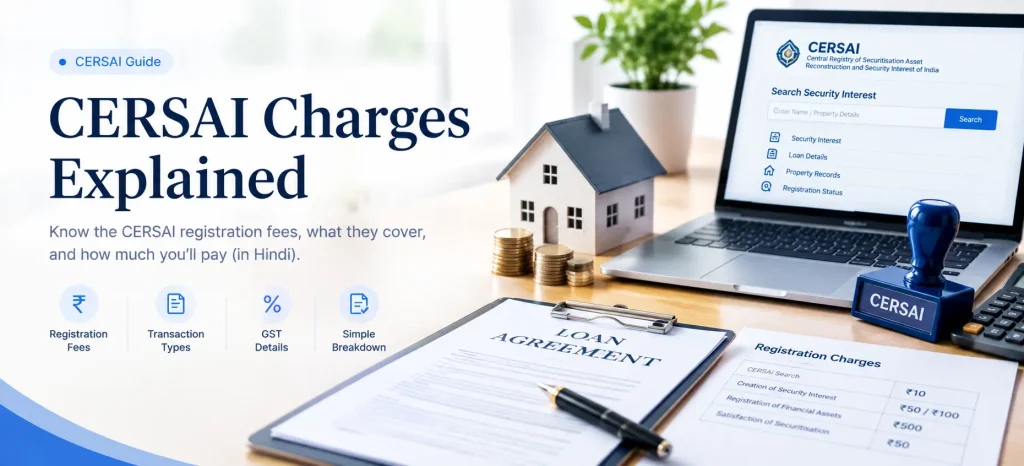
CERSAI charges are statutory fees for registering, modifying, or satisfying a security interest. They go to the registry, not the bank. The lender pays on your behalf and recovers the amount from you.
Fees depend on the transaction type and loan size. Based on publicly available information from lenders, the structure looks roughly like this (excluding GST):
| Type of Transaction | Indicative CERSAI Fee (Excl. Tax) |
|---|---|
| CERSAI Search | ₹10 |
| Creation of Security Interest (loan up to ₹5 lakh) | ₹50 |
| Creation of Security Interest (loan above ₹5 lakh) | ₹100 |
| Registration of Financial Assets (securitisation) | ₹500 |
| Satisfaction of Securitisation | ₹50 |
Treat these as indicative only. Check the official CERSAI portal or your lender for current rates before budgeting, since fee notifications get revised.
What is CERSAI charges in hindi translates to: यह एक वैधानिक शुल्क है जो संपत्ति पर बनाए गए बंधक या सिक्योरिटी इंटरेस्ट को केंद्रीय रजिस्ट्री में दर्ज कराने के लिए लिया जाता है। The fee is generally non-refundable, and for most home loans it is a one-time cost that barely registers against the total borrowing.
How CERSAI Registration Works: Step-by-Step
You will not log into the CERSAI portal yourself. The lender does. But knowing the sequence helps you spot when something has stalled.
- Loan sanction and mortgage creation. After sanction, the lender creates a charge on the property either through a registered mortgage deed or by taking deposit of title deeds (equitable mortgage). In Telangana, a registered mortgage deed will also be recorded with the sub-registrar and reflected in your Encumbrance Certificate.
- Lender files on the CERSAI portal. The bank logs in and enters the security interest particulars borrower details, property details, loan amount, and charge type. This filing is due within 30 days of charge creation.
- CERSAI fee is paid. The applicable fee is remitted during filing. In practice, it appears as a debit in your loan account or as part of the processing fee.
- Registration reference is generated. The filing is recorded, and the lender receives a registration reference. Ask your loan officer for this reference number it is useful if you ever need to follow up on satisfaction later.
- Modifications and satisfaction. If the loan is restructured, transferred, or fully repaid, the lender must file the corresponding update. On full repayment, a satisfaction entry releases the charge.
- Search before you buy. A buyer or their advocate can run a CERSAI search by the seller’s name. This sits alongside the EC from IGRS Telangana and land records on the Dharani portal state records show ownership and transactions, while CERSAI shows whether a lender holds a charge.
Two pitfalls worth knowing. First, an equitable mortgage may not show up clearly in your EC if the title deeds were simply deposited with the bank the CERSAI search is what catches it.
Second, if your builder or seller took a construction loan against the project land, that charge can sit on the property even after your sale deed is registered. Search the developer’s name too, not just the individual seller’s.
Information and Documents Involved
Since the lender files, you are not submitting anything directly to CERSAI. The data used comes from paperwork already in your loan file:
- Loan agreement showing the sanctioned amount and borrower name
- Mortgage deed or title deed particulars for the pledged property
- Borrower KYC PAN, Aadhaar, or whatever was submitted at application
- Property identification: address, survey number, and registration details
If you are running a CERSAI search yourself before a purchase, you generally need the debtor’s name and payment of the nominal search fee. In Telangana, having the seller’s PAN handy helps narrow results, since common names can throw up multiple entries.
Common Mistakes and Points to Note
- Treating CERSAI as a substitute for EC or Dharani verification. It is not. CERSAI only captures loan charges filed by lenders. Ownership, title flow, and transaction history come from the Telangana registration department’s EC and Dharani records. You need both.
- Skipping the CERSAI search because the EC looks clean. Equitable mortgages are the usual culprit here the charge exists, but the EC may not tell the full story.
- Forgetting the satisfaction filing after repayment. This is the one that bites people years later. You close your home loan, get a no-dues letter, and assume everything is clear. Then you try to sell, and the buyer’s advocate finds an open CERSAI charge. Follow up with your lender within a few weeks of closure and confirm the satisfaction has been filed.
- Expecting the fee to be negotiable. It is a statutory amount. The lender’s own administrative charge for handling the filing is a separate matter and varies by institution.
You may also like to read these posts : 👇
Partition Deed – Meaning, Format, Documents & Registration Process
How to Verify Original Property Documents & Spot Fake Property Papers
Mortgage Deed & Equitable Mortgage Registration Stamp Duty Explained
Frequently Asked Questions (FAQs)
Q1: What is the full form of CERSAI in Hindi?
CERSAI का पूरा नाम सेंट्रल रजिस्ट्री ऑफ सेक्युरिटाइजेशन एसेट रिकंस्ट्रक्शन एंड सिक्योरिटी इंटरेस्ट ऑफ इंडिया है.
Q2: Is CERSAI registration mandatory for all loans?
It is mandatory for banks and financial institutions notified under the SARFAESI Act, covering security interests on immovable property, movable assets, and certain intangible assets. For borrowers, the lender handles the filing.
Q3: Who pays the CERSAI charges?
The fee is statutory. The lender pays at filing and debits the amount, plus applicable taxes, to your loan account or bundles it into processing fees.
Q4: Can I search CERSAI myself?
Yes. The portal offers a search facility, usually by the debtor’s name, for a nominal fee. It is worth doing before purchasing property or extending a private loan.
Q5: What happens if the lender does not register with CERSAI?
A notified lender that skips registration cannot enforce its security interest under the SARFAESI Act. Your repayment obligation does not disappear only the lender’s fast-track enforcement route does.
Q6: How do I check if my property has a CERSAI charge?
Search the CERSAI portal using the borrower’s or owner’s name. Your advocate or lender can do this on your behalf. Cross-verify with the EC from IGRS Telangana for the complete picture.
Closing Thoughts
If you have just closed a loan, the most useful thing you can do is chase the satisfaction filing not next year, but within a month of the final payment.
Lenders process these in bulk, and a charge that lingers in the registry has a way of surfacing at the worst possible moment, usually when a buyer’s lawyer is doing their checks.
If you find an open charge that should have been closed, write to the lender’s nodal officer with your loan account number and closure date, and keep the acknowledgement.

6 Comments
Pingback: MOD Full Form & Meaning | Property Loan Guide
Pingback: Release Deed vs Relinquishment Deed | Key Differences
Pingback: Partition Deed | Format, Documents & Registration
Pingback: How to Verify Original Property Documents | Easy Guide
Pingback: Mortgage Deed & Equitable Mortgage Registration | Guide
Pingback: How to Search Encumbrance Certificate by Name in Telangana |