
You’ve found a property you like, negotiated the price, and are ready to pay the advance.Then the bank officer or your lawyer asks for one document you’ve never heard of: an Encumbrance Certificate.
Your first instinct might be to ask what does that even mean? And if you’re dealing with records in a state where the official language isn’t English, the confusion multiplies.
Understanding the encumbrance meaning in Hindi, Tamil, Telugu, or Marathi isn’t just about translation it’s about knowing what you’re looking for in those documents.
If you can’t recognize the local term for “encumbrance” on a land record, you might miss a red flag that could cost you your deal or your loan approval.
This article breaks down what an encumbrance is, what it’s called in four major Indian languages,
and how to actually get that all-important certificate without getting lost in bureaucracy.
What Exactly Is an Encumbrance?
In property law, an encumbrance is any claim, lien, or liability attached to a piece of land or property that is held by someone other than the owner.
It doesn’t necessarily stop the owner from selling, but it does limit what they can do with the property or how it can be transferred.
Take a simple example. Suppose you’re buying a plot, and the seller had taken a home loan against it five years ago. That bank has a registered charge on the property.
Until the seller clears that loan and gets a release deed, the bank’s claim remains. That claim is an encumbrance.
When you apply for a loan yourself, the bank wants to ensure that the property isn’t already serving as collateral for someone else.
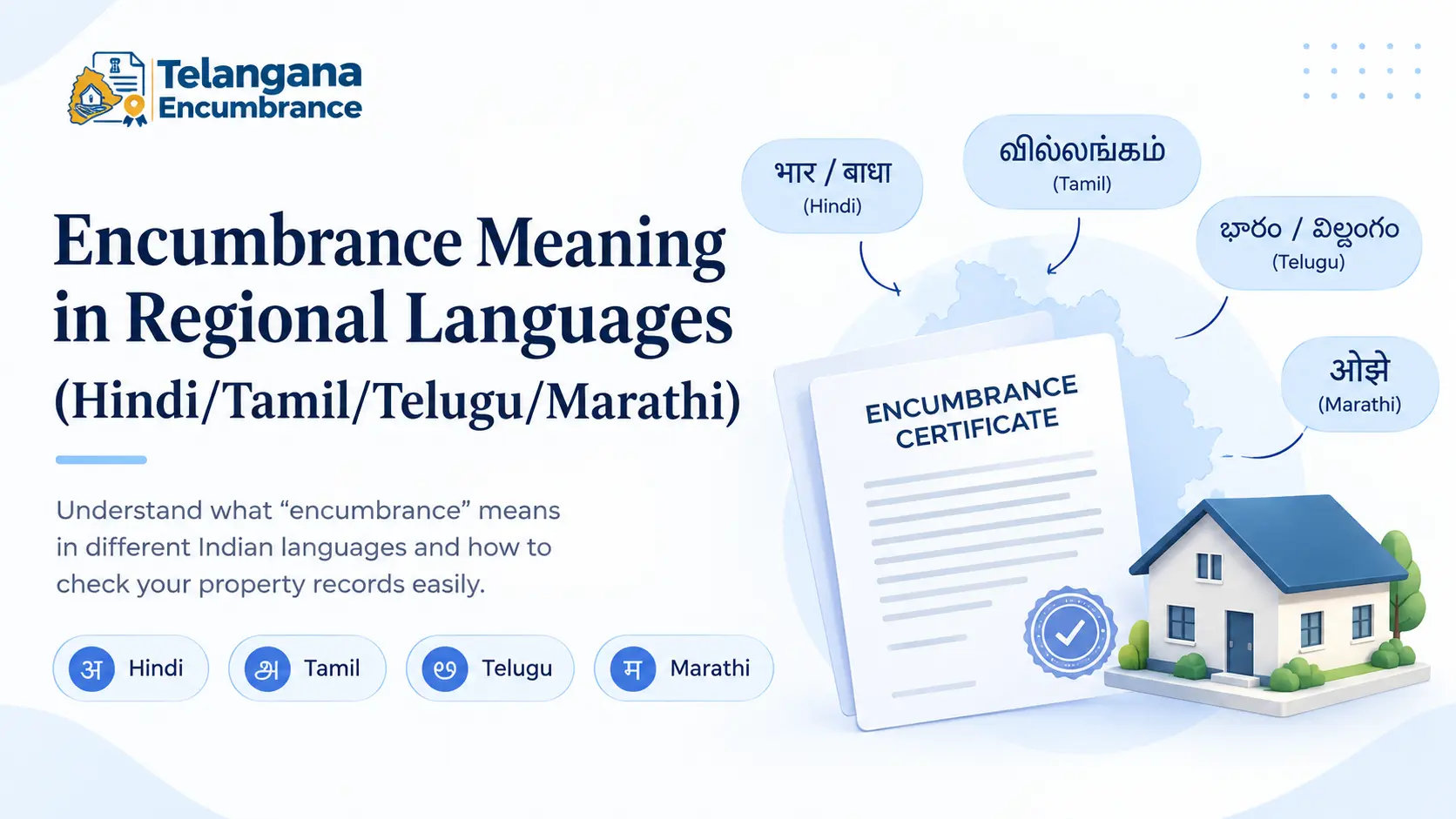
The everyday encumbrance meaning in Hindi is straightforward it’s a भार (bhaar) or बाधा (badha). In plain terms, it’s a burden on the property.
The Encumbrance Certificate (EC) is the document that either confirms these burdens exist or certifies that the property is free of them for a specific period.
You may also like to read these posts :👇
Encumbrance Meaning – Simple Explanation & Types
What is an Encumbrance Certificate? Full Explanation
Encumbrance Meaning in Hindi (भार / बाधा)
For anyone navigating property registrations in Uttar Pradesh, Delhi, Madhya Pradesh, or Bihar, knowing the encumbrance meaning in Hindi is often the difference between understanding your document and signing it blindly.
The most widely understood Hindi term is भार (Bhaar) which translates literally to “weight” or “burden.”
A loan on a property is a financial bhaar. Legal restrictions, pending litigation, or unpaid dues are all bhaar as well.
The second common term is बाधा (Badha), meaning an obstruction or hindrance. While less frequently used in official forms, it appears in legal correspondence and older property documents.
If you’re reading a sale deed or a property title document in Hindi and see either of these words, pay attention they’re flagging a potential issue.
What to look for in Hindi documents:
- Encumbrance: भार (Bhaar), बाधा (Badha), आलग्नता (Alagnta)
- Encumbrance Certificate: भार रहित प्रमाण पत्र (Bhaar Rahit Pramaan Patra) literally “burden-free certificate”
If a document mentions “इस संपत्ति पर कोई भार नहीं है” (there is no burden on this property), that’s the equivalent of a “Nil Encumbrance” statement.
Encumbrance Meaning in Tamil (கலன் / வில்லங்கம்)
Tamil Nadu has one of the most digitized registration systems in the country through the TNREGINET portal.
Yet many buyers from other states, or even local first-time buyers, stumble when they encounter the Tamil terminology.
The primary Tamil equivalent for encumbrance is வில்லங்கம் (Villangam) . This word appears in the name of the certificate itself வில்லங்கச் சான்றிதழ் (Villangam Saanthithal) which is the Encumbrance Certificate.
Villangam essentially means an impediment or a legal obstruction. When you hear someone ask for a villangam certificate, they’re asking for the EC.
The secondary term is கலன் (Kalan) , which refers to a charge or a claim on property. It’s used more in banking and financial contexts.
If you’re looking for a nil certificate of encumbrance on property tamilnadu, you’re essentially asking for proof that the property is free of both kalan and villangam during a specific period.
Key terms for Tamil Nadu property records:
- Encumbrance: வில்லங்கம் (Villangam), கலன் (Kalan)
- Encumbrance Certificate: வில்லங்கச் சான்றிதழ் (Villangam Saanthithal)
One practical tip: when you apply for a villangam certificate online tamilnadu through TNREGINET, you’ll have to select the sub-registrar office jurisdiction and the document number range.
The portal will ask for the time period if you’re applying for a home loan, banks typically ask for the last 15 years.
Encumbrance Meaning in Telugu (భారం / విల్లంగం)
In Telangana and Andhra Pradesh, property records have undergone massive digitization, especially with Telangana’s Dharani portal.
The encumbrance certificate meaning in telugu is most commonly expressed through two words: భారం (Bhaaram) and విల్లంగం (Villangam) .
Bhaaram translates to “burden” and is the everyday term used in conversation. Villangam is the more formal legal term,
borrowed from the same root as the Tamil usage, and appears in official documentation.
If you’re searching for what is encumbrance certificate in telugu on government websites, look for the option that says భార రహిత ధృవీకరణ పత్రం (Bhaara Rahita Dhriveekarana Patram) which literally means “burden-free verification certificate.” In practice, people simply ask for a Villangam certificate or EC.
For a property in Hyderabad or elsewhere in Telangana, here’s what matters: when you log into the Dharani portal, the term you’re looking for under land records will be Villangam.
A “Nil Encumbrance” status on Dharani means there are no registered charges against that survey number.
That status భార రహిత (Bhaara Rahita) is the green flag your bank is looking for.
Encumbrance Meaning in Marathi (ओझे)
Maharashtra property buyers whether in Mumbai, Pune, Nagpur, or rural districts frequently encounter the Marathi term ओझे (Ojhe) .
The encumbrance meaning in marathi is simply ojhe, which means a burden or weight.
When you hear about encumbrances meaning in marathi, it’s the same word: ओझे. It could be a mortgage,
an unpaid property tax liability, a court attachment, or even a right of way that benefits a neighbour. All of these are ojhe.
The encumbrance certificate meaning in marathi is often phrased as “भार रहित प्रमाणपत्र” (Bhaar Rahit Pramaanpatra), though many banks and lawyers in Maharashtra simply call it an EC or Nil Encumbrance Certificate.
If you’re dealing with older property records in Maharashtra, you might also see the term आकस्मिकता (Aakasmikata) used in some legal contexts, though it’s far less common than ojhe.
Marathi terms to know:
- Encumbrance: ओझे (Ojhe)
- Encumbrance Certificate: भार रहित प्रमाणपत्र (Bhaar Rahit Pramaanpatra)
Here’s a practical point for Maharashtra: the IGRS Maharashtra portal allows you to apply for ECs online. But many older properties still have manual records in the local sub-registrar’s office.
If your property’s registration predates digitization, you’ll need to ask the clerk for the “ojhe mukt pramaanpatra” (encumbrance-free certificate) to ensure you’re understood.
Why You Can’t Skip the Encumbrance Certificate
Across India, the Encumbrance Certificate serves one primary purpose: it establishes the chain of ownership and confirms
whether any financial or legal liability is attached to the property. It’s not just a bureaucratic formality it’s your safety net.
Four specific situations make the EC non-negotiable:
- Property purchase: Without an EC, you can’t know if the seller has cleared their previous loans. A seller might have a verbal assurance, but the registration office records are what legally matter.
- Home loans: Banks don’t rely on your word or the seller’s. They mandate an EC for the last 10 to 30 years, depending on their policy, to ensure the property isn’t already pledged elsewhere.
- Property tax mutation: Municipal bodies often ask for an EC to approve ownership changes in their records. Without it, you could end up paying tax on a property that isn’t legally recognized as yours.
- EPF withdrawals: The Employees’ Provident Fund Organisation requires an EC if you’re withdrawing your EPF balance to buy or construct a house. It’s their way of verifying that the property has a clean title.
Step-by-Step Guide to Getting an Encumbrance Certificate
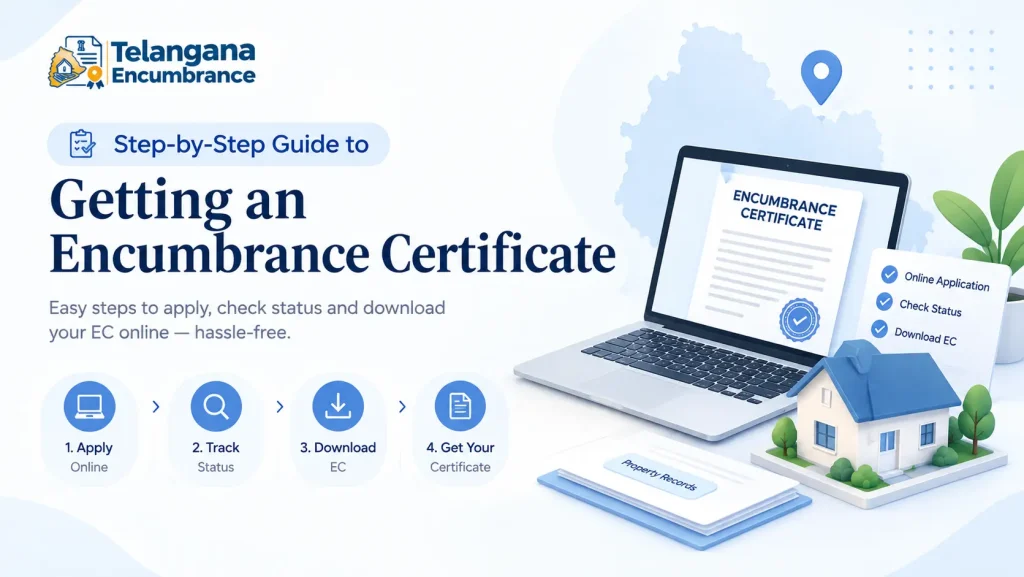
The exact process depends on your state, but the steps follow a pattern. Here’s what actually happens when you apply.
Step 1: Find the right state portal
Start with the official registration or land records portal for your state. Telangana property owners use Dharani. Tamil Nadu uses TNREGINET. Maharashtra has IGRS Maharashtra.
Andhra Pradesh uses Meebhoomi or the registration department’s portal. These are the only official sources avoid third-party websites that charge extra for the same service.
Step 2: Choose Nil or Non-Nil
This decision is simpler than it sounds. A Nil EC is issued when no transactions are registered against the property during the period you specify.
A Non-Nil EC lists every registered transaction (sales, mortgages, gifts, releases) that occurred.
If you’re buying a property, your bank or lawyer will typically ask for a Non-Nil EC for the last 15-20 years.
The Nil EC alone doesn’t prove clean title it only proves no transactions happened in that window.
A Non-Nil EC shows you the ownership history so you can trace it back.
Step 3: Fill in the application
You’ll need:
- The district and sub-registrar office jurisdiction where the property is registered.
- The survey number or plot number (this is critical get this exactly as it appears in the sale deed).
- The village or ward name.
- The period for which you need the certificate (for example, 01/04/2010 to 31/03/2025).
Entering the wrong survey number by even one digit will return someone else’s property records or a “No Records Found” error.
Double-check this against your sale deed or the property’s index number.
Step 4: Pay the fee and submit
The fee varies by state and the number of years you’re requesting. Some states charge per year; others have a flat fee for a standard period.
Pay online through the portal’s payment gateway. Offline applications require a challan payment at a designated bank or at the sub-registrar’s cash counter.
Step 5: Portal processing and verification
In digitized states, the portal processes your application automatically if the records are already scanned.
However, if the transaction is recent say, registered in the last few months the records may not be fully indexed online.
In that case, you’ll get a “pending” status, and the sub-registrar’s office will verify the physical documents. This is where delays happen.
A pitfall to watch for: Even after you receive the EC online, the office might issue a separate physical copy. Some banks insist on the stamped physical copy from the sub-registrar.
Don’t assume the downloaded PDF is sufficient—check with your bank beforehand.
Step 6: Collect your certificate
If you applied online and your state issues digital ECs, you can download the certificate immediately or within a few working days. For offline applications, you’ll typically receive it in 7 to 15 days.
If the records are old or complex, this can stretch to a month. Start the application early don’t wait until the day before your loan application is due.
Documents Typically Required
These are the documents you’ll usually need, though requirements vary by state and sub-registrar office:
- A properly filled application form in most states, this is Form 22 or an equivalent online form.
- The property’s survey number, plot number, or document number from the sale deed.
- The village name, district, and sub-registrar jurisdiction.
- The applicant’s Aadhaar card and a government-issued photo ID (PAN card, voter ID, or driving licence).
- A copy of the sale deed or the index number of the property’s last registered transaction.
If you’re applying through a power of attorney, carry the notarized POA document. If you’re the buyer and the property is still in the seller’s name, you’ll need the seller’s consent or a copy of the agreement of sale.
Frequent Mistakes That Derail EC Applications
These are the errors people make most often. Avoid them and you’ll save yourself weeks of frustration:
Applying for too short a period. A 5-year EC is rarely sufficient. Most banks ask for 15 years minimum. Some ask for 20 or even 30.
Always check your bank’s requirement before submitting. If you apply for 5 years and the bank wants 15, you’ll have to start over and pay again.
Relying on the seller’s EC. The seller might provide an EC they obtained six months ago. That doesn’t cover the period between then and now.
New charges could have been registered in those six months. Always get a fresh EC that covers the date up to the present.
Ignoring non-monetary encumbrances. Not every encumbrance is a loan. Easement rights (like a path through your property for a neighbour’s access),
lease agreements that haven’t been terminated, or court attachments (like a pending partition suit) are all encumbrances.
An EC doesn’t always capture these if they’re not registered. You may need a separate title search from a lawyer to identify them.
Forgetting the physical verification. In several states, even after the online application is processed, you must visit the sub-registrar’s office with original documents for verification.
This step isn’t optional if you skip it, your application will remain unissued indefinitely.
Frequently Asked Questions
1. What is the encumbrance meaning in Hindi when I see it on a property document?
In Hindi, encumbrance is referred to as भार (Bhaar) or बाधा (Badha). If a property document says “इस पर कोई भार नहीं” (there is no burden on this), it means the property is encumbrance-free for that period.
2. How do I get a villangam certificate online in Tamil Nadu?
Visit the official TNREGINET portal. Under the “Encumbrance Certificate” section, select your district and sub-registrar office.
Enter the property details survey number, village, and the period and pay the fee online. The certificate will be available for download once processed.
3. What’s the difference between a Nil EC and a Non-Nil EC?
A Nil EC confirms that no transactions were registered against the property during the specified period.
A Non-Nil EC lists all registered transactions sales, mortgages, gifts, or releases that occurred.
If you’re buying a property, ask for a Non-Nil EC for the last 15 years so you can verify the chain of ownership.
4. Can I get an Encumbrance Certificate for a property outside my home state?
Yes. You need to apply through the registration department of the state where the property is physically located.
For example, if you live in Delhi but own property in Maharashtra, you apply through IGRS Maharashtra, not the Delhi registration office.
5. What if the official portal shows no records for my property?
“No records” could mean the property records haven’t been digitized yet, or the registration happened before the digitization cutoff date. In such cases, visit the sub-registrar’s office with your sale deed.
The office will verify the physical register and issue a manual certificate. This is common for properties registered before the 2000s.
6. Does an Encumbrance Certificate expire?
The EC itself doesn’t have an expiry date it covers a specific period. However, it becomes outdated as soon as a new transaction is registered against the property.
If you obtained an EC six months ago and the seller took a new loan in the interim, the old EC is effectively useless. Always get a fresh EC that covers the period up to the current date.
One Final Word
The Encumbrance Certificate is one of the few documents in Indian real estate that genuinely protects both buyer and lender.
It doesn’t guarantee the property is free of every possible defect unregistered easements, verbal agreements, or pending court cases may not appear on an EC.
That’s why you should always combine the EC with a lawyer’s title search.
But for the vast majority of transactions loan approvals, property sales, and legal verifications the EC remains the first and most important check.
Start the application as early as you can, get the period right, and if the portal seems stuck, don’t wait endlessly visit the sub-registrar’s office in person.
A conversation with the clerk often resolves what a week of waiting online cannot.
Disclaimer: This article provides general informational content about property encumbrances and land records. It is not legal advice. State government portals, fees, and processing times change frequently.
Always verify current procedures on the official website of the respective state’s registration department or consult a qualified property lawyer for your specific case.

3 Comments
Pingback: What is an Encumbrance Certificate? | Easy Guide
Pingback: Telangana EC Search Online Free | Quick Guide
Pingback: TS EC Download | Telangana EC Guide