
Your plot has a clear title, the layout is approved, and the seller insists everything is in order. Then the sub-registrar’s office flags one line in the Pahani: the land is still classified as agricultural. Registration stalls, the buyer’s loan is held up, and the deal sits in limbo until a NALA conversion is completed.
This situation is common across Telangana, where lakhs of acres were sold as developed plots without the underlying land classification ever being changed. This article walks through what a NALA certificate actually is, how the process works on the dharani non agriculture portal and the newer Bhu Bharati system, and how to complete a nala certificate download once your application is approved.
What a NALA Certificate Actually Confirms
A NALA certificate is the revenue department’s record that a specific parcel of agricultural land has been assessed and converted for non-agricultural use under the Telangana Non-Agricultural Lands Assessment framework.
The certificate does more than change a label in the records. It confirms three things at once: that the land is legally permitted to be used for non-agricultural purposes, that the applicable conversion fee has been paid, and that the Pahani now reflects the new classification. If any one of these is missing, the conversion is not complete, regardless of what a seller or broker claims.
The consequences of skipping conversion are concrete. Revenue and municipal authorities periodically demolish structures built on unconverted agricultural land. Banks generally refuse home loans or plot loans when the Pahani classification does not match the actual use. And when you try to resell, the buyer’s advocate will spot the mismatch during title verification, which either kills the deal or forces a price renegotiation.
Dharani, Bhu Bharati, and Where NALA Fits
Telangana’s land records system has been in transition, which is a major source of confusion for applicants.
The Dharani portal launched in October 2020 as the state’s integrated Land Records Management System, handling everything from passbook updates to NALA applications. Since then, Telangana has begun rolling out the Bhu Bharati system under the Telangana Bhu Bharathi Act, 2025, in phases across districts.
Here is what matters practically: the underlying NALA process has not changed with the platform shift. You still submit an application, pay the conversion fee, attend a biometric slot, and wait for field verification and Collector-level approval. What changes is the interface you use and, in some districts, the office where your slot is processed.
Separately, the IGRS Telangana portal handles the actual property registration once conversion is done. NALA conversion and property registration are two distinct steps. Completing one does not automatically complete the other.
You may also like to read these posts : 👇
IGRS Full Form & Meaning – What is IGRS?
IGRS Telangana Full Form and Meaning Explained
IGRS Telangana Guide: Land Registration and Document Search
Telangana Stamp Duty & E-Stamp – Complete Guide
The NALA Conversion Process, Step by Step
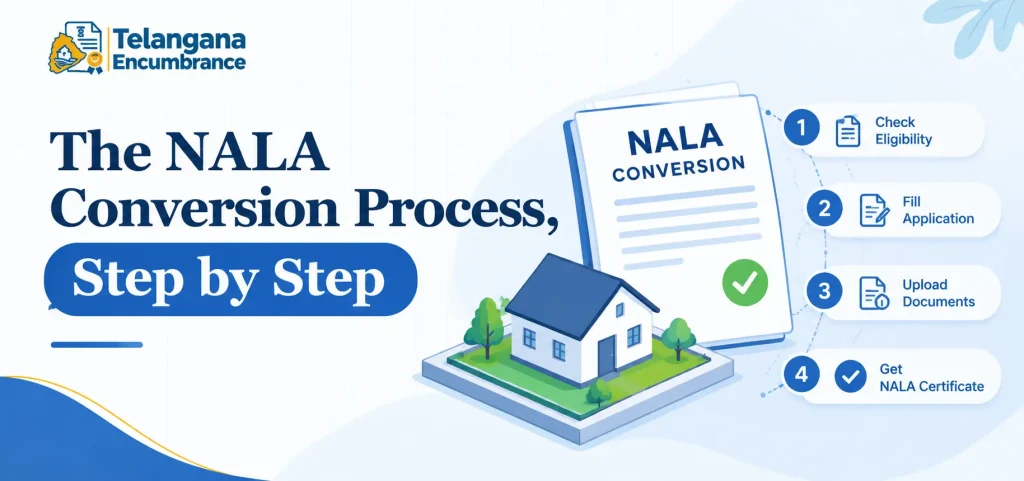
The workflow below reflects how the process generally runs. District-level practices vary, and the platform in use may differ depending on where your land is located.
Step 1: Prepare Your Documents Before Touching the Portal
Gather everything first. Applying with incomplete documents is the single most common reason applications bounce back. You will typically need:
- Pattadar Passbook and current Pahani (ROR 1B)
- Latest registered sale deed
- Encumbrance Certificate, commonly covering 13 years or more
- Survey sketch showing the exact extent to be converted
- Aadhaar and PAN of the applicant
- Land revenue receipts showing dues are cleared
Before submitting anything, confirm the land is not listed under Section 22-A prohibitory properties and has no pending court litigation. A Section 22-A listing will stop your application at the Tahsildar level, and you will have wasted the fee.
Step 2: Submit the Application Online
Log in to the applicable portal and select the NALA conversion option. Enter your passbook number and specify the extent of land you want converted against the survey numbers in your passbook.
A pitfall worth knowing: if you only want to convert part of a survey number, the extent must be entered precisely and must match your survey sketch. Rounding off the extent to an easy figure is a common mistake that triggers a field inspection discrepancy and delays approval by weeks.
Step 3: Pay the Conversion Fee
The fee is calculated as a percentage of the land’s basic value as per IGRS records. Within GHMC limits, the rate is generally around 3% of basic value; outside GHMC, it is typically around 5%. Because basic values vary widely by location, the absolute amount can differ substantially between two plots of the same size.
Do not rely on figures quoted by agents or old blog posts. Check the official portal for current rates, since these are subject to revision.
Step 4: Book Your Slot and Attend Biometric Verification
After payment, book a slot through the portal and visit the designated office usually the Tahsildar cum Joint Sub-Registrar office on the appointed date. Your application appears in the operator login, where witness details, biometric data, and photographs are captured.
Bring your original documents to this appointment, not photocopies. If a witness cannot attend, confirm in advance whether an alternative arrangement is permitted, as this varies by office.
Step 5: Field Inspection and Approval Chain
From here, the file moves through three levels. The Tahsildar or MRO conducts a field inspection covering ownership, boundaries, extent, current usage, and encumbrances.
The report goes to the Revenue Divisional Officer, who checks zoning compliance against HMDA or DTCP master plans. The District Collector issues the final conversion order.
Second pitfall: construction already standing on the land during inspection can complicate or delay the process. Converting before you build is always the cleaner route.
Step 6: Pahani Update and Certificate Generation
Once approved and the fee is confirmed paid, the Pahani is updated to show the non-agricultural classification. The NALA certificate is generated and becomes available on the portal.
Downloading Your NALA Certificate
After the Pahani reflects the converted status, you can retrieve the certificate:
- Log in to the portal with your registered credentials.
- Open the land records or application status section.
- Locate your application using the application number or passbook details.
- Download the transaction summary, eChallan, and the NALA certificate.
If the certificate does not appear despite an approved status, the issue is usually a sync delay between the revenue office and the portal. Visiting the local Tahsildar office with your application number resolves most of these cases faster than waiting.
Common Mistakes That Cost Time and Money
Trusting a broker’s word on conversion status. Verify the Pahani classification yourself on the portal. A certificate shown on a phone screen proves nothing.
Assuming layout approval equals NALA clearance. A layout may carry DTCP or HMDA approval while individual plots inside it still show agricultural classification in the Pahani. Check each plot separately.
Confusing LRS with NALA. The Layout Regularization Scheme regularizes unauthorized layouts. It does not automatically change the land use classification of individual plots.
Paying the fee and assuming the job is done. Payment is one step. Without field verification and Collector approval, the conversion is incomplete.
Frequently Asked Questions
What is the difference between NALA and CLU?
NALA is the revenue-side process that changes land classification from agricultural to non-agricultural. CLU, or Change of Land Use, is a broader term often used in development authority contexts involving HMDA or DTCP. A plot may need both, depending on its location and intended use.
Can NRIs apply for NALA conversion?
Telangana has built NRI-specific provisions into the portal. NRIs can register using a passport number and authorize a GPA holder by uploading the relevant documents through their own login, without travelling to India for the initial stages.
How long does NALA conversion take?
Timelines depend on district workload, document completeness, and whether field inspection raises objections. Since the file passes through the Tahsildar, RDO, and Collector, the most reliable estimate comes from checking your application status on the portal rather than relying on general figures.
What happens if I paid the NALA fee but conversion was never completed?
The Telangana government has acknowledged this problem and issued directives allowing district collectors to consider regularizing lands where fees were paid but conversion remained pending. Approach your local revenue office with payment proof and application details to check eligibility.
Is a NALA certificate mandatory to register a plot?
For land originally agricultural and now sold as a developed plot, an updated non-agricultural Pahani is generally expected for smooth registration and to prevent future title disputes. Confirm your specific case with the sub-registrar office or a local legal professional.
One Last Thing Worth Knowing
If your land falls under the Bhu Bharati rollout, do not assume your old Dharani application number will carry over seamlessly. Confirm with your district revenue office which platform is currently active for your area before you start a fresh application submitting on the wrong system is one of the few mistakes that can cost you the full fee without any refund.
